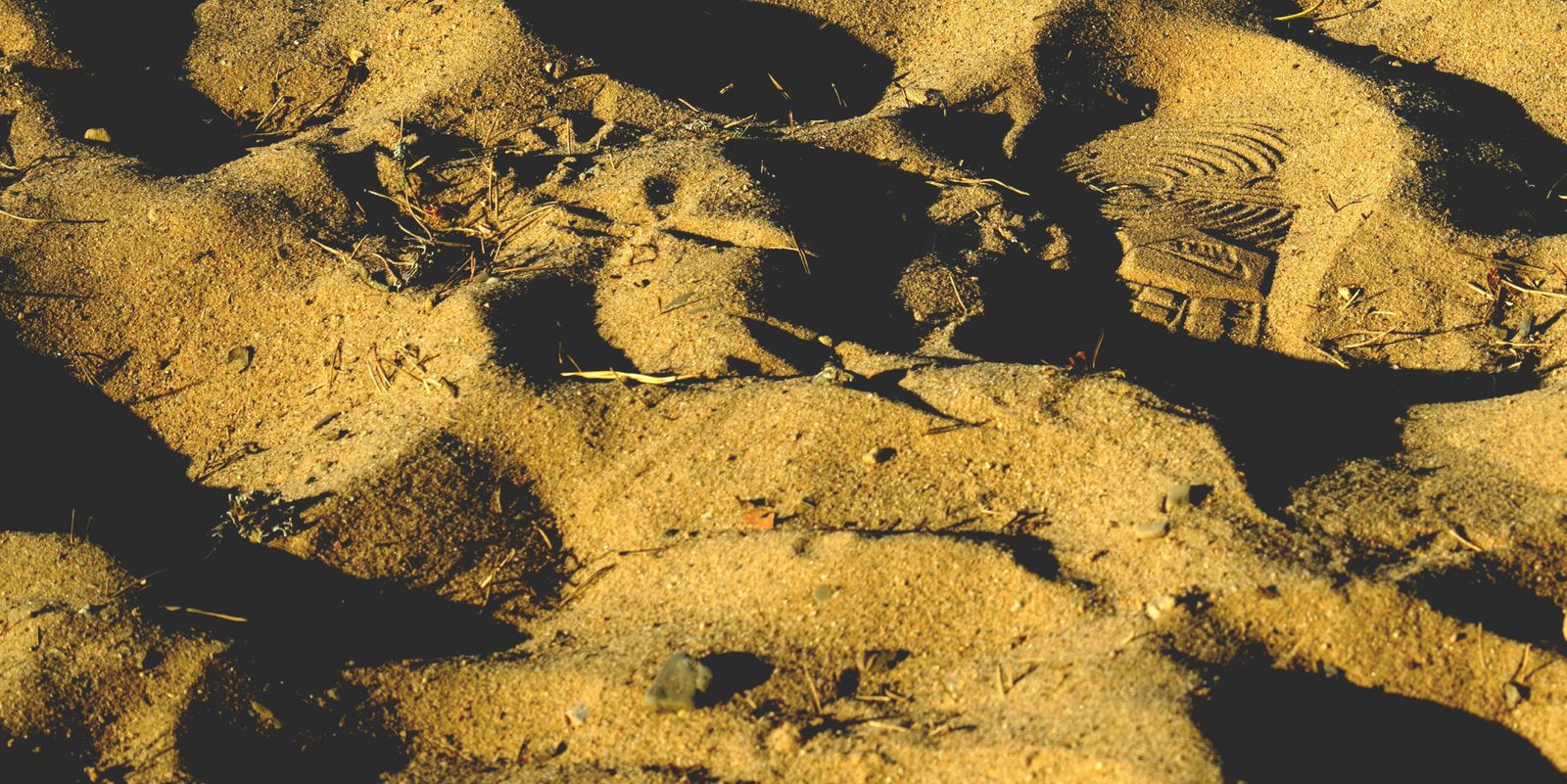
The two sets of bootprints Neil Armstrong and Buzz Aldrin pressed into the powdery grey soil of the Sea of Tranquility on 20 July 1969 are still there this morning, sharp-edged, exactly as they were the moment the men climbed back into the lunar module. No wind has touched them. No rain has fallen on them. Nothing has grown across them. On a world with no atmosphere to speak of, no liquid water and no biology, a footprint behaves less like a mark in sand and more like a fossil pressed into cement.
They will still be recognisable, in some form, roughly a million years from now.
Why a footprint on the Moon behaves like a fossil
A boot pressed into wet beach sand on Earth is gone within hours. The tide comes in. The wind lifts grains. A gull walks through it. Rain rounds the edges. Somewhere in the sand a burrowing worm rearranges the grains from underneath. Erasure on Earth is not one process. It is dozens of them, running in parallel, all the time.
The Moon has effectively none of that machinery. Its atmosphere is so thin that surface pressure is vanishingly small compared to Earth’s. There is no liquid water anywhere on the surface. There is no life. The interior is geologically quiet — no active volcanoes, no shifting plates, no earthquakes strong enough to reshape the ground at a landing site. None of the forces that erase a beach footprint in an afternoon operate on the Moon at all.
The soil itself helps. Lunar regolith is not rounded like beach sand. It is a fine dust of crushed, sharp-edged rock, produced by billions of years of impacts, with no water to smooth it. When Armstrong’s boot compressed the powder on 20 July 1969, the jagged grains locked against each other like tiny puzzle pieces. That is why the prints came out crisp, with visible tread ridges, and why they have stayed that way.
What a Hasselblad captured that afternoon
The most famous photograph of the print was taken by Aldrin as part of a soil-mechanics experiment, documenting how the regolith deformed under pressure so engineers could design future landers.
There are dozens of prints scattered across a patch of ground roughly the size of a baseball infield, along with the ladder scuffs, the discarded overshoes, the seismometer, the laser-ranging reflector that scientists still bounce lasers off today, and the four-legged descent stage of the lunar module Eagle. A NASA visualization of the six Apollo landing sites shows each one in the order it was visited, with annotations on how long each crew stayed on the surface.
Nothing has moved since. Nothing living has walked through the scene.
The Moon does erode — just slowly
The tidy version of the story stops there. The full version is more interesting.
The Moon is not a static museum. It is being sandblasted, constantly, by a fine rain of micrometeorites — specks of interplanetary dust, most smaller than a grain of table salt, striking the surface at tens of thousands of kilometres per hour. Each impact is trivial on its own. Each one throws up a tiny puff of ejecta, digs a pit a fraction of a millimetre across, and moves on. Over long enough spans, they do the work that wind and water do on Earth.
Planetary scientists call the process impact gardening. The top layer of regolith is turned over the way a spade turns over topsoil, only with a spade the size of a dust grain and a schedule measured in geological time.
How fast? Estimates have shifted. Older estimates put the overturn of the top centimetre at roughly one cycle every ten million years. More recent research using orbital imagery to catch fresh impacts and their splash patterns in the act has found that secondary cratering — debris thrown from a primary impact re-striking the surface nearby — churns the uppermost regolith on much shorter timescales.
More recent work on samples returned by China’s Chang’e-5 and Chang’e-6 missions has extended the picture. A study in Nature Communications on million-year solar wind irradiation in those samples showed how deeply the solar wind implants itself into grains over roughly a million years, and how the balance between implantation and impact-driven overturn shapes what the surface looks like. A related paper on the saturation of space weathering in lunar regolith particle morphology tracked how individual grains eventually reach a limit — a point past which further exposure barely changes their shape.
The gardener works with tweezers, not a shovel
Impact gardening sounds violent. In practice, at any single square metre of the Apollo 11 site, it is closer to somebody working the soil with tweezers over the length of a geological epoch. A given bootprint is not likely to be obliterated by one direct hit. It is far more likely to be softened, incrementally, as micrometeorite splash from nearby impacts sifts fresh dust across it and blurs the sharpest ridges of the tread.
The exposed surfaces of Apollo rocks brought back to Earth show erosion occurring at extremely slow rates. A bootprint a few centimetres deep, sitting in a compressed, cohesive layer of regolith, has a lot of geological runway before that kind of grinding erases it.
Planetary scientists who have studied the longevity of the Apollo sites have estimated the outer limit at something like ten to a hundred million years before the traces of Apollo are effectively gone. The light marks fade first — the bootprints and rover tracks — then the small equipment, with the heavy descent stages lasting longest. A million years, in that context, is well inside that survival window. The bootprints will look softer than they do today. They will still be bootprints.
The camera that keeps checking
NASA’s Lunar Reconnaissance Orbiter has been photographing the six Apollo sites from lunar orbit with a camera resolution good enough to see the descent stages, the experiment packages, the rover parked at Apollo 15, and — under the right lighting — the darker trails of disturbed regolith where the astronauts walked. The scuffs read as thin dark lines in the images, because the crew’s boots kicked aside the slightly brighter surface layer and exposed the darker, less-weathered material beneath.
The Hubble Space Telescope, for all its power, cannot resolve them. At the Moon’s distance, Hubble’s angular resolution is insufficient to see features as small as the Apollo landing modules. The lunar modules measure only a few metres across. You need a camera much closer in, which is what LRO provides.
Every few years, LRO passes over Tranquility Base again. The image looks the same as the last one. The tracks are where they were. The descent stage casts the same short shadow. Nothing has moved.
A law that treats a footprint as heritage
In 2020, the United States passed the One Small Step to Protect Human Heritage in Space Act, which requires American companies working with NASA on lunar missions to agree to abide by NASA guidelines protecting the Apollo landing sites and the government hardware left there. The Conversation’s analysis of the law is more cautious than the popular shorthand suggests: the statute binds only NASA’s US commercial partners, not other countries’ space agencies, and the individual footprints themselves are not yet legally protected in their own right.
The law is narrow in reach, and the legal status of the sites under the Outer Space Treaty remains ambiguous. What it does mark is a shift in how the sites are treated: the landing site as a whole is increasingly catalogued and discussed as heritage, even if no single bootprint carries its own line of legal protection yet.
What lasts, and what everything else looks like next to it
Compare the timescale to almost anything else humans have made. The oldest confidently dated cave art, a narrative scene found in a Sulawesi limestone cave, is at least 51,200 years old. The oldest surviving cuneiform tablets are around 5,400 years old. The Great Pyramid of Giza has stood for about 4,500 years and has lost its polished limestone casing and several metres of height in that span, worn by wind and quarrying. A bootprint in the Sea of Tranquility, given a survival window of ten to a hundred million years for the landing site as a whole, will outlast every one of them by two to four orders of magnitude.
It will likely outlast the human species in its current form.
That is a strange sentence to type about a scuff in dust made by a man in a pressure suit over the course of two and a half hours on a summer evening in 1969.
The other things humans have flung outward
The Moon is only one place where 20th-century human hardware is quietly running out the clock. Energy Daily has previously covered the Voyager 1 Golden Record, engineered for a billion-year readable lifespan, and the Parker Solar Probe’s carbon-composite heat shield keeping its instruments at room temperature while its front face glows at 1,377 degrees Celsius. Each is a piece of hardware designed to persist against a specific set of forces — cosmic rays, solar heat, interstellar time.
The Apollo 11 bootprints were not designed to persist at all. They were an accidental byproduct of walking. Their longevity is the Moon’s doing, not the astronauts’.
The total time humans spent on the lunar surface across all six Apollo landings, according to NASA’s mission logs, is about 80 hours. Twelve people walked there. The tally of humans who have ever left Earth stands, as Energy Daily has noted in its piece on Gagarin’s first orbit and the count of astronauts since, at more than 780. The physical evidence of the twelve who walked on the Moon is more durable than the physical evidence of the great majority of those who have since flown.
What the site will look like in a million years
Picture Tranquility Base in the year 1,001,969. The sky is still black at noon. The Earth still hangs in roughly the same spot above the horizon, because the Moon is still tidally locked. The descent stage is still there, its gold thermal blanket by now brittle and pitted, its four legs still splayed in the powder. The seismometer stopped transmitting decades after 1969 and has been silent for essentially the entire elapsed span.
Around the lander, the bootprints are softer. The sharp ridge lines of the tread have blurred a fraction of a millimetre. A dusting of ejecta from small nearby impacts has settled into them, lightening them slightly against the surrounding regolith. Under low sun, at the right angle, the trails between Eagle and the experiment packages still read as faint depressions — a scatter of ovals leading out and back.
An observer standing on the rim of Little West Crater, about 60 metres east of the landing point — roughly where Armstrong himself walked to look into it near the end of the EVA — would still be able to see where two men once walked.
The Sun will set on Tranquility Base, as it does every 14 Earth days, and the temperature will drop from 120 degrees Celsius to minus 170. The prints will not care. They will still be there in the morning.