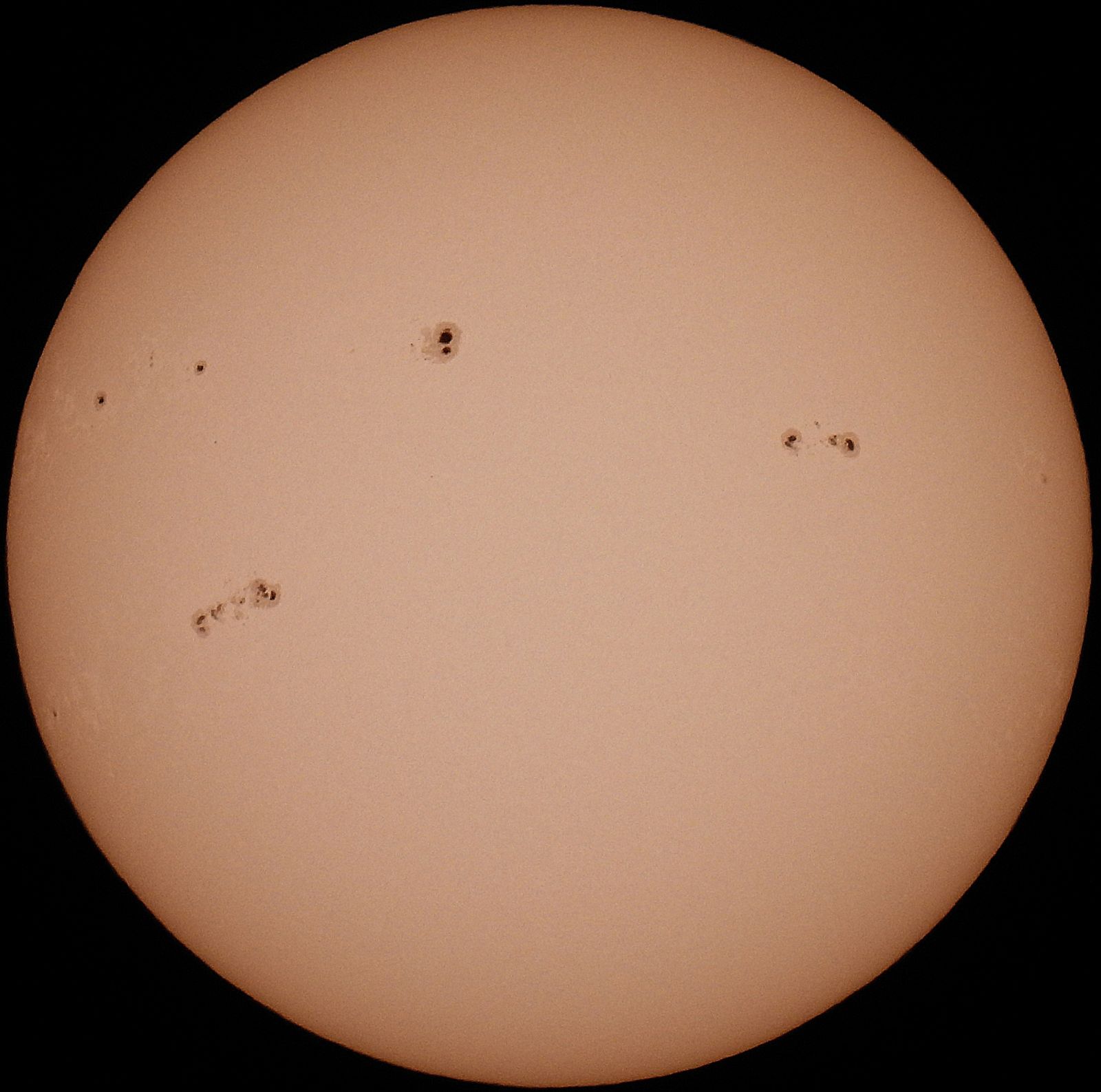
The Parker Solar Probe is right now moving faster than any object humans have ever built, threading a loop through the Sun’s corona at roughly 191 kilometres per second — about 692,000 kilometres per hour, quick enough to cross the continental United States in the time it takes to read this sentence twice. At closest approach it skims within 6.1 million kilometres of the solar surface, closer to the Sun than Mercury has ever been. And it does this while hiding behind a disc of carbon foam and reinforced carbon-carbon just 11.4 centimetres thick.
The front of that shield glows at 1,377 degrees Celsius. The instruments tucked half a metre behind it sit at roughly room temperature.
A number that sounds like a typo
Six-point-one million kilometres feels like a lot until you compare it to the distances astronomers usually deal with. Earth orbits at about 150 million kilometres. Mercury, the innermost planet, never gets closer than roughly 46 million. Parker is flying at less than four percent of the Earth-Sun distance — inside the Sun’s outer atmosphere, the corona, in a region where solar wind is still being born.
The Johns Hopkins University Applied Physics Laboratory, which built and operates the spacecraft for NASA, described the Christmas Eve 2024 perihelion as the moment humanity’s hardware would become the closest human-made object ever to a star. That perihelion set the geometry the probe now repeats: a long elliptical loop that whips it in past the corona and flings it back out toward Venus.
The speed follows from the geometry. Anything falling that deep into the Sun’s gravity well picks up enormous kinetic energy. At perihelion, Parker is moving fast enough to circle Earth in about three and a half minutes.
The shield is basically a foam sandwich
The Thermal Protection System — the part that keeps the probe from vaporising — is deceptively simple. Two sheets of reinforced carbon-carbon composite sandwich a 11.4-centimetre core of carbon foam. The whole disc is about 2.4 metres across and weighs roughly 73 kilograms. That’s it. That’s what stands between the instruments and a star.
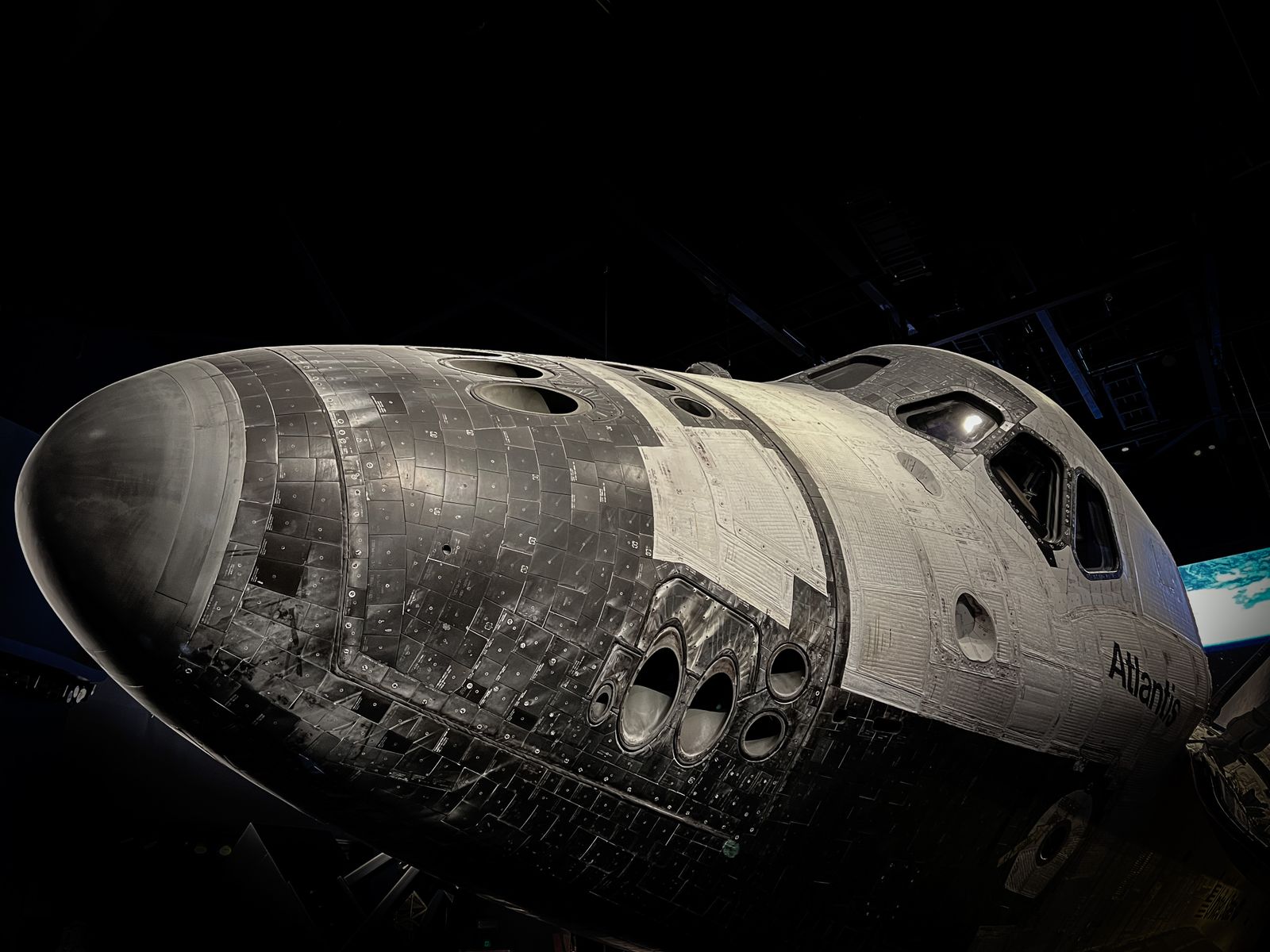
Reinforced carbon-carbon is the same family of material used on the leading edges of the Space Shuttle’s wings during re-entry. It doesn’t melt at solar-corona temperatures because it barely melts at all — carbon sublimates rather than liquefying, and the foam core is more than 97 percent empty space, which makes it a spectacular insulator. Heat radiated onto the front face has almost nothing solid to travel through to reach the back.
The Sun-facing surface is coated with a sprayed alumina layer that reflects as much sunlight as possible. The shield has actually been running cooler in flight than the team designed and tested for — engineers built in more thermal margin than the shield has needed so far, and that margin is part of why it’s holding up better than expected.
1,377 degrees on the front, room temperature in the back
The temperature gradient across those 11.4 centimetres is one of the more absurd numbers in modern engineering. During the December 2024 pass, the front face of the shield reached temperatures topping 930 degrees Celsius (1,700 degrees Fahrenheit) according to NASA’s pre-flyby estimates, with peak modelled temperatures on subsequent close approaches reaching around 1,377 degrees Celsius. The instrument deck behind it stays close to 30 degrees Celsius — the temperature of a warm office.
Put differently: the front of the shield is hot enough to melt aluminium, copper, and gold. The back is comfortable enough for a laptop. The gap between them is roughly the width of a paperback novel.
The reason this works — and the reason a spacecraft can survive inside a stellar atmosphere at all — is that the corona is extremely hot but extraordinarily thin. Temperature measures how fast individual particles are moving. Heat measures how much energy actually transfers to something. In the corona, particles are screaming along at millions of degrees, but there are so few of them per cubic metre that the total energy delivered to the shield is manageable. The Sun radiates onto the front face. The shield radiates most of that heat back out into space.
Why go this close at all
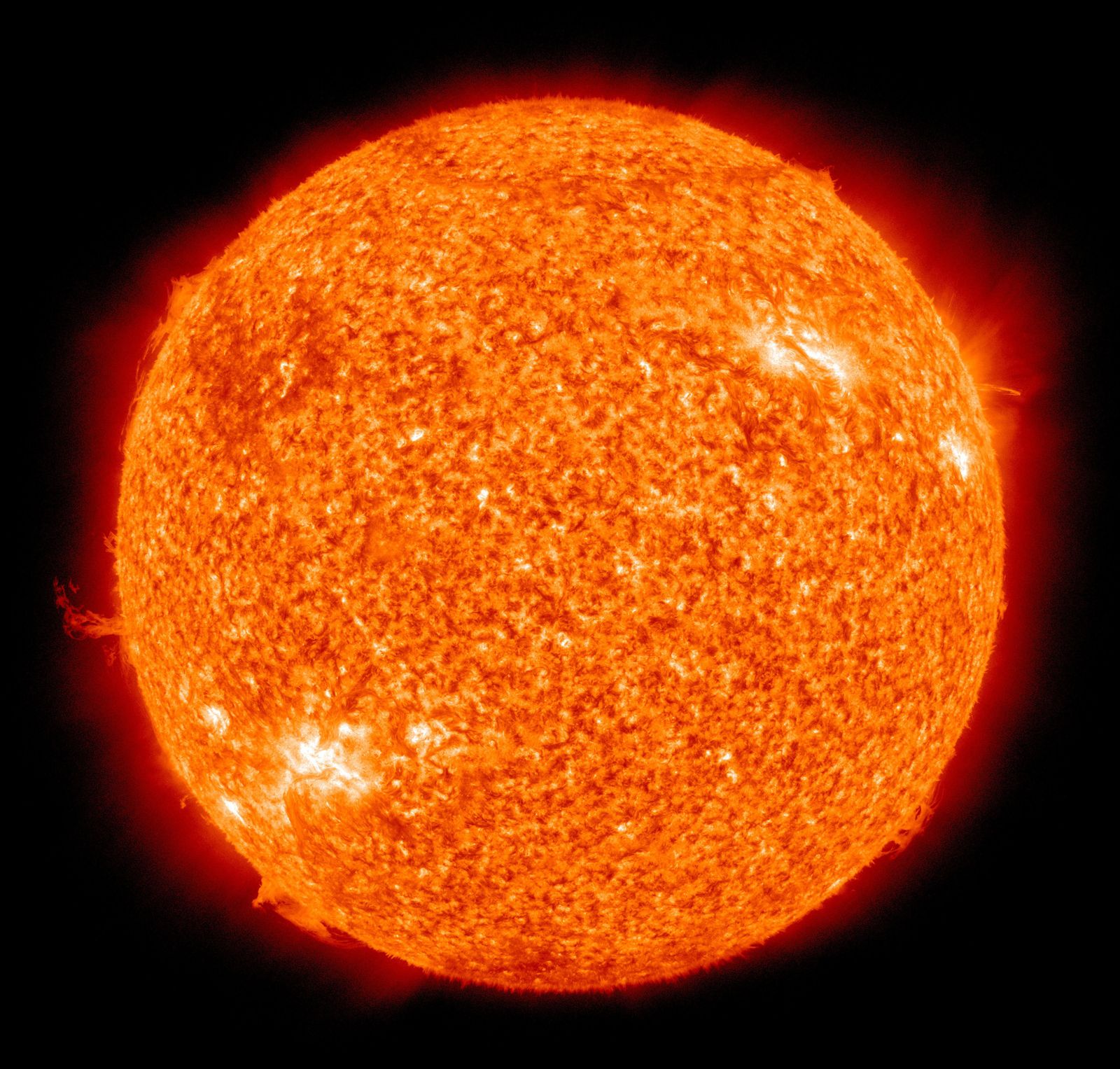
The corona is where the Sun’s biggest unsolved problems live. It is hundreds of times hotter than the surface below it, a fact solar physicists have been arguing about for eighty years. It is where the solar wind gets accelerated to the speeds that eventually strip planetary atmospheres and knock out power grids. And it is where coronal mass ejections — the plasma eruptions that can disrupt satellites and communications on Earth — first take shape.
Every previous solar mission has watched from a distance. Parker flies through it. The probe’s four instrument suites sample the magnetic fields, plasma density, energetic particles, and white-light structure of the corona directly, in situ, while sitting inside the environment they’re measuring.
The mission’s project scientist put it plainly: the probe would become the closest human-made object ever to a star. The subsequent flyby confirmed the probe had, in the words of one Forbes headline, effectively touched the Sun.
Seven years of falling
Getting to 6.1 million kilometres took most of a decade of orbital choreography. Parker launched in August 2018 aboard a Delta IV Heavy — a rocket the mission needed because slowing something down to fall toward the Sun requires almost as much energy as launching it out of the solar system entirely. Earth is orbiting sideways at 30 kilometres per second, and the probe had to shed most of that sideways motion to spiral inward.
It did so with seven gravity-assist flybys of Venus, each one bleeding orbital energy and lowering the probe’s perihelion a little further. The final Venus flyby, on 6 November 2024, set up the geometry that put Parker inside 6.1 million kilometres of the solar surface. The probe now repeats that close pass every 88 days.
During the closest approaches the spacecraft goes fully autonomous. It’s out of contact with Earth — the Sun is between the probe and mission control, and the radio antenna is behind the heat shield anyway. The team on the ground waits for a beacon signal days after the flyby to confirm the spacecraft made it through. Full science data trickles back over the following weeks.
The solar wind doing something strange
Parker’s proximity has already produced observations no other instrument could make. The probe has flown through switchbacks — sharp S-shaped kinks in the Sun’s magnetic field that appear to be part of how the solar wind gets accelerated. It has watched the solar wind itself perform what NASA described as a U-turn, curling back on itself in ways the old models didn’t predict.
These are the kinds of measurements that require being inside the corona rather than looking at it. A telescope on Earth, even a very good one, sees only what light reaches it after crossing 150 million kilometres of space. Parker samples the plasma itself.
The relationship between the Sun’s outer atmosphere and its surface — and why the corona is so much hotter than the photosphere below it — is one of the questions Parker was built to answer. Recent work has begun to refine how coronal heating is understood, pointing to small-scale magnetic reconnection events as a likely driver. Parker’s flybys are producing the direct measurements needed to test those ideas.
The engineering restraint
Everything about the spacecraft is built around the shield. The solar panels — which have to power the probe while being pointed toward the source of more sunlight than any panel has ever seen — retract and tilt as Parker approaches perihelion, exposing only a small strip to direct sunlight. A water-based cooling loop pumps heat away from the panels and radiates it into space through white-painted radiators.
The whole vehicle is small. The bus is about 1 metre across. The dry mass is roughly 555 kilograms. The instruments hide entirely in the shadow cast by the shield, and if the spacecraft’s attitude drifts by more than a few degrees, sensors at the edges of the shield’s shadow detect sunlight starting to leak onto the body and automatically fire thrusters to correct.
The team over-engineered the shield’s tolerances, and the spacecraft is now benefiting from that margin. The solar panels are also degrading less than predicted. The mission may be able to continue beyond its planned duration due to better-than-expected performance of the spacecraft’s components. The prime mission ends after the current set of perihelia, but Parker has enough fuel to hold its orbit for years, and the team is seeking bridge funding to keep operating through the next heliophysics senior review.
Sun-in-a-lab, sun-in-space
Recreating solar conditions on Earth is a parallel effort worth thinking about alongside Parker. Fusion labs try to bring the Sun into the lab by squeezing hydrogen isotopes to stellar temperatures inside tokamaks and inertial-confinement chambers. Parker does the inverse: it takes the lab to the Sun. Both approaches are trying to answer variants of the same question — how energy actually moves through plasma at extreme temperatures.
The comparison is instructive. A fusion reactor holds a small plasma at 100 million degrees for a fraction of a second inside a magnetic bottle. The corona holds a diffuse plasma at similar temperatures for billions of years using magnetic fields the Sun generates itself. Parker is essentially a diagnostic instrument for the biggest fusion device in the neighbourhood.
What 692,000 km/h actually feels like
The speed number is worth sitting with. At 191 kilometres per second, Parker covers the distance from New York to Los Angeles in about 20 seconds. It crosses the diameter of Earth in 66 seconds. If it were flying at sea level on Earth (which it obviously cannot), it would circle the equator in three and a half minutes. It is moving roughly 200 times faster than a rifle bullet.
That velocity is not something the spacecraft is doing — it’s something the Sun’s gravity is doing to it. Parker is falling. It’s just falling on a trajectory that misses.
Each perihelion, the probe passes closest approach in a matter of hours, then swings back out toward Venus at a slower pace, its solar panels rotating back into the sunlight to recharge the batteries. Then it does it again. And again. Every 88 days, for as long as the shield holds — which, based on how it’s performing, could be a very long time.
Somewhere overhead right now, a disc of carbon foam smaller than a garden table is glowing white-hot in the outer atmosphere of the Sun, and behind it, a room-temperature computer is quietly recording magnetic field data that will not reach Earth for weeks. The probe is still falling. The star is still there. The gap between the two keeps closing on schedule.