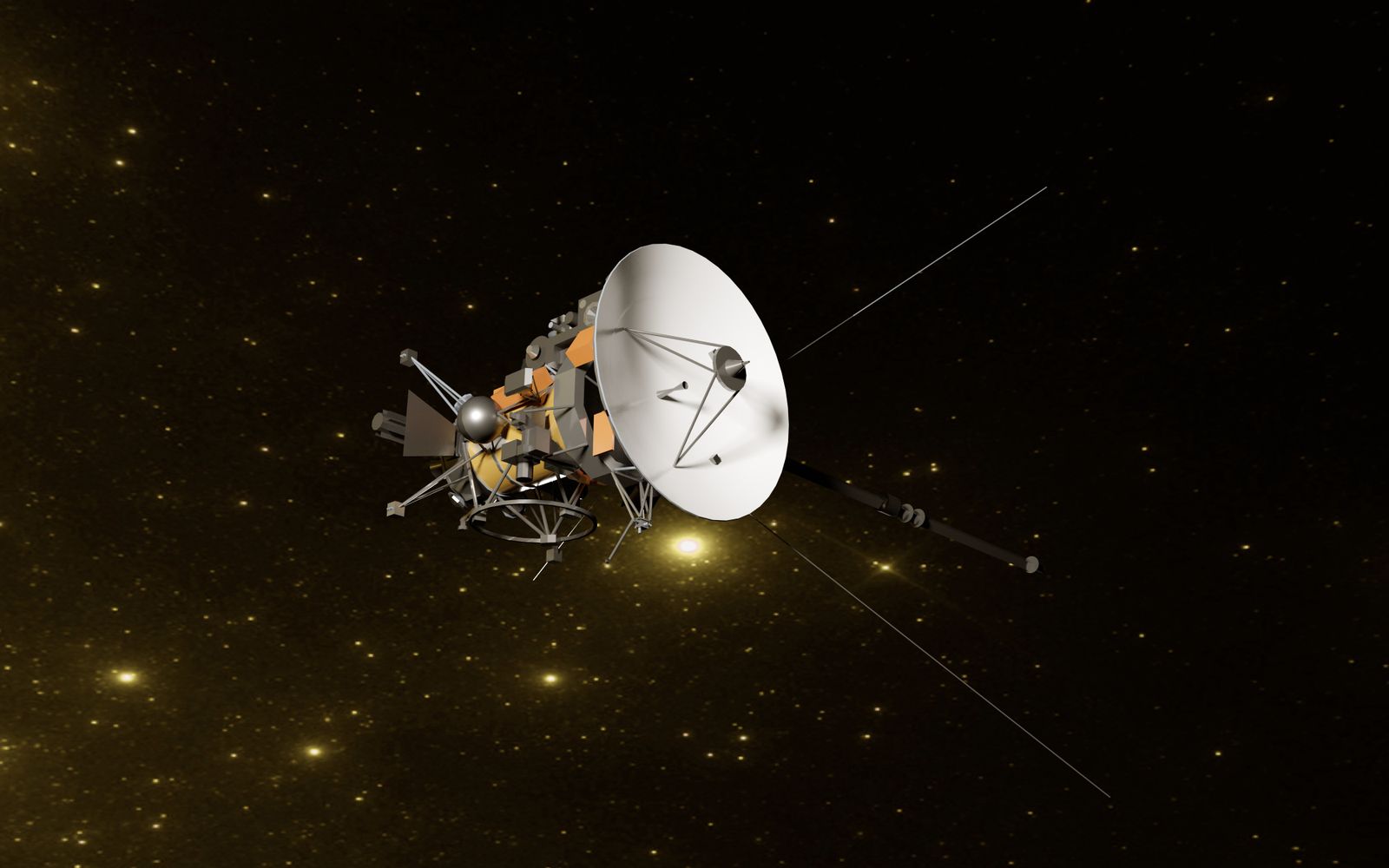
Bolted to the side of a spacecraft now more than 15 billion miles from Earth, a 12-inch gold-plated copper disc is spinning through interstellar space at roughly 38,000 miles per hour. It carries the sound of a kiss, a Peruvian wedding song, greetings in 55 languages, 115 encoded images, whale calls, and the brainwaves of a woman in love. Its estimated shelf life is one billion years. The spacecraft carrying it, Voyager 1, will not drift near another star for about 40,000 years.
The record was never meant to be read soon. It was meant to outlast almost everything.
A four-year mission that is now in its 49th year
Voyager 1 lifted off from Cape Canaveral on September 5, 1977, aboard a Titan/Centaur rocket. Its twin, Voyager 2, had launched two weeks earlier on August 20, taking a slower path that would eventually let it become the only spacecraft ever to visit all four outer gas giants. The pair were authorized for a four-year tour of Jupiter and Saturn, nothing more.
The engineers who built them had a secret. A rare geometric alignment of the outer planets, occurring roughly once every 176 years, made it possible to slingshot a single spacecraft past all four gas giants using their gravity. So they quietly designed the Voyagers to survive far longer than the mission on paper.
Nearly half a century later, both probes are still transmitting. NASA calls them the agency’s longest-lived mission, with a running cost above $865 million.
Why the record exists at all
By the mid-1970s, Carl Sagan and a small committee had been given a strange assignment: decide what humanity should say to whoever, or whatever, might one day find a spacecraft drifting between the stars. The team had six weeks.
They chose a phonograph record. Analog, mechanical, readable with a needle and a diagram. The cover is etched with instructions in symbolic language, including a map of Earth’s location drawn using the frequencies of 14 pulsars — a kind of galactic postal code that will still be accurate hundreds of millions of years from now.
Inside is a curated portrait of a planet. Greetings in 55 languages, from Akkadian to Wu. Music from 27 cultures, including a Bulgarian shepherdess’s song, Chuck Berry’s Johnny B. Goode, Bach’s Brandenburg Concerto No. 2, and gamelan from Java. There are the sounds of surf, thunder, a mother’s first words to her newborn, a Saturn V launch, and Morse code spelling out ad astra per aspera.
The 115 images, encoded as audio and meant to be reconstructed line by line, include a fetus in utero, a woman eating grapes, the Sydney Opera House, a diagram of DNA, and a page from Isaac Newton’s System of the World. There is no war, no religion, no famine. It is Earth’s résumé, edited for a reader who may never arrive.
The physics of a billion-year shelf life
Copper is soft. Gold does not tarnish. The record is copper, plated in gold, sealed inside an aluminum jacket that itself is bombarded with a tiny amount of uranium-238 — a decay clock a finder could measure to calculate how long the record has been traveling.
In the vacuum between stars, there is almost no oxygen, no water, no biological agent, no weather. The main threats are cosmic ray erosion and the occasional dust grain traveling at tens of kilometers per second. Even so, engineers estimate the etched grooves will remain readable for something on the order of a billion years — longer than complex life has existed on Earth.
For context, the oldest surviving human writing, cuneiform on baked clay tablets, is roughly 5,300 years old. The Voyager record’s expected lifespan exceeds that by a factor of nearly 200,000.
How a 1970s nuclear battery is still talking
Solar panels are useless past Jupiter. Sunlight at Voyager 1’s current distance is about 1/400th as strong as it is on Earth. So the probes run on something older and stranger: a radioisotope thermoelectric generator, or RTG, a design that dates to the late 1950s. It is, as UNH astronomer John Gianforte put it, a kind of nuclear power supply, a little bit bigger than a car battery.
Inside each RTG, pellets of plutonium-238 decay and give off heat. Thermocouples convert that heat directly into electricity. There are no moving parts. The Voyagers launched with about 470 watts each. They now generate closer to 220, and lose about 4 watts every year.
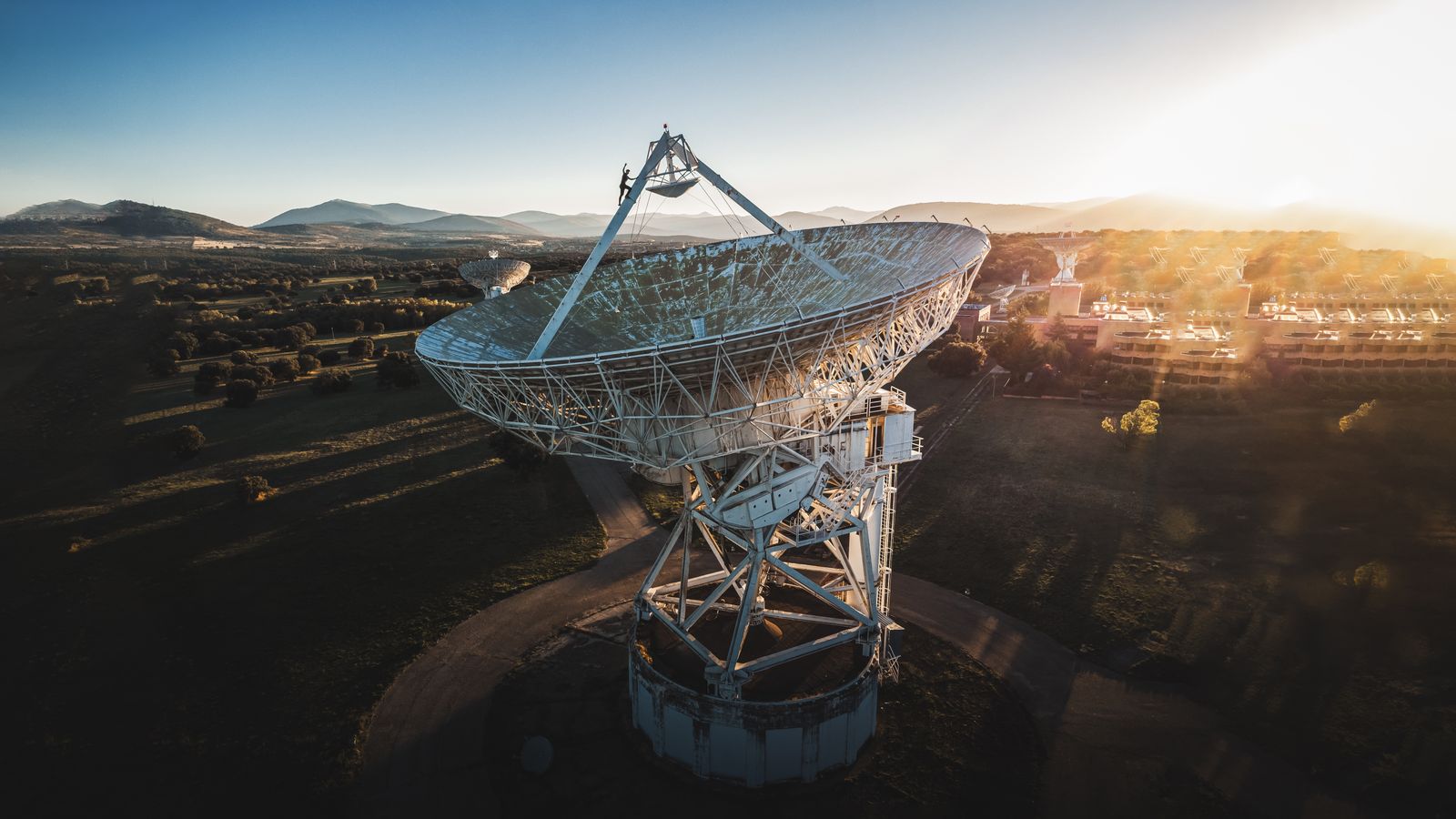
That is roughly the power of a dim refrigerator bulb, sent as a radio whisper across 15 billion miles. By the time the signal reaches the Deep Space Network’s 70-meter dishes in California, Spain, and Australia, it is a fraction of a billionth of a billionth of a watt.
Turning off instruments to buy years
To stretch what power remains, engineers have been switching instruments off, one by one. In 2025, NASA powered down two of Voyager 1’s science instruments to keep the rest running. In August 2026, the agency swapped some devices on Voyager 2 for lower-power alternatives, buying at least another year of operation. The same treatment is planned for Voyager 1.
The probes have already survived scares that would have killed most missions. In 2022, Voyager 1 began sending garbled data; engineers traced the problem to a computer that had quietly died years earlier. In 2023, a wrong command tilted Voyager 2’s antenna away from Earth. NASA blasted a “shout” across the solar system to nudge it back, and days later the signal returned.
The lesson runs through every era of spaceflight: a single small error can end a mission before it starts, or leave it drifting for decades. Energy Daily has covered a starker version of the same principle — the 1962 Mariner 1 probe to Venus, destroyed 293 seconds after launch because of a missing overbar in a line of guidance code. The Voyagers, by contrast, have absorbed error after error and kept going.
What the probes have already seen
Before Voyager 1 turned toward interstellar space, it and its twin returned a photo album that reshaped planetary science. At Jupiter in 1979, the two probes took roughly 50,000 images and discovered active volcanoes on the moon Io — the first active volcanism ever seen beyond Earth. They found a thin ring around Jupiter and two new moons, Thebe and Metis.
At Saturn in 1980 and 1981, they mapped the ring structure in resolutions that ground-based telescopes could not touch. Voyager 2 went on alone, reaching Uranus in January 1986 and passing within 50,600 miles of the planet, adding two rings and ten previously unseen moons to the catalog. Then in 1989, twelve years after launch, Voyager 2 passed within 3,000 miles of Neptune, becoming the first and only spacecraft ever to visit the outer ice giant.
Voyager 1 took its last photograph in 1990, from 4 billion miles out: 60 frames of the solar system, including the single pixel of Earth that Carl Sagan named the Pale Blue Dot. Then NASA switched the cameras off to save power.
The border of the solar system
In August 2012, Voyager 1 crossed the heliopause — the boundary where the sun’s stream of charged particles gives way to the wind of the galaxy. It became the first human-made object to enter interstellar space. Voyager 2 followed in November 2018, and its instruments revealed a previously unknown layer just beyond the heliosphere.
The probes now report back on things no other instrument can measure: the density of interstellar plasma, the strength of the galactic magnetic field, and the faint hums the plasma itself produces, likely the vibration of the electrically charged medium between stars.
By November 2026, Voyager 1 will sit about 16 billion miles from Earth — one light-day away. A radio command sent from a New Mexico antenna today takes roughly 22 and a half hours to reach the probe, and another 22 and a half to hear back. Voyager 2 trails at more than 13.2 billion miles, cruising at 34,000 mph relative to the sun.
Forty thousand years to the next star
Voyager 1 is headed roughly in the direction of the constellation Ophiuchus. In about 40,000 years, it will pass within 1.6 light-years of a small red dwarf called Gliese 445, in the constellation Camelopardalis. Voyager 2, on a different trajectory, will pass within about 1.7 light-years of the star Ross 248 in roughly the same timeframe.
Neither will be captured. Neither will land. They will simply cruise by, silent long before then, still carrying their golden records. Sometime in the 2030s, the RTGs will finally fall below the threshold needed to run even a single instrument, and Earth will lose contact. The spacecraft will keep moving. Nothing in interstellar space is likely to stop them for a very long time.
Human spaceflight, by comparison, is a very local activity. As Energy Daily has noted, only about 600 people had left the planet by late 2021, and none has traveled beyond the moon. The Voyagers, unmanned and uncrewed, have made a journey no human is likely to make for centuries.
A message with no expected reply
The golden record was a strange kind of confidence. Sagan’s committee assembled it knowing that no one on Earth would live to see any response. It was made for a reader who might not exist, in a form that reader might not recognize, sent on a spacecraft moving too slowly to matter in any human timeframe.
And yet the record’s design assumes the recipient will be curious enough to try. The cover diagrams show how to spin the disc at the correct rate — 16 and 2/3 revolutions per minute — using the fundamental transition of a hydrogen atom as the unit of time. Hydrogen is the most common element in the universe. Whoever finds it, if anyone ever does, will know what hydrogen is.
Long after the last radio signal fades, long after the sun expands and swallows Mercury and Venus, the two Voyagers will still be out there, spinning slowly in the dark. The plutonium will have decayed into lead. The aluminum jackets will have taken a few pockmarks from dust. And somewhere on the side of each craft, a copper disc will still hold the sound of a Peruvian wedding song, and a woman saying hello in Wu, and the recorded electrical activity of a human brain in love, waiting.