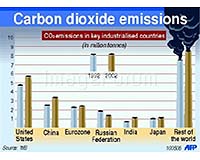
The global market for carbon dioxide (CO2) emissions — an innovative offshoot of the Kyoto pact on global warming — has shown explosive growth, the World Bank said Wednesday.
But in a new report, the World Bank also noted that recent events in the European Union's Emissions Trading System (ETS) had underscored how deeply volatile the market remains.
The study said the worldwide market in CO2 trading was worth more than 10 billion dollars in 2005, 10 times the value of 2004.
"To put that figure in perspective, the entire US wheat crop in 2005 was valued at about 7.1 billion dollars," said Karan Capoor, senior financial specialist at the World Bank and the report's main author.
"The data makes it clear that carbon is now a financial commodity. Carbon is now priced and business managers take the carbon price into consideration along with other factors in making business decisions," he said.
Capoor added: "But like other financial commodities, the events of the last two weeks in the EU ETS shows that markets can be volatile."
The market is the brainchild of the Kyoto Protocol for controlling greenhouse-gas emissions — the carbon gases emitted mainly by burning oil, gas and coal that are driving perilous climate change.
Its backbone is the 25-nation EU's ETS marketplace.
Under this, 11,500 firms that are big users of fossil fuels have to meet a target of CO2 emissions or else pay a penalty of 40 euros (50 dollars) a tonne for 2006 and 2007, a punishment that, from 2008, will rise to 100 euros a tonne.
Those that are below their quota can sell their surplus on the ETS to companies that are over, thus providing a financial carrot to everyone to clean up.
But when it was discovered in late April that several EU countries were polluting far less than they had thought, prices plunged by more than half to a 12-month low, from a high of 30 euros for a tonne of CO2.
Analysts warn that a white-knuckle price ride could undermine confidence in what Kyoto's supporters claim is the smartest and most flexible way to tackle carbon pollution.
Nonetheless, the World Bank report said the fledgling market was already achieving its aim of lending a financial incentive to countries to change their ways.
The EU system accounted for 75 percent of the total market in 2005, but almost half of the total volume of gas emission reductions came from the developing world, it said.
"This report shows that this young market works well, that it responds to market signals and that it is changing the way business is done in Europe and around the world," said Andrei Marcu, president of the International Emissions Trading Association, which co-sponsored the World Bank report.
The report said the power of the market is being seen even in the United States and Australia, which have both refused to support the Kyoto agreement.
In the United States, the Chicago Climate Exchange saw some 1.25 million tonnes of CO2 equivalent traded in the first three months of 2006, compared with 1.45 million over the whole of 2005.
Informal trading schemes have sprung up in New South Wales, where in April last year about 3.2 million tonnes of CO2 were offset from 30,000 hectares of eucalyptus planting.
In total over the World Bank's period of study, 453.5 million tonnes of CO2 were bought in the marketplace. The leading buyers were Japan (38 percent), Britain (15 percent) and Italy (11 percent).
The United States, Australia, Canada and New Zealand each bought one percent from the market.
On the seller's side, China placed 66 percent of the total for trading, ahead of Brazil with 10 percent and the rest of Latin America with seven percent. India sold three percent of emissions.
Source: Agence France-Presse