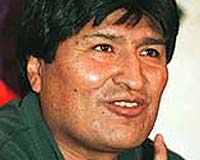
Bolivian President Evo Morales proposed scrapping capitalism and developing clean energies as part of radical measures "to save the planet and mankind."
"If we really want to save the planet, we must eliminate the capitalist system," Bolivia's first indigenous president told hundreds of indigenous delegates from around the world.
Morales argued that the capitalist system was mainly responsible for climate change and for the "accumulation of waste."
He also railed against the development of biofuels which he said only serve to fuel "poverty and hunger" and he instead expressed strong support for clean energies.
"Biofuels are very harmful, in particular for the poor people of the world," he later told reporters.
The leftist leader called for "respect of Mother Earth," guaranteeing access to basic services for all and putting and end to consumerism.
He noted that indigenous peoples had a different perspective on life, including a stronger commitment to social justice and a preference for communal ownership of the land.
"Mother Earth is not a commodity. It's not something to buy and sell," he said.
And he proposed an international convention "to protect water resources and prevent their privatization by a few."
Morales, who was elected Bolivia's first indigenous president in December 2005, has alienated the country's rich lowland regions, whose populations are largely ethnically European and mixed, by pushing his constitutional plan to redistribute the country's wealth to the poor natives in the mountains.
The Bolivian president also said the UN system, particularly the powerful Security Council, should be "democratized" so that power is not monopolized by a few nations.
In a message to the indigenous forum, UN chief Ban Ki-moon, who is currently on an African tour, said: "I welcome your choice of climate change as the special theme of this session."
"As custodians of these lands, they (indigenous peoples) have accumulated deep, first-hand knowledge about the impacts of environmental degradation, include climate change. They know the economic and social consequences, and they can and should play a role in the global response," he added.
More than 2,500 indigenous delegates were taking part in a two-week session, the first since the UN General Assembly adopted a non-binding declaration last September upholding the human, land and resources rights of the world's 370 million indigenous people.
Indigenous peoples say their lands and territories are endangered by mineral extraction, logging, environmental contamination, privatization and development projects, classification of lands as protected areas or game reserves and use of genetically modified seeds and technology.