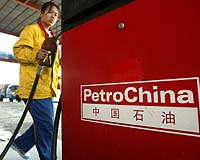
The biggest company in the world doesn't have its headquarters in the United States or Europe but, in a sign of the world economic tectonic shift, in Beijing.
PetroChina, the China National Petroleum Corp.'s listed segment, began public trading in 2007 with an initial public offering of $8.9 billion. It recently topped a market value of $336 billion, passing U.S. oil giant ExxonMobil as the most capitalized company in the world.
The shift in the top spot is similar to the global industry where Japan's Toyota has overtaken General Motors Corp. as the No. 1 car seller in the world. It is a large psychological change as well as a monetary one.
Market fluctuations could leave ExxonMobil and PetroChina jockeying for the top spot for a while, but the long-term trend, focusing on growth in the petroleum market in China, favors the Beijing company.
Demand for petroleum products in China is on a strong upswing, while demand in the United States and Europe is flat at best. Overall, the Chinese economy has moved to No. 3 in the world, behind the United States and Japan but ahead of Germany. PetroChina has gone along on that ride.
"If you look at what China is now spending, that's a continuation of what's been happening for years," Andy Brogan, an Ernst & Young oil industry analyst, told Britain's The Telegraph newspaper.
"In terms of the biggest spenders China is right up there. PetroChina is the (biggest) oil company in the world, based on market capitalization, right now."
PetroChina bases its interests on Chinese oil reserves and production, but it's also involved in international agreements. For instance, PetroChina has deals with Caracas that are envisioned to increase production in Venezuela to 1 million barrels a day by 2015.
There's a deal to build a 400,000-barrel-a-day refinery in Guangdong province. That plant will work with Venezuelan oil, which, as Venezuelan President Hugo Chavez said in February, is "at the service of China. All the oil China needs for the next 200 years, it's here. It's in Venezuela."
That refinery is part of an expectation, as reported Tuesday in the China Daily newspaper, that China is stockpiling 440 million barrels of oil by 2015. By comparison, last week U.S. officials said the United States had 361.6 million barrels of crude oil on inventory.
PetroChina also recently said it was buying 45.5 percent of the Singapore Petroleum Co., a $1 billion buy that marked its first international acquisition and appears to be part of a strategy to strengthen the company's flexibility in oil trading.
Look for more such deals, as at PetroChina's annual meeting in May Chairman Jiang Jiemin said the company planned to spend nearly $50 billion in the next year on upgrading current assets and buying additional ones. At the same meeting, a $15 billion bond issue was approved to pay for expansion plans.
Share This Article With Planet Earth