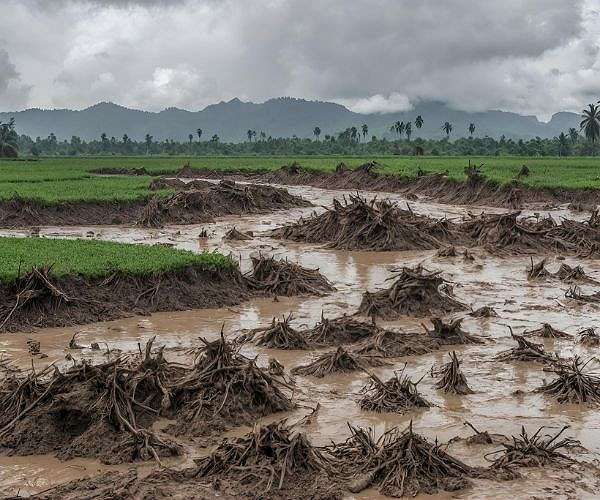
A study led by the University of Oxford and ETH Zurich has identified a fundamental weakness in current climate models: their inability to accurately simulate the large-scale wind and circulation patterns that determine where rain falls. The finding helps explain why regional rainfall forecasts remain persistently uncertain even as global warming trends become clearer, and why projections of future floods and droughts carry significant confidence gaps.
The research, published April 29 in Nature, is based on an analysis of winter rainfall patterns across the Northern Hemisphere spanning 1950 to 2022. The team found that while models reliably capture thermodynamic effects – such as the well-established principle that a warmer atmosphere holds more moisture – they struggle to represent how large-scale atmospheric circulation shifts in response to human-driven emissions. It is those circulation shifts, not moisture content alone, that ultimately govern where and when precipitation occurs.
The researchers separated two distinct physical processes driving rainfall change. Thermodynamic effects relate to heat and moisture, including the increased rainfall intensity that results when a more humid atmosphere releases water. Dynamic effects refer to shifts in large-scale circulation patterns such as the jet stream, which steers storm tracks and controls rainfall distribution across regions. Using statistical methods combined with advanced climate model experiments, the team isolated each contribution and assessed how well current models handle them.
The results revealed a stark contrast. Climate models consistently reproduce thermodynamic changes. But circulation-driven changes are severely underestimated in key regions. In Southern Europe, models simulate only around 10 percent of the observed circulation-driven rainfall trend – a gap the researchers describe as a major shortcoming in current regional projections.
The study identifies two compounding sources of uncertainty. First, large-scale atmospheric circulation naturally varies over multi-decade timescales. Patterns such as the North Atlantic Oscillation can shift unpredictably, masking or amplifying the effects of long-term climate change and making it difficult to distinguish natural variability from a human-induced signal. Second, climate models may themselves underestimate how much these circulation patterns respond to anthropogenic forcing, adding a structural error on top of the variability problem.
Together, these factors mean that even when global warming trends are unambiguous, predicting where rainfall will increase or decrease at the regional level remains highly uncertain – particularly in areas already exposed to drought or flood risk.
Dr. Lei Gu of the University of Oxford's Department of Physics, formerly at ETH Zurich, said: "By combining two complementary approaches, we were able to show that climate change is already influencing the large-scale wind patterns that shape rainfall, even though the size of that effect remains uncertain. Our work aims to better understand how we can make model simulations of rainfall more robust."
Dr. Gu is a researcher on the BREATHE project (Bridging Research on Environmental Attribution and Health Equity), led by the University of Bristol. The project is building on rainfall attribution advances to connect large-scale circulation changes with regional climate impacts. The Oxford team, co-led by Dr. Antje Weisheimer, is working with high-resolution weather forecast models from the European Centre for Medium-Range Weather Forecasts to examine how climate change is altering the circulation patterns that govern rainfall risk.
The authors say that closing the identified gap in circulation modeling could enable more confident projections of regional rainfall change, improving preparation for both flooding and prolonged drought.
Research Report: Uncertain dynamic response of mid-latitude winter precipitation