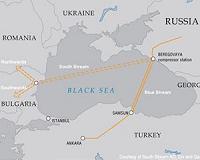
Low demand for natural gas in the European market may have been a factor in the Russian decision to revisit the South Stream pipeline, Fitch Ratings said.
Russian officials this week said they were suspending the effort to build the South Stream natural gas pipeline across the Black Sea to the European market. Wary of the role of Russian energy company Gazprom in the European market, lawmakers in the European Parliament this year called for a suspension of South Stream contracts.
Fitch, in a note sent Friday to UPI, said the decision reflects low demand for additional natural gas volumes in the European market as much as it does frustration with Russia's role in the market.
"We believe that there is little appetite among large utilities to commit to more long-term import contracts," the ratings agency said. "This is because demand has been cyclically and structurally weak as market economics favor other sources of electricity generation in many countries."
South Stream was Russia's answer to challenges presented by contractual disputes and political tensions with Ukraine. Gazprom in 2006 and 2009 suspended gas deliveries through conventional routes in Ukraine because of monetary problems. Russian military action in Ukraine, meanwhile, was greeted with economic sanctions by Western powers targeting the Russian energy sector.
Russia and Europe have both sought to move gas around Ukraine through alternate pipeline networks. Fitch says the amount of gas sent to Europe through Ukraine has declined as volumes through the twin Nord Stream route, a Gazprom project running through the Baltic Sea to Germany, increased.
"We expect natural gas consumption for electricity generation to gradually decline over the next decade, while overall European gas demand, including industrial, commercial and residential use, will grow only marginally," the ratings group said. "The first sustained increase in gas-fired generation probably won't come until around 2026 as the full effects of retired coal and nuclear capacity are felt."
Contractual parties to the South Stream consortium are weighing their options in the wake of the Kremlin's decision.