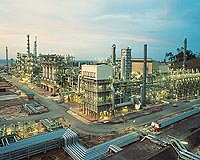
The gas-to-liquids (GTL) business is involved in the chemical conversion of stranded natural gas feedstocks to liquid products such as transportation fuels and chemicals. Insofar as beneficial processing of the world's huge resource base of stranded natural gas is concerned, GTL processing is a relatively recent R and D focus of the petrochemical industry.
Development of commercial-scale GTL plants, utilizing stranded natural gas is a relatively recent development, too. Hence, the need for this BCC report.
Liquid GTL products are primarily transportation fuels (and are defined as synthetic fuels) and chemical feedstocks such as methanol, hydrogen, and other petrochemicals. As the terms are presently used in the petrochemical industry, "GTL" and "GTL products" refer mainly to the output of plants (or refineries) that utilize stranded natural gas as feedstock.
For that reason, conventional production of chemicals, including high-volume methanol, typically via steam methane reforming (SMR) of non-stranded natural gas, is not a principal focus of this report.
The objective of this BCC Research report is to provide an up-to-date and critical evaluation of the most dynamic and path breaking aspects of GTL technology and describe how recent breakthroughs in conversion technology have made GTL products competitive with products refined from crude oil.
This report discusses the use of GTL processes to produce ultra-clean diesel fuels and high-quality chemical products such as waxes. BCC assesses the role of GTL as an enabling technology for the production of clean transportation fuels.
A principal focus of the report are individual company initiatives and R and D focus, Discussed as well is the status of all major GTL projects around the world that utilize stranded gas. Included are descriptions of technologies and products, and a forecast of the GTL market through 2014. The report quantifies demand for GTL by type of output, application, and production technology.
A significant component of this report analyzes competitive synthetic fuel concepts, as the commercial success of competitive synthetic fuel concepts will weigh heavily on the ultimate trajectory of the GTL business. These competitive fuels include those derived from coal-to-liquids (CTL) and biomass-to-liquids (BTL).
Reasons For Doing The Study
A significant amount of the world's natural gas resources are stranded, far from existing markets. Gas-to-liquids technologies can economically convert these resources into high-quality, ultra-low sulfur fuels that can be transported to consumers or used in remote locations.
Fischer-Tropsch (FT) processing of synthesis gas has undergone significant improvements in reactor design and product recovery. This has enabled the economic use of stranded natural gas feedstocks in GTL production on the front-end (i.e., the stranded natural gas is the initial feedstock that yields synthesis gas that is then processed via FT).
Therefore, GTL fuel production is in a relatively advanced stage of development, with commercial production well demonstrated in, for example, Qatar, Malaysia, and South Africa. Although synthetic fuels can be produced from a range of feedstocks-biomass, coal, and natural gas-the GTL process is at the most advanced stage of commercial development. In addition, GTL utilizes gas resources that either are flared or are currently unmarketable.
Synthetic fuel production via GTL processing of stranded gas is approximately 100,000 barrels per day (bbl/d), and it is estimated that as many as 10 large-scale GTL plants will be in operation over the next decade, producing as much as 1 million barrels per day (Mbbl/d) of GTL products.
Nearly every major oil company has announced plans to investigate producing synthetic diesel fuel via a GTL process. However, a handful of companies, such as established GTL companies Sasol, Shell, Syntroleum, and Rentech, are the dominant producers.
As discussed in this report, though, there are numerous "second-tier" companies that have sizable GTL support operations in engineering, design, plant construction, ancillaries, and related activities. Generally, research and development are improving the efficiency and economics of GTL production as well as quantifying the costs and benefits of production and use of GTL fuel in vehicles.
GTL derived fuels do have competition in the market, and these competitors include low-grade and synthetic petroleum (e.g., from tar sands in Canada) CTL, biofuels, electricity (EVs), and hydrogen.
Although liquid fuels could be increasingly supplied by low-quality and synthetic petroleum, such as tar sands, due to the sheer size of readily accessible resources and the available technologies to turn such resources into liquid fuel, those fuels have much higher GHG (greenhouse gas) emissions than conventional petroleum, as well as GTL, and BCC predicts this will be a highly significant negative factor in terms of product demand.
Currently, production capacity for fossil-based "alternative" fuels is about 2.5 Mbbl/d, of which the largest portion is tar sands and extra-heavy oil production. This, of course, far exceeds present GTL output.
These fossil-based "alternative" fuels now account for only 3% of global oil production but could double within the next 5 years. However, environmental mandates could be a significant force behind growing utilization of GTL for chemical and energy production.
Higher-purity transportation fuels, such as ultra-low sulfur diesel, will become mandatory in most jurisdictions. GTL will offer both petroleum refiners and automakers flexibility to meet international agreements. In addition, GTL derived fuel may have a slight GHG emission advantage.
Share This Article With Planet Earth