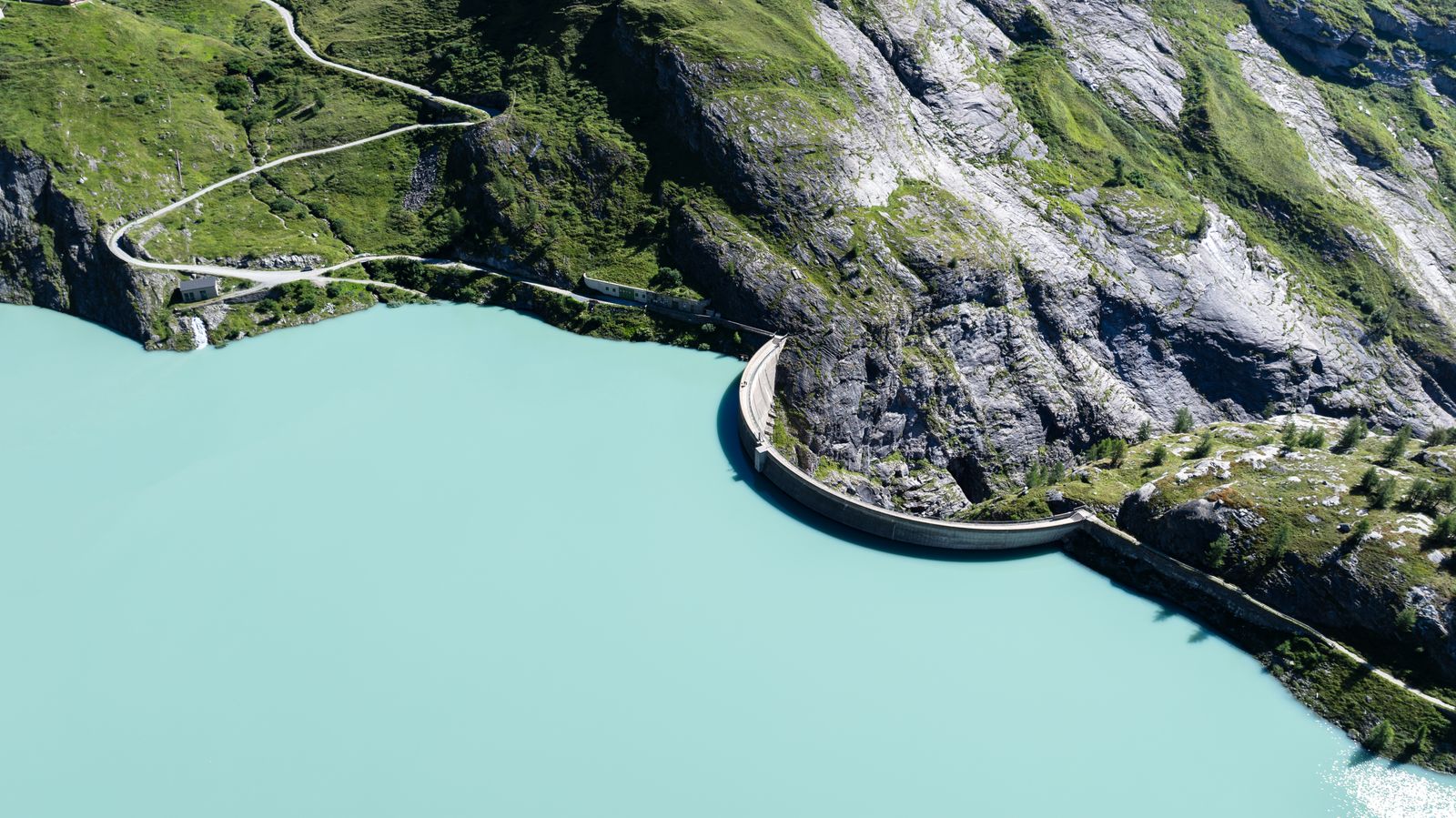
The Three Gorges Dam holds back enough water on the Yangtze to fill roughly 39 cubic kilometres of reservoir — a lake stretched behind a concrete wall. When NASA geophysicist Benjamin Fong Chao ran the numbers, he calculated that lifting that much mass above sea level should change how fast the planet spins. The answer came out to 0.06 microseconds added to the length of a day.
Sixty billionths of a second. Every rotation. Because China built a dam.
The physics behind a spinning ice skater
The mechanism is the same one every figure skater uses. Pull your arms in and you spin faster. Push them out and you slow down. Physicists call the quantity that governs this the moment of inertia — a measure of how mass is distributed around an axis of rotation.
Earth is a very large, slightly lumpy skater. Anything that redistributes mass — melting ice sheets, shifting ocean currents, earthquakes that drop a slab of crust by a few centimetres — changes the moment of inertia and, by conservation of angular momentum, changes the length of the day. The effect is minuscule, but it is real and measurable with atomic clocks and very-long-baseline interferometry.
Chao’s calculation for the Three Gorges reservoir treated the impounded water as a mass raised from near sea level to the elevation of the reservoir surface behind the dam. Pushing water uphill and holding it there is, in rotational terms, the skater slowly extending an arm. The planet spins fractionally slower. A day gets fractionally longer.
How much water is 39 cubic kilometres
A cubic kilometre is a cube of water one thousand metres on every side. Thirty-nine of them, stacked end to end, would stretch from London to Reading. Poured out flat over Manhattan, the water would submerge the skyscrapers and keep rising until it was more than half a kilometre deep over the top of One World Trade Center.
According to Nature’s coverage of the dam’s completion in 2006, the reservoir at full capacity adds up to 40 cubic kilometres to China’s freshwater storage — which had climbed from 0.06 cubic kilometres in 1950 to 180 cubic kilometres by 2002. The Three Gorges impoundment alone represents more than a fifth of that half-century of dam-building.
The wall itself is a small mountain of concrete. Vast amounts of concrete went into the structure between 1993 and its completion — many times the volume poured into the Hoover Dam on the Colorado.
0.06 microseconds, and why it matters that it’s measurable at all
A microsecond is a millionth of a second. Six hundredths of a microsecond is the time it takes light to travel about 18 metres — roughly the length of a city bus. It is not something anyone will feel. It is not something a wristwatch will register. Astronomical timekeeping, though, operates at a precision where such numbers matter.
The comparison Chao offered at the time was with the 2004 Sumatra-Andaman earthquake, which shifted enough of Earth’s mass toward the axis of rotation to shorten the day — in the opposite direction from the Three Gorges effect. The earthquake pulled mass inward. The dam pushes it outward and upward.
Neither event will show up on a clock in a train station. Both will show up in the running record kept by organizations that track the planet’s spin using radio telescopes pointed at distant quasars.
The scale of the machine that produced the number
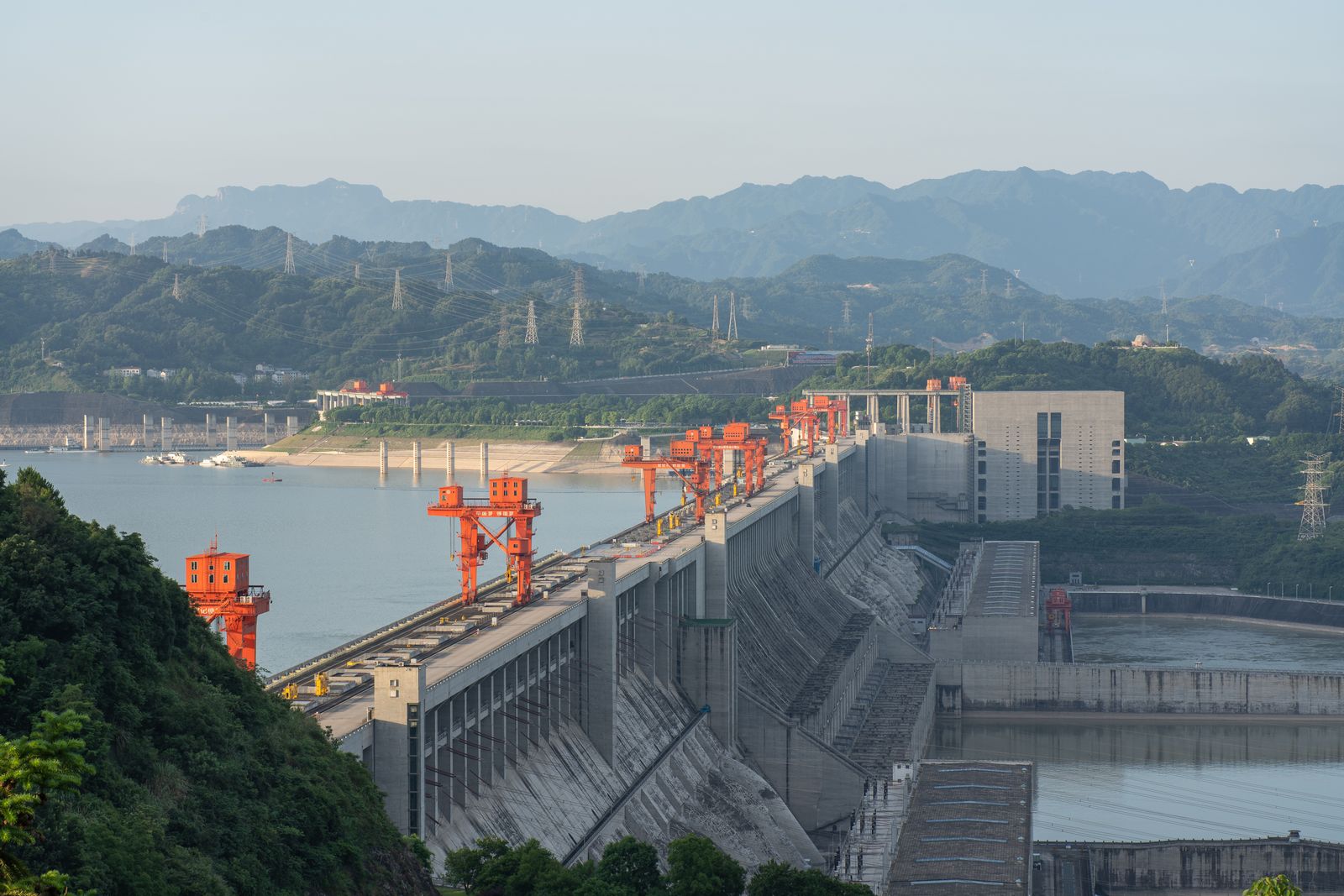
Everything about the Three Gorges project runs to superlatives. When all its main turbines are turning, the dam produces around 18 billion watts of electricity — roughly the output of five large coal-fired stations, and enough to make it the most productive hydroelectric plant on the planet. The Hoover Dam, by comparison, produces far less.
The reservoir rises and falls with the seasons. In July 2024, according to China Daily’s reporting on the dam’s first flood-discharge event of that year, water was flowing into the reservoir at 50,000 cubic metres per second — enough to fill 20 Olympic swimming pools every second — and the level had climbed to a record height. Sluice gates opened, discharging tens of thousands of cubic metres per second downstream.
Those numbers matter for the microsecond calculation. The dam does not hold a static 39 cubic kilometres. It breathes. It fills in the wet season, draws down in the dry, absorbs floods, and releases them. The rotational effect breathes with it, by tiny fractions.
A million people moved to make room for the water
The physics is elegant. The human cost is not. Large numbers of residents of the Yangtze valley were relocated to clear the reservoir zone during construction, with more following in the years after the main wall was finished. Ancient towns went underwater. Archaeological sites were surveyed and, where possible, moved brick by brick to higher ground.
The environmental repercussions ran downstream as well. Silt that once flowed to the Yangtze delta near Shanghai now piles up behind the dam wall, starving the coastal wetlands of the sediment that built them — a pattern seen on other major rivers after large dams were built. The long debate over whether the price of the Three Gorges project was worth paying is a question that has followed the dam since the first concrete was poured.
Where Three Gorges sits in the family of planet-nudging structures
Every large reservoir tugs on Earth’s spin by some tiny amount. The cumulative effect of the many thousands of large dams built worldwide in the last century is measurable, if small — enough shifted mass to have detectably influenced the planet’s rotational dynamics. Three Gorges is the biggest single contributor, but it is a contributor to an accumulating total.
Pumped-hydro storage runs the same trick on a smaller scale, deliberately. A station like Dinorwig in Wales moves millions of cubic metres of water up a mountain at night and lets it fall back through turbines in the morning. The rotational effect of that daily up-and-down is far too small to detect, but the principle is identical: lift mass, slow the spin; drop it, speed it back up.
The Three Gorges reservoir is different only because it is enormous and, in engineering terms, permanent. The water stays lifted.
The flooding season and a reservoir that keeps growing in importance
The dam is not just a physics experiment. In August 2026, Chinese authorities allocated 80 million yuan in emergency relief funds to Henan, Hubei, and Anhui provinces after severe flooding along the middle Yangtze, according to China Daily’s coverage of the relief effort. The reservoir’s flood-buffering role — absorbing peak flows from upstream storms and releasing them at controlled rates — has grown more central as monsoon patterns in the basin have shifted.
When the ministry of water resources discusses the dam’s flood control function, this refers to the reservoir deliberately storing higher volumes of water during flood peaks. During the summer 2024 event, the water level sat well above its normal operating elevation. For those weeks, the planet’s day was very slightly longer than it would have been at the winter drawdown level.
How the number was calculated
Chao’s method was a straightforward application of rigid-body mechanics adapted to the geometry of a rotating, oblate planet. The change in moment of inertia depends on the mass of the water, the latitude of the reservoir, and the change in radial distance from Earth’s axis of rotation. The Three Gorges reservoir sits in the northern mid-latitudes, which means lifting water there moves it both upward from sea level and outward from the spin axis at a favourable geometry for the effect.
The output — 0.06 microseconds per day — is dwarfed by other natural sources of variation. Tidal friction from the Moon lengthens the day by about 1.7 milliseconds per century. Seasonal shifts in atmospheric mass, as air moves between hemispheres with the changing sun, produce day-length variations of about a millisecond over a year. The dam’s contribution sits several orders of magnitude below either.
It is still measurable, in principle, against the background. It is still a real number.
What a lengthened day actually looks like
Imagine a stopwatch that started when the last load of concrete was poured at the dam wall on 20 May 2006. Two decades later, in August 2026, the accumulated lag from the Three Gorges reservoir alone is on the order of 0.4 milliseconds — less time than it takes a hummingbird to complete a single wingbeat.
Compared with the dam’s electrical output — roughly 100 billion kilowatt-hours a year, enough to power tens of millions of homes — the rotational side effect is a curiosity. A footnote. The kind of number that gets read out at physics colloquia to make the point that engineering at planetary scale has planetary-scale consequences, even the ones nobody planned for.
The rotational effect was not a design goal. Nobody at the China Yangtze River Three Gorges Project Development Corporation set out to slow the planet. They set out to control floods, generate electricity, and open the upper Yangtze to shipping. The lengthened day is a receipt.
The larger accounting
Every gigatonne of ice that slides off Greenland into the North Atlantic changes the planet’s spin by a fraction of a microsecond, in the opposite direction from the dam — melting ice moves mass from high latitudes toward the equator, from land to sea, and, on the whole, redistributes it in ways that slightly slow the rotation as well. Climate models track this. Sea-level rise, driven by ice-sheet loss and thermal expansion of the oceans, is now a measurable term in the length-of-day budget.
The dam and the melting ice sheets are working in the same direction. Both are lifting or spreading water. Both are, in the language of a spinning skater, arms extending outward.
The Three Gorges wall will stand for as long as the concrete holds — engineers designed it for a service life of well over a century. The reservoir behind it will keep breathing with the seasons, filling in July, drawing down in January. And each rotation of the planet, for as long as that mass sits up there, will take an extra 0.06 microseconds to complete. Sixty billionths of a second, over and over, roughly 365 times a year, for however long the wall stands and the water stays lifted above the sea.