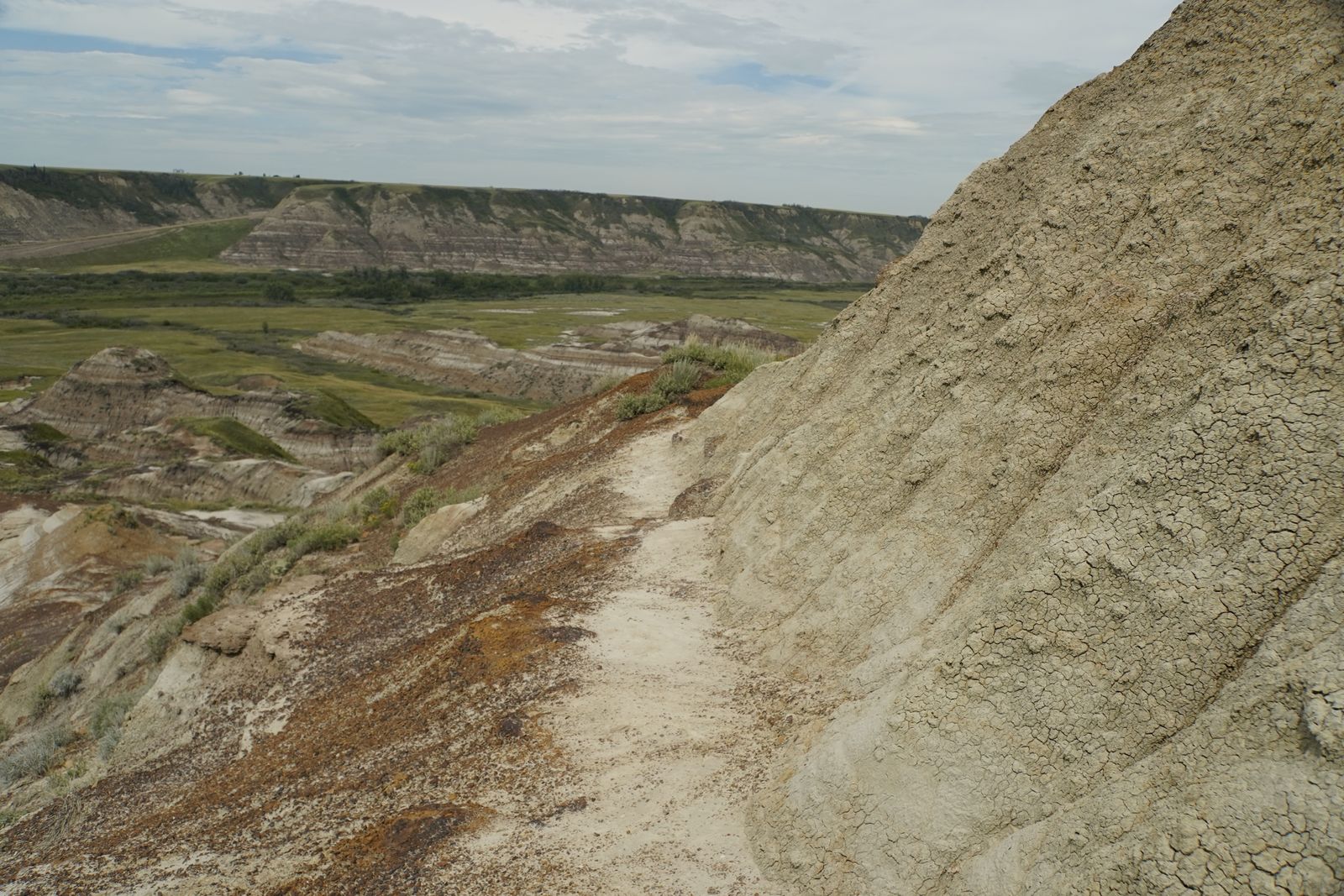
In the badlands of southwestern North Dakota, sturgeon and paddlefish lie tangled inside a chaotic layer of mud, tree debris and marine fossils. Tiny impact spherules are lodged between the fishes’ gill rakers, where the animals filtered particles from the water. Their position shows that the fish were still alive while debris from the Chicxulub impact was falling. It does not prove that the glass caused them to choke to death.
The site is called Tanis, and it lies near the top of the Hell Creek Formation, the same geological unit that has produced Tyrannosaurus rex and many other fossils from the final part of the Cretaceous. A National Geographic overview of the extinction evidence describes Tanis as a fossil deposit extremely close to the Cretaceous-Palaeogene boundary. Its importance comes from the unusually narrow interval it records: tens of minutes to a few hours after the impact.
A bone bed made in minutes
Most fossil beds are assembled slowly. Bones may be scattered, weathered, scavenged and moved repeatedly before sediment finally covers them. A layer containing several species can therefore combine animals that died years, centuries or even longer apart.
Tanis is different. In a 2019 peer-reviewed PNAS paper, palaeontologist Robert DePalma and his co-authors described an approximately 1.3-metre-thick event deposit containing densely packed freshwater fish, tree trunks, plant material and marine fossils. Many of the fish and logs are aligned by the same powerful flow, while some carcasses pass through much of the deposit vertically, indicating that the sediment accumulated rapidly.
The deposit records at least two surge pulses moving inland, against the river’s normal direction. Freshwater paddlefish and sturgeon were mixed with ammonite shells and other marine material, suggesting that the surge drew material from an estuarine or marine-influenced environment before sweeping it into the river channel. Rapid burial explains why the fish remained articulated instead of breaking apart or being scattered by scavengers.
Directly above the deposit is a fine-grained boundary clay containing an iridium anomaly. Iridium is scarce in Earth’s crust but enriched in many meteorites, making the global iridium-rich K-Pg layer one of the principal markers of the Chicxulub impact. At Tanis, that layer caps the event deposit and helps place the burial after the impact but before the finest atmospheric debris had finished settling.
Glass inside the gills
When the Chicxulub impactor struck carbonate-rich rock near the present-day Yucatán Peninsula, it excavated and melted enormous quantities of material. Some of that material travelled outward as molten droplets before cooling into small, rounded impact spherules. At Tanis, most of the identified spherules measure approximately 0.3 to 1.4 millimetres across.
Spherules occur throughout the event deposit, inside amber and in the gill regions of more than half of the examined sturgeon and paddlefish. Paddlefish are suspension feeders that move through the water with their mouths open and use closely spaced gill rakers to capture food. The most direct interpretation is that they filtered the spherules from the water while the particles were falling.
A 2022 Nature study led by Melanie During examined another Tanis paddlefish using high-resolution tomography. The researchers found impact spherules exclusively in its gill rakers and not elsewhere in the mouth, digestive tract or surrounding carcass. They concluded that the fish were alive and foraging when the spherules arrived, and that the accumulation of glass in the gills occurred at the same time as the destructive surge.
That finding rules out the original article’s description of spherules travelling along an expulsion tract. It also changes the meaning of the fossils slightly. The glass is an exceptionally precise timestamp, but it is not proof that inhaling the glass was the direct cause of death.
How the first hours were timed
Tanis sits roughly 3,050 kilometres from the centre of the Chicxulub crater. Calculations in the PNAS paper indicate that different seismic waves would have reached the region approximately six to 13 minutes after the impact. Impact-melt spherules could have started arriving about 15 minutes after the collision, with most falling during the following one to two hours.
A tsunami travelling directly from the Gulf of Mexico would have taken far longer, with the study estimating a minimum journey of about 18 hours. That timing led the researchers to favour a locally generated seiche, a powerful oscillation of an enclosed or partly enclosed body of water triggered by seismic shaking. The Chicxulub impact produced an earthquake estimated at roughly magnitude 10 to 11.5, powerful enough to disturb distant rivers, lakes and remnants of the Western Interior Seaway.
The published sequence is therefore not a simple story in which a wave buried the fish and glass fell afterward. Seismic waves probably initiated the water movement shortly before the first spherules arrived. The surge, falling ejecta and the fishes’ final moments overlapped within the same narrow window.
The impact beyond Tanis
The Chicxulub impactor was probably around 10 to 15 kilometres wide. It struck with enough energy to excavate an approximately 200-kilometre-wide crater and throw asteroidal and target-rock material high into the atmosphere. Conditions near the impact site would have been immediately catastrophic.
Material transported around the planet included dust, soot and sulphur-bearing aerosols. Re-entering ejecta contributed to an intense heat pulse, while fires added soot to the atmosphere. In the longer aftermath, dust and sulphate aerosols reduced sunlight and produced a severe impact winter that disrupted photosynthesis and destabilised food webs.
Approximately 76% of species disappeared during the K-Pg mass extinction, including all non-avian dinosaurs, pterosaurs and ammonites. Tanis does not preserve that entire global extinction in one afternoon. What it preserves is a local record of the impact’s earliest physical effects before the longer climatic crisis unfolded.
Why the fossils survived
Exceptional fossil preservation generally requires rapid burial and protection from scavenging, erosion and later disturbance. Tanis received a large volume of sediment in a short period, entombing fish, plants and marine material before the carcasses could separate. Many specimens remained articulated in three dimensions.
The Nature team also reported delicate non-ossified tissues associated with the brain region of one paddlefish. Their preservation, together with the restricted position of the spherules inside the gills, argues against prolonged transport or extensive reworking after death. There is no need to speculate that hot spherules sterilised the layer, a mechanism that the cited studies do not establish.
Some Tanis spherules were sealed inside amber blebs attached to tree trunks or large branches. Amber protected their glass from chemical alteration, allowing researchers to compare its composition and radiometric age with material from Chicxulub. Those rare unaltered samples closely match Chicxulub impact glass.
Other fossil deposits can also preserve unusually fine slices of time. A 2026 Global and Planetary Change study concluded that tidal layers at Italy’s Villaggio del Pescatore fossil site accumulated over roughly 40 years, with storms, tides and microbial mats contributing to exceptional preservation. Tanis compresses the interval much further, from decades to hours.
The season of the impact
The Tanis fish have also helped researchers estimate when during the year the asteroid arrived. Melanie During and her colleagues analysed growth marks and stable carbon-isotope patterns in the bones of six sturgeon and paddlefish. Those records preserved repeating annual cycles that ended shortly after a new period of active growth had begun.
The team concluded that the impact occurred during boreal spring, meaning spring in the Northern Hemisphere and autumn in the Southern Hemisphere. The fish had begun their favourable growing and feeding season, but the annual cycle had not yet reached its summer peak. That finding is more precise than the broader spring-to-summer estimate offered by another Tanis study published in 2021.
Season may have affected which organisms were most exposed or biologically vulnerable when the longer crisis began. The Nature paper noted that Southern Hemisphere ecosystems appear to have recovered as much as twice as quickly as some Northern Hemisphere communities. The researchers presented that pattern as consistent with a seasonal influence, not as proof that season alone determined survival.
The debate around Tanis
Tanis has attracted unusual scrutiny because some of its most dramatic claims reached documentaries and magazines before detailed peer-reviewed descriptions appeared. A skeptical 2022 LabRoots commentary raised questions about access to the fossils, the site’s interpretation and the amount of information released through popular media. It was commentary, however, not the peer-reviewed analysis the original article called it.
The distinction between published and publicised evidence matters. The surge deposit, Chicxulub-linked glass, iridium-bearing cap, fish containing spherules and spring timing all appear in peer-reviewed papers. The dinosaur leg, alleged pterosaur egg and several other specimens promoted through television coverage have not carried the same level of formally published support.
That does not make every unpublished specimen false. It means they should be described as reported or under investigation rather than used as settled evidence. Tanis remains extraordinary without requiring every television claim to be accepted in advance of publication.
What Tanis actually records
The strongest reconstruction begins with a river or estuarine system in what is now southwestern North Dakota. Seismic waves from Chicxulub reached the region within minutes and probably triggered a powerful local seiche. Water moved inland through the channel, gathering fish, trees, sediment and marine material as impact spherules began falling through the atmosphere.
Sturgeon and paddlefish continued filtering the water during that overlap. Glass accumulated between their gill rakers while the surge was still moving. The animals were then buried rapidly inside more than a metre of sediment, before the finest iridium-bearing impact material settled across the top.
Tanis is therefore not a literal minute-by-minute film of the day the dinosaurs died. It is something the fossil record almost never provides: a deposit constrained to the first tens of minutes or hours after a known planetary event, complete with animals that were alive while its debris was arriving.
Reading the first hours
The final image does not need embellishment. A paddlefish was filtering river water while glass droplets, most only fractions of a millimetre across, settled around it. The particles stopped in the same structures the animal had used to gather food throughout its life.
Before the atmospheric debris had finished falling, the surge reached the fish and closed mud around its body. The glass in its gills is not a proven record of choking. It is a timestamp marking the brief moment when an animal in North Dakota was still alive inside the expanding consequences of an impact 3,000 kilometres away.