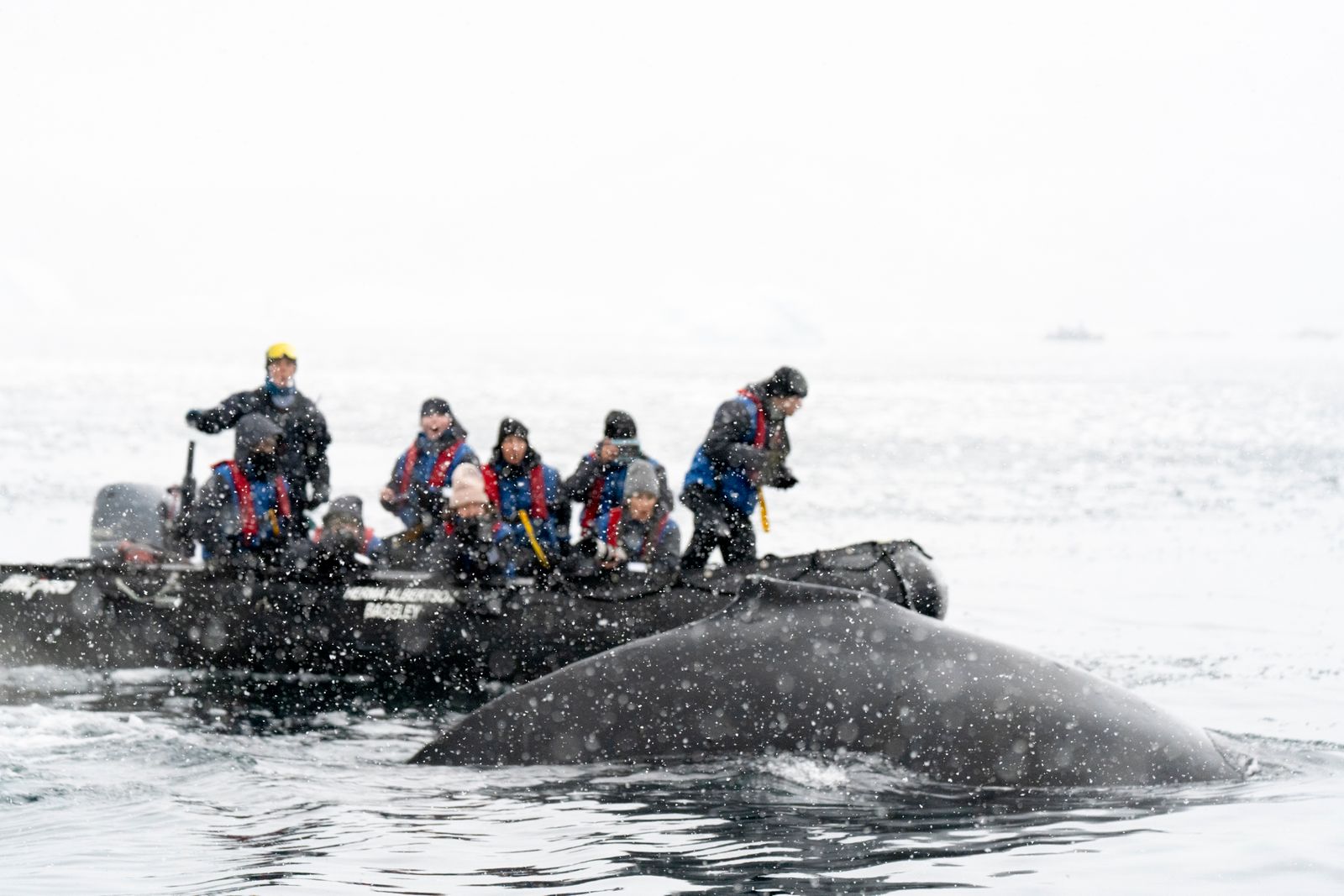
On 16 May 2007, Iñupiat whalers at Barrow, Alaska, now known as Utqiaġvik, landed a 14.9-metre male bowhead whale. During the postmortem examination, a metal fragment was recovered from the animal’s right shoulder blade. The object was not a stone point. It was a set of three finely machined brass components from a nineteenth-century bomb lance, according to a Polar Biology report by John C. “Craig” George and John R. Bockstoce.
George and Bockstoce compared the fragment with bomb lances in the New Bedford Whaling Museum’s collection. They identified it as part of a model patented in 1879 by New Bedford inventor Ebenezer Pierce and superseded by an improved design in 1885. Based on when manufactured whaling equipment entered widespread use in northern Alaska, they concluded that the weapon was probably fired within a few years of 1890.
That conclusion still contains uncertainty. The lance might have been stored for some time before it was used, so the artifact cannot establish an exact date for the strike. Even so, if it entered the whale around 1890, the animal survived with the fragment for approximately 117 years before it was killed in 2007. A contemporary Associated Press report carried by CBS News placed the whale’s estimated age between 115 and 130 years.
What the fragment actually was
Bomb lances were explosive projectiles developed for nineteenth-century whaling. Early versions could be fired from heavy shoulder guns, while later darting guns mounted the firing mechanism beside a harpoon. The projectile contained gunpowder and a delayed fuse intended to detonate after entering the whale.
The fragment recovered in 2007 consisted of the lance’s brass point, an ignition weight or “hammer,” and the housing that connected those parts to the explosive body. The body itself was not recovered. Without it, George and Bockstoce said it was impossible to determine whether this particular lance had been fired from a shoulder gun or a darting gun.
The surviving components also cannot reconstruct the exact course of the injury. A contemporary report said Bockstoce believed the device had exploded, but the peer-reviewed paper concentrated on the weapon’s design, likely date and the considerable healing around the wound. The physical evidence shows that the strike was not immediately fatal and that the whale survived long enough for the injury to become old and heavily healed.
Six small notches had been filed into one ridge of the brass point. Alaska Native hunters consulted by the researchers thought they might have been an ownership mark, perhaps recording earlier whales taken by the captain who possessed it. That interpretation was offered cautiously, but it added another human trace to an object already carrying more than a century of history.
Why some accounts mention stone weapons
Stone and ivory weapon points really have been recovered from bowhead whales, but not from this particular animal. George and Bockstoce described separate finds from whales landed in 1981, 1992, 1993 and 1997. Because the manufacture dates of those traditional artifacts were unknown, they provided only rough evidence of extreme longevity.
The brass fragment found in 2007 was different because its design could be tied to a narrow technological period. Pierce’s 1879 model lacked the vent ports added to his improved 1885 design, and the researchers concluded that the older version was almost certainly no longer being manufactured after 1885.
A second fragment from the same Pierce design had been recovered from a female bowhead landed at Gambell in 1980. Together, the two dateable bomb-lance finds offered independent support for age estimates obtained through biological methods. They did not provide exact birthdays, but they showed that some bowheads can survive for more than a human lifetime after being struck.
How scientists estimate a bowhead’s age
Determining the age of a bowhead is unusually difficult. The whales have no teeth whose growth layers can be counted, their ear plugs are not considered reliably readable, and baleen-based estimates work mainly for younger animals because the plates wear away over time.
For older bowheads, scientists use a chemical process in the proteins of the eye-lens nucleus. A Marine Mammal Science study of aspartic acid racemization analysed 52 eyes from 42 bowhead whales. The method measures the changing balance between two molecular forms of aspartic acid that accumulate in metabolically inactive lens proteins as an animal ages.
The rate of that change must be calibrated, including for body temperature, so the results come with uncertainty rather than producing a precise birth certificate. In the 2013 sample, one male was estimated to be more than 100 years old. Earlier analyses using the same approach produced estimates potentially exceeding 200 years, a range now broadly consistent with other lines of evidence.
The weapon fragment therefore matters because it is independent of eye chemistry. A brass design that had become obsolete in the nineteenth century was still inside a living whale in 2007. Even with uncertainty over the firing date, it confirms that bowhead lifespans can extend well beyond a century.
Why bowheads can live for so long
Bowhead longevity does not appear to have a single simple explanation. A body that remains alive for two centuries must repeatedly repair molecular damage while limiting the mutations and cellular failures that accumulate with age. Scientists have consequently examined bowhead genomes, tissues and cultured cells for unusually effective maintenance systems.
A 2025 study published in Nature found that bowhead whale cells displayed enhanced repair of DNA double-strand breaks, greater repair fidelity and lower mutation rates than cells from other mammals. The researchers also identified high levels of CIRBP, a cold-responsive protein that improved several DNA-repair processes during laboratory experiments.
The findings suggest that bowheads may preserve their genomes by repairing damage particularly faithfully rather than simply eliminating every damaged cell. That does not make the animals immune to cancer or ageing, and it does not mean that one gene explains their lifespan. It does provide a more direct biological basis for their longevity than the idea that their cells merely divide more slowly.
A species shaped by ice and whaling
Bowheads spend almost their entire lives in Arctic and subarctic waters. According to NOAA Fisheries’ current species account, they can carry a layer of blubber 17 to 19 inches thick, and their massive skulls allow them to break through sea ice. These are adaptations to an ice-bound environment, although they do not make a bowhead impervious to weapons or injury.
Commercial whaling devastated the species. By the time commercial bowhead hunting effectively ended in 1921, NOAA estimates that worldwide abundance had fallen below 3,000 animals. The Western Arctic population has since recovered substantially, with the current estimate standing at approximately 15,229 whales, although the much smaller Okhotsk Sea population remains at only a few hundred.
The whale examined in 2007 came from an Alaska Native subsistence harvest, which is separate from commercial whaling. Bowheads have provided food, materials and cultural continuity to Indigenous communities for at least 2,000 years. Since 1981, the United States and the Alaska Eskimo Whaling Commission have co-managed the traditional harvest under established quotas and reporting requirements.
That cooperation is also why finds such as the 2007 fragment become available to science. Whaling crews permit postmortem examinations and provide biological samples, observations and recovered objects. The brass lance could be studied because a landed whale connected present-day community knowledge with museum collections and nineteenth-century manufacturing records.
The songs beneath the ice
Bowheads are not merely long-lived. They are also highly vocal animals whose lives unfold through sound beneath Arctic ice. A 2018 University of Washington account of research published in Biology Letters reported 184 different songs in recordings gathered from 2010 to 2014 near Greenland.
The researchers found that new sets of songs appeared in different seasons, with no song types repeated between years in the recordings they examined. Lead author Kate Stafford compared the animals’ changing repertoire with jazz because of its variety and free-form quality. Scientists still do not know exactly why bowheads change their songs so extensively.
Those findings cannot tell anyone what the 2007 whale remembered about the strike that left brass in its shoulder. They do, however, make the animal more than a passive container for an old weapon. It spent its life navigating, feeding and communicating in an acoustic world beneath the ice while the fragment remained inside its body.
What the artifact really records
The New Bedford Whaling Museum’s collection helped George and Bockstoce identify the obsolete design, but the research paper does not state that the museum took possession of the fragment recovered from the whale. Its decisive role was comparative: preserved examples and photographs made it possible to connect an embedded object with a particular patent and manufacturing period.
The fragment is therefore a time marker, but not a perfect stopwatch. It supports the conclusion that the whale survived a failed bomb-lance strike probably delivered around 1890 and carried part of the weapon for roughly a century. It does not establish a stone point, an exact firing date or a guaranteed minimum age of 117 years.
The verified version of the story remains remarkable. A small piece of nineteenth-century brass entered a bowhead’s shoulder during the final decades of industrial Arctic whaling. More than a century later, it emerged from the body of an animal that had survived the strike and continued moving beneath the Arctic ice.