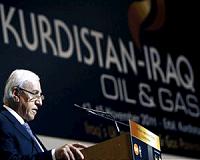
Norwegian oil and gas company DNO said Thursday it was moving full speed ahead in the Kurdish north of Iraq, with operations proceeding without interruption.
The company said its operating profit soared in the third quarter and revenues improved year-on-year. Third quarter revenue of $73 million was down 11 percent from the previous term, but 48 percent higher than the same period last year.
DNO said third quarter production averaged 115,200 barrels of oil equivalent per day. Kurdish assets represented the clear majority of the company's portfolio, with output at 110,500 barrels per day during the quarter.
The company in September assumed the role of operator after acquiring 50 percent of Exxon Mobil's stake in the Baeshiqa reserve area, but conceded that Exxon's early efforts were disrupted by security concerns related to the regional fight against the group calling itself the Islamic State.
Iraqi and Kurdish paramilitary forces engaged in battle in the weeks that followed a controversial Kurdish referendum for independence from federal Iraq. As Kurdish forces conceded contested territory, Iraqi troops seized control over the oil fields in Kirkuk, cutting off a revenue lifeline for the semiautonomous Kurdistan Regional Government.
The Kurdish referendum coincided more or less with the liberation of parts of northern Iraq from the Islamic State.
Oil leaves the Kurdish region from a pipeline and by trucks to a Turkish port at Ceyhan. DNO said operations inside Kurdish territory are continuing without interuption.
"The company has received year-to-date export payments totaling $297 million net to DNO, up from $210 million during the full-year 2016," it said. "With continuing export payments, DNO will step up investments in Kurdistan in 2018."
Earlier this week, the Kurdish Ministry of Natural Resources said it was postponing a London oil and gas conference meant to showcase the regional potential "due to the current logistical and other circumstances."
First coast-to-coast land motion map of Scotland derived from satellite radar images
The first country-wide map of relative land motion has been created by a team at the University of Nottingham. Using hundreds of satellite radar images the team, working with Geomatic Ventures Limited (GVL), an innovative University spin-out company, created a complete map of mainland Scotland.
The map covers a two-year period from 2015 to 2017 and was created using Intermittent Small Base … read more