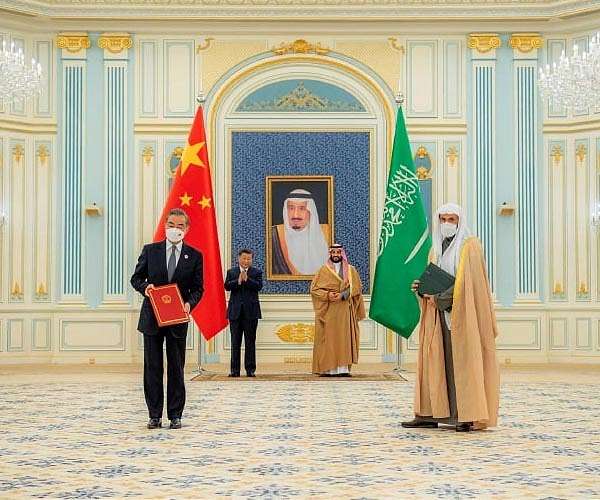
Chinese President Xi Jinping on Friday touted close security and energy ties with Gulf nations during summit meetings in Saudi Arabia that have highlighted tensions with Washington.
On the third and final day of his visit, Xi attended summits of the six-member Gulf Cooperation Council and a broader China-Arab leaders' meeting.
This is only Xi's third journey outside China since the coronavirus pandemic began.
The discussions came one day after bilateral sit-downs with Saudi royals yielded a joint statement stressing "the importance of stability" in oil markets — a point of friction with the United States. Washington has urged the Saudis to raise production.
"China will continue to firmly support the GCC countries in maintaining their own security… and build a collective security framework for the Gulf," Xi said at the start of the China-GCC summit.
"China will continue to import large quantities of crude oil from GCC countries on an ongoing basis," he said, also vowing to expand other areas of energy cooperation including liquefied natural gas imports.
Oil from Saudi Arabia alone accounted for 17 percent of China's imports last year, and last month Qatar announced a 27-year natural gas deal with China.
Earlier on Friday, a joint Chinese-Saudi statement spoke of "focusing on emissions rather than sources" in tackling climate change, the approach championed by the resource-rich Gulf monarchies.
Forty-six bilateral agreements and memorandums of understanding were announced on everything from housing to Chinese language teaching. Both sides are seeking economic and strategic benefits by deepening cooperation.
However, few details were released despite a Saudi state media report on Thursday that about $30 billion in deals would be signed during Xi's visit.
Riyadh and Beijing stressed "deepening relations within the framework of the comprehensive strategic partnership between the two countries, and reaching new and promising horizons", the statement said.
Xi's visit comes during tensions between Saudi Arabia and the United States, its long-time partner and security guarantor, over oil production, human rights issues and regional security.
It follows US President Joe Biden's trip to Jeddah in July, before midterm elections, when he failed to persuade the Saudis to pump more oil to calm prices.
– 'Prestige' trade deals –
Crown Prince Mohammed bin Salman, Saudi Arabia's 37-year-old de facto ruler, addressed both summits on Friday, promising "continuing Arab-Chinese cooperation to serve our common goals and aspirations of our peoples".
The Gulf countries, strategic partners of Washington, are bolstering ties with China as part of an eastward turn that involves diversifying their fossil fuel-reliant economies.
At the same time China, hit hard by its Covid lockdowns, is trying to revive its economy and widen its sphere of influence, notably through its Belt and Road Initiative which provides funding for infrastructure projects around the world.
Officials provided few details about the agenda for Friday's talks, but one potential area of focus was a China-GCC free trade agreement under discussion for nearly two decades.
Drawing those negotiations to a close would be "a matter of prestige for Beijing," said Robert Mogielnicki of the Arab Gulf States Institute in Washington.
"It's not as simple for the GCC states, which seem to be more invested in advancing bilateral ties and are engaged in varying degrees of regional economic competition with their neighbouring member states."
A breakthrough on the trade pact could help Saudi Arabia, the Middle East's biggest economy, diversify its economy in line with the Vision 2030 reform agenda championed by Prince Mohammed.
Beijing's foreign ministry has described Xi's trip as the "largest-scale diplomatic activity between China and the Arab world" since the People's Republic of China was founded.
The visit earned a rebuke from the White House, which warned of "the influence that China is trying to grow around the world".
Washington called Beijing's objectives "not conducive to preserving the international rules-based order".
As Xi visits, resource-rich Gulf seeks stronger China ties
Dubai (AFP) Dec 9, 2022 –
Arab Gulf countries, strategic partners of Washington, are bolstering ties with China as part of an eastward turn that involves diversifying their fossil fuel-heavy economies.
As a Gulf-China summit takes place in Riyadh on Friday, AFP examines key areas of economic cooperation between the six-member Gulf Cooperation Council and the world's second-largest economy.
– Energy –
By 2020, China had risen to become a primary trading partner with the GCC states, especially in the field of energy.
China imports hydrocarbons from Oman, the United Arab Emirates, Kuwait and Saudi Arabia, which alone accounted for 17 percent of the Asian giant's oil imports in 2021.
Qatar supplies China with liquefied natural gas — trade that has been bolstered by the global energy crisis resulting from the war in Ukraine.
In November, Qatar announced a 27-year natural gas deal with China worth more than $60 billion, saying it was the longest such agreement to date.
– Free-trade talks –
In July 2004, China and the GCC announced the launch of negotiations for a free-trade agreement.
Nearly two decades later, and after nine rounds of talks, the parties have yet to clinch a final deal, despite pledging in January to "accelerate the process".
Friday's Gulf-China summit is widely seen as an opportunity to jumpstart the negotiations.
Chinese trade relations are particularly strong with the UAE, which is the largest Middle East market for Chinese products and is a major export hub for Chinese goods, especially to the rest of the Arab world.
– Investment –
Between 2005 and 2022, Chinese companies invested more than $107 billion in GCC states, according to data collected by the American Enterprise Institute.
The largest share of Chinese investment went to Saudi Arabia, the Arab world's biggest economy.
Investments in the kingdom were valued at around $49.6 billion over the past 17 years, according to the think tank.
For its part, Saudi Arabia was the 12th-largest investor in China in 2019, with nearly $2.3 billion, according to the official Saudi Press Agency.
Gulf sovereign wealth funds are also increasingly looking to Asia.
In 2015, China and the UAE agreed to create a $10 billion joint investment fund. The UAE-China Joint Investment Cooperation Fund is managed by the Abu Dhabi state fund Mubadala and two Chinese state institutions.
– Weapons and technology –
As Washington watches closely, the GCC has also turned to China for technology and arms as part of the region's efforts to diversify its suppliers.
In February, the UAE said it would purchase 12 attack planes from China, a few weeks after threatening to cancel its purchase of F-35s from the United States.
In March, Saudi Arabia and China signed an agreement to jointly develop military drones in the oil-rich kingdom, according to Saudi-owned media.
Eager to curb their dependence on hydrocarbon sales, GCC rulers are also turning to China for technological collaboration.
Since 2019, most GCC telecom firms have signed 5G contracts with Huawei.
The firm is controversial in Europe and the United States over accusations that it is close to China's military and that its technology could be used for espionage, charges Beijing has denied.