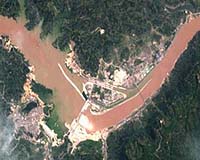
With a blast powerful enough to topple 400 10-storey buildings, Chinese engineers Tuesday blew up a major barrier protecting the huge Three Gorges dam, state media reported.
More than 190 tonnes of explosives were fitted under the waterline at the Yangtze river construction site before the 12-second blast was triggered at 4:00 pm (0800 GMT), with the event shown live on national television.
It caused nearly 190,000 cubic meters (6.7 million cubic feet) of concrete from the upper 30-meter (100-foot) section of the cofferdam to tumble into the river, according to the Xinhua news agency.
A cofferdam is a temporary barrier used to keep an area dry in the main dam structure to allow construction work to take place.
The blast released enormous amounts of water into the dam, and state-of-the art measures were taken to ensure the main walls could absorb the resulting "tremendous shock waves", Xinhua said.
Xinhua quoted officials as saying they did not believe the blast would have severe geological consequences, although it is located in an area with some risk of earthquakes.
"Blasting away the concrete cofferdam and the Three Gorges reservoir's water storage will spark no severe geological disasters," said Li Yong'an, general manager of China Yangtze River Three Gorges Development Corporation.
Officials also downplayed the risk to marine life near the dam, saying two high tech boats had been deployed to dispel fish. "We used electric devices to create a high-pressure electric pulse in the water to dispel fish schools," Tan Xichang, a biologist from the Chinese Academy of Sciences, told Xinhua.
The blast was another step towards completion of what will be the world's largest hydropower project with a total installed capacity of 18,200 megawatts.
The construction phase of the dam was officially completed on May 20, although it will still be more than two years before all the power generators are installed and the dam becomes fully operational.
Source: Agence France-Presse