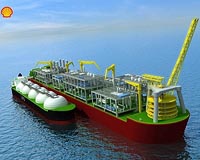
Canada approved on Tuesday a massive Can$36 billion ($27 billion USD) project by Malaysia's Petronas to build a liquefied natural gas pipeline along its Pacific Northwest coast, targeting Asian markets.
The project is the first deal by Canada's year-old Liberal government that goes against environmentalists in the name of the country's economic interests. Environmental activists and indigenous groups have opposed the plans.
"The government approved the Pacific Northwest LNG project," said Environment Minister Catherine McKenna.
"As the prime minister has emphasized, the only way to get resources to market in the 21st century is if it is done sustainably and responsibly. Today's announcement reflects this commitment," she said.
Prime Minister Justin Trudeau has repeatedly said that the economy and environment should be pursued in parallel, without sacrificing one for the other.
The project includes a pipeline and two Petronas terminals to ship gas to Asia.
The gas terminals are to be built on Lelu Island, near Prince Rupert on the Pacific coast. Each will have a capacity of six million tons per year, with the possibility of adding a third down the road.
The pipeline built by the operator TransCanada must cross 900 kilometers of British Columbia between Hudson's Hope (about 400 kilometers or 250 miles north of Prince George), ending at Lelu Island.
The pipeline deal comes after Petronas in late 2012 snapped up Canada's Progress Energy Resources gas producer for $5.2 billion.
– Climate change, pollution worries –
Environmental groups worry the pollution created will worsen global warming.
"How can Prime Minister Trudeau claim to be a climate leader on the international stage, while approving this new project that will become the single largest source of climate pollution in the country," said Karen Mahon, national director of Stand.
"Honestly we expected better," she said. "This government cannot make decisions like this while honoring their promises on climate change."
Meanwhile, many members of Canada's First Nations — indigenous people whose ancestors lived off the land gently for thousands of years — are concerned about potential sullying of fishing waters.
The deal means heavy LNG traffic through a maze of islands where salmon is a vital resource.
However, others were upbeat about job opportunities.
The green light for the pipeline project comes a few weeks after a key meeting between federal and provincial governments to define the necessary steps to reduce carbon emissions under last year's Paris climate agreement.
Canada, which has pledged to ratify the agreement, wants to impose a carbon tax on the provinces, a decision that does not hit everyone equally — especially oil-producing Saskatchewan.
Other Canadian provinces want to keep the carbon trading market principle already in force.
Hurdle remains for mega deal in Asian LNG market
Port Moseby, Papua New Guinea (UPI) Sep 28, 2016 –
A company with a strong position in the Asia-Pacific market for liquefied natural gas said it was waiting for a court decision before merging with Exxon Mobil.
InterOil said it was waiting for a court to review objections to the planned merger.
"Completion of the transaction prior to the end of September would require issuance of a final order no later than the close of business on Thursday," the company said in a statement. "Exxon Mobil and InterOil intend to close the transaction promptly after the final order is obtained"
Exxon emerged the victor after rival Oil Search Ltd. dropped out of the bidding process for InterOil in July. Exxon countered a bid backed by French energy company Total with a $2.2 billion offer. More than 80 percent of the InterOil shareholders voted in favor of the proposed transaction Sept. 21.
InterOil's sole focus is on the natural gas in Papua New Guinea. It said its holdings in the Elk-Antelope field there is on one of the largest undeveloped gas fields in Asia.
Exxon offered a set payment for each trillion cubic-foot equivalent of resources in the Elk-Antelope basin in Papua New Guinea, subject to a cap of 10 trillion cubic feet.
For its part, Oil Search in early September said it grabbed a tighter hold over license areas off the coast of Papua New Guinea after acquiring a 40 percent stake from a subsidiary of CNOOC Ltd., China's largest producer of offshore crude oil and natural gas, for an undisclosed sum.
Oil Search said Exxon, which also acquired a 40 percent stake in the area in question, will take over as the operator of the license areas in the deep waters off the coast of Papua New Guinea.
Construction of a facility for LNG in Papua New Guinea began in 2010. The facility is expected to produce more than 9 trillion cubic feet of natural gas over its 30-year lifespan. The country, meanwhile, is positioned well to take advantage of the growing energy demands from economies in the Asia-Pacific region.
The Asian Development Bank last year cautioned that Papua New Guinea's growth prospects dwindle, however, as the "one-off boost" for LNG exports fades from the country's economy.