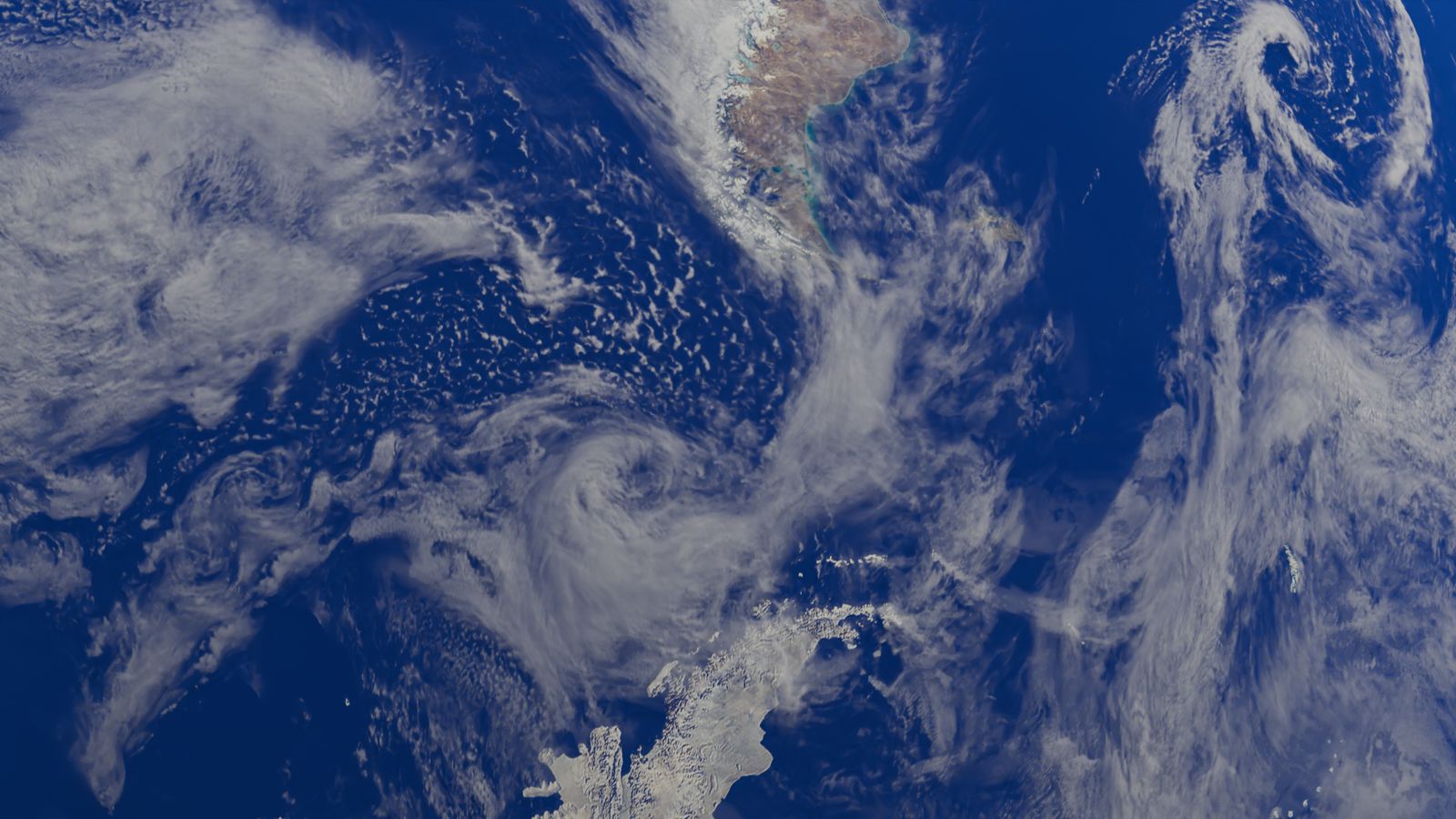
Every year the Sahara exports roughly 182 million tonnes of pulverised rock across the Atlantic, and about 27.7 million tonnes of it settles on the Amazon — the equivalent freight of more than a hundred thousand semi trucks arriving from the other side of the ocean, on the wind, for free.
The rainforest needs the delivery. Tropical rain, the same downpour that grows the canopy, also strips the soil of phosphorus faster than almost any other biome on Earth. Without a resupply, the largest rainforest on the planet would slowly starve.
The resupply comes from a desert.
A river of dust, five kilometres up
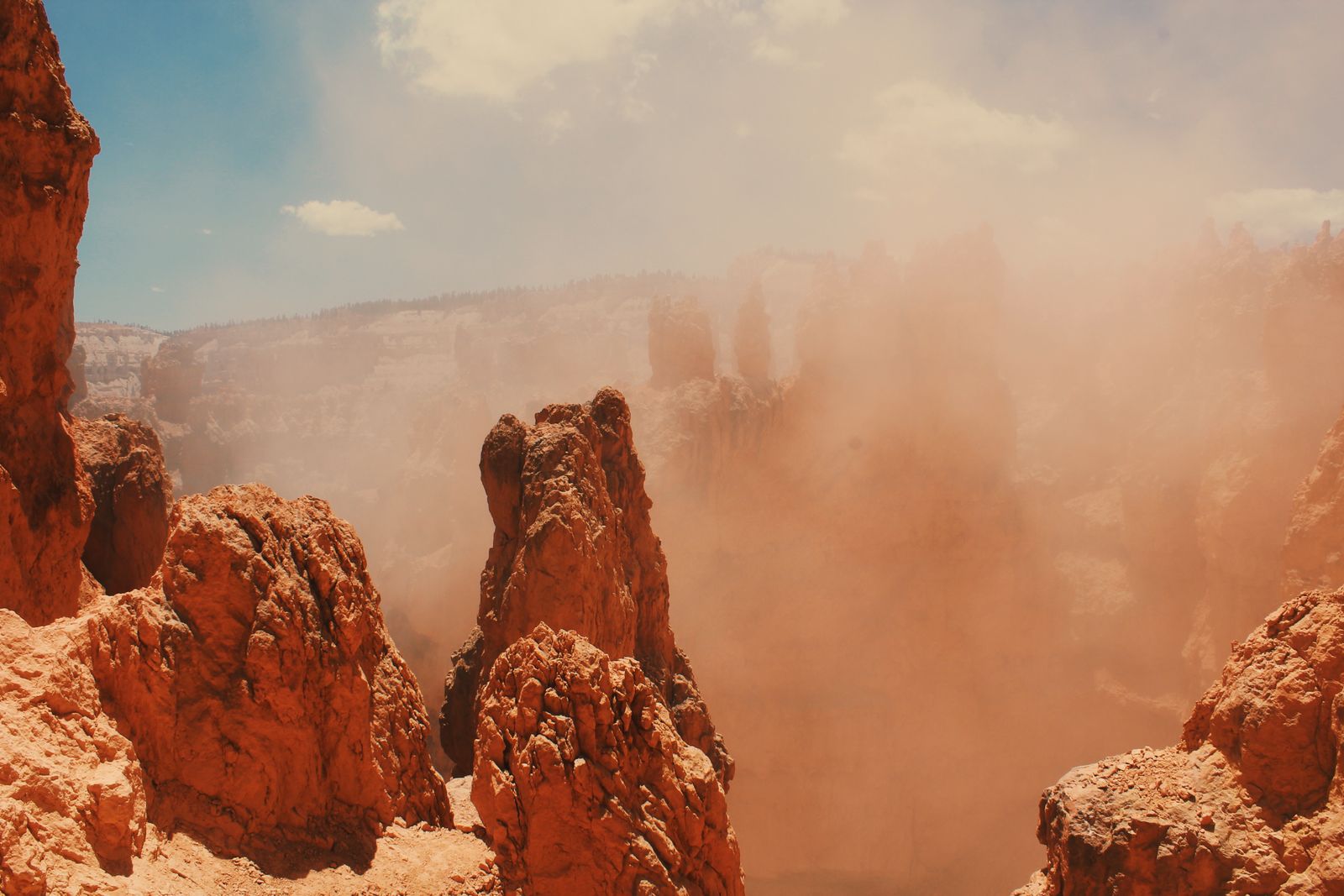
The plume is not metaphorical. It is a physical layer of dry, dusty air that sits above the Atlantic, warm enough and dense enough to suppress hurricanes forming beneath it. Meteorologists call it the Saharan Air Layer. In July 2026 it drifted far enough west to turn skies hazy across the Gulf Coast.
Trade winds do the carrying. They form over the arid heart of the Sahara from spring through autumn, catch the dust into a layer two to two and a half miles thick, and push it west at altitude for five thousand kilometres.
A satellite finally measured the whole conveyor. Between 2007 and 2013, the lidar aboard NASA’s Cloud-Aerosol Lidar and Infrared Pathfinder Satellite Observation — CALIPSO — tracked the plume in three dimensions as it crossed from Africa to South America. A team led by Hongbin Yu, an atmospheric scientist at the University of Maryland working at NASA’s Goddard Space Flight Center, published the seven-year average in Geophysical Research Letters in 2015: an average of 182 million tonnes of dust leaves the western edge of the Sahara each year, and about 27.7 million tonnes of it falls on the Amazon basin.
The ghost of a lake in Chad
A large share of that dust starts life in one extraordinary place. The Bodélé Depression, a dry lakebed in northern Chad wedged between the Tibesti and Ennedi mountains, is the most intense dust source on Earth.
It is what’s left of Mega-Chad, an inland sea that during the African Humid Period covered a vast area. When the water went, the sediment stayed: diatomite, the fossilised skeletons of freshwater algae, enriched with the phosphorus those organisms had spent millennia pulling from the lake water.
The geography does the rest. Northeasterly trade winds funnel between the two mountain ranges and accelerate across the exposed bed like air through a nozzle, lifting diatomite powder several kilometres into the sky.
How much of the Amazon’s delivery the Bodélé actually accounts for is less settled than it once looked. The depression — roughly 0.5 percent of the Amazon’s area — has long been estimated to supply about half the mineral dust reaching the basin. But a more detailed analysis of satellite and model data, summarised by NASA’s Earth Observatory, found that much of the Bodélé plume settles over Africa or is washed out by rain before it reaches South America, and that most of the dust arriving in the Amazon comes instead from El Djouf, a desert spanning Mauritania and Mali some 2,500 kilometres to the west. What no one disputes is that the Bodélé is the single most productive dust source on the planet.
Sit in the Amazon on a hazy afternoon in April and some of what is drifting overhead began as microscopic algae in a lake in Chad when the Sahara was still green.
Why a rainforest needs the delivery
Phosphorus forms the backbone of DNA and RNA, the head group of the lipids in every cell membrane, and the P in ATP — the molecule cells use to shuttle energy. Every leaf on every tree in the Amazon depends on it.
Unlike nitrogen, phosphorus has no gaseous phase at Earth’s surface. Bacteria cannot pluck it from the atmosphere. It moves through the biosphere as dust, as dissolved ions in water, and as rock weathering on geological timescales. Once a tropical downpour washes it out of the topsoil and into a river, the forest cannot pull it back.
The Saharan dust falling on the Amazon each year carries roughly 22,000 tonnes of phosphorus. That is close to the amount the forest is estimated to lose to rain and flooding. The dust appears to balance the ledger.
The match is rough. Estimates of Amazon phosphorus loss vary. Dust deposition swings widely between wet and dry years. And not all the phosphorus in the falling dust is chemically available to plants — chemical studies of Bodélé sediment show much of it is bound as sparingly soluble apatite or attached to iron oxides, with a smaller portion identified as fossilised fish bone and scale, dissolving the way bone meal does in a garden.
The direction of the flux, though, is clear. The Amazon receives more phosphorus from African dust than from any other external source.
The same conveyor, seen from the ground
The plume does not only feed rainforests. It also delivers hazards. Reporting from Health Policy Watch on the hidden health toll of natural air pollution describes how sand and dust storms generate enormous quantities of particulate matter that travel thousands of miles, and how downwind populations breathe the consequences.
The dust that reaches the U.S. and Europe carries more than minerals — bacteria and fungal spores ride with it. In the Caribbean, Puerto Rican air quality monitors sometimes register their worst readings on days with no local pollution source at all. In Miami in June, the sky occasionally takes on a milky cast. In July 2026, the plume settled over the Gulf.
The same dust that fertilises a rainforest can trigger asthma attacks a thousand miles away.
How steady is the delivery?
Not very. Across the CALIPSO record, the flux varied considerably between the smallest and largest years. That variability tracked rainfall in the Sahel, the semi-arid strip immediately south of the Sahara: wetter Sahel years produce more vegetation, less exposed soil, and less dust. Drier Sahel years produce more.
The system is coupled in ways that are still being worked out. If the Sahel greens under a warming climate, the dust might diminish. If it browns, the dust might grow. The models disagree on the sign of the change, let alone the magnitude.
The plume also shifts seasonally. It is strongest in boreal spring and early summer, when the Sahara is at its hottest and the intertropical convergence zone sits far enough south to steer the trade winds directly at South America. By late summer it swings north and starts feeding the Caribbean and the southeastern United States instead.
The 2025 fire season added another layer. The Copernicus Atmosphere Monitoring Service reported the highest wildfire emissions in at least 23 years for Europe after a summer that also brought unusually intense dust transport — a reminder that the atmosphere carries whatever gets lifted into it, dust, smoke, ash, and rearranges it far from the source.
A single interconnected system
The Sahara-to-Amazon connection is one of the clearest examples of the planet behaving as one machine. Coverage from Mongabay on how the Sahara keeps the Amazon going traced the link back to that dried Chadian lake, and to the plants thousands of kilometres downwind that depend on its dust.
It links the desertification of the Sahel, the drying of an ancient African lake, and the productivity of a South American forest that stores enough carbon to matter to the global climate. Disturb any part of it — pave the Bodélé, shift the trade winds, alter Sahelian rainfall — and the effects propagate.
Dust is not the only free fertiliser the planet moves around at scale. A 2009 study in Nature, reporting results from the CROZEX experiment near the Crozet Islands, found that naturally iron-fertilised waters in the sub-Antarctic Southern Ocean export two to three times more carbon to depth than an adjacent nutrient-rich patch without the iron — another case where a trace element carried by nature quietly rewrites the productivity of an entire ecosystem.
What the numbers still don’t answer
How much of the deposited phosphorus is actually taken up by trees, and how much is washed out again by the next rainy season, is not resolved. Whether the flux has been stable over centuries or varies with African climate cycles — the way ice cores hint it might — is not resolved either. And the fossil-fish-bone fraction, the most biologically available slice of the delivery, has only recently been identified.
What is settled is the scale. Nearly 28 million tonnes of dust, carrying about 22,000 tonnes of phosphorus, arriving each year on the wind, from lakebeds and deserts that dried out when humans were still figuring out agriculture.
The tree at the end of the chain
Picture the last step. A grain of diatomite lifts off the Bodélé on a January morning, catches a trade wind, climbs to four kilometres, and drifts west for a week over open ocean. It falls through the Amazon canopy in April, lands on wet leaf litter at the base of a kapok tree, and is pulled into a root along with rainwater.
Inside a cell, the phosphorus atom it carries slots into a strand of DNA, or the head of a lipid in a membrane, or the tail of an ATP molecule that will power the synthesis of a new leaf.
The algae that first concentrated that phosphorus lived in a freshwater lake in central Africa around the time the earliest cities were being built in Mesopotamia. They died, sank, dried, and waited seven thousand years for the wind.
Then the wind came.