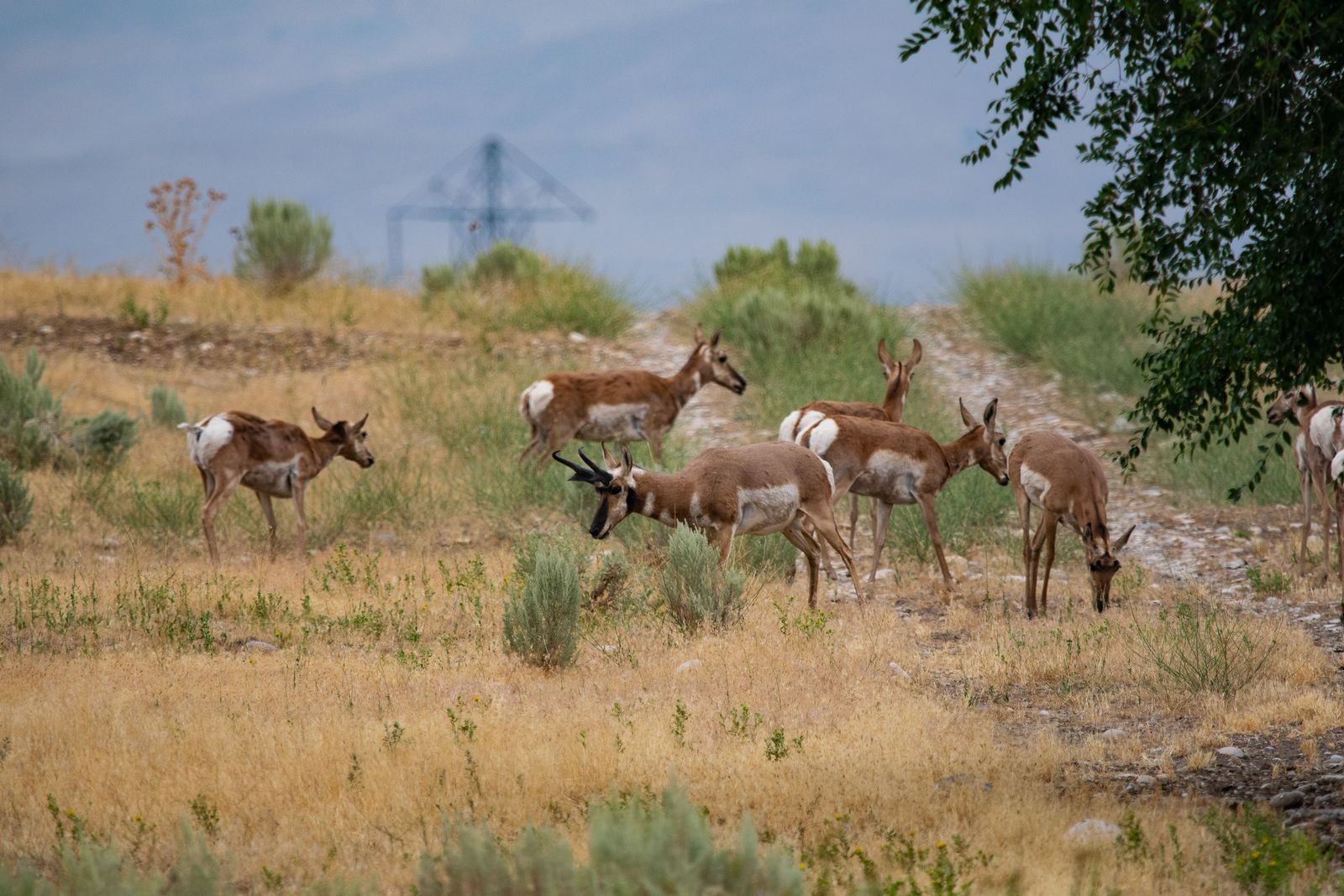
Pronghorn are built to notice movement across an enormous sweep of open country. A current National Park Service species profile estimates their field of view at about 320 degrees and says they can detect moving objects three miles away. An earlier National Park Service brochure from Bryce Canyon places the upper distance at four miles and describes a field of view exceeding 300 degrees.
Those distances should be understood as field estimates rather than laboratory measurements of visual acuity. Even so, they describe an animal exceptionally suited to open prairie and sagebrush, where seeing movement early can provide the time needed to escape at speeds approaching 55 miles per hour.
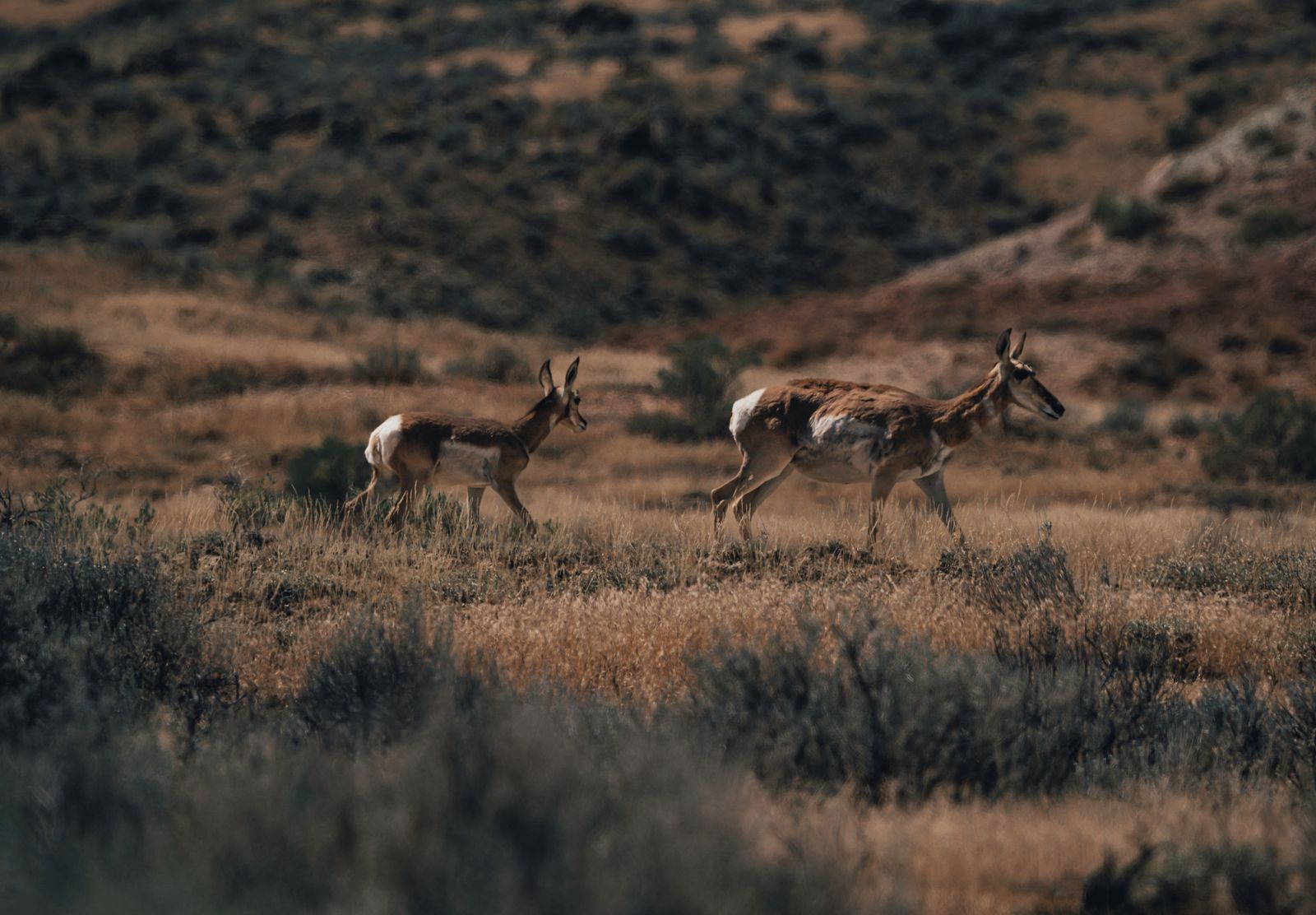
Eyes built for the open
Pronghorn eyes sit high and toward the sides of the head, producing broad peripheral coverage with only a limited area behind the animal left unseen. National Park Service material compares their eyes in size to those of a horse, but the more important adaptation is their position. A grazing pronghorn can monitor much of the surrounding landscape without repeatedly turning its head.
Human vision covers roughly 210 degrees when peripheral awareness is included. Jumping spiders reach even farther around themselves with eight eyes that collectively provide a nearly complete view, as described in a Science News Explores account of jumping-spider research. Pronghorn achieve similarly broad coverage with two laterally positioned eyes, although the two animals have very different visual systems.
For a prey animal living in open country, that geometry has a clear advantage. Threats cannot rely as easily on approaching from the side while the animal is feeding.
Four miles is an upper estimate
The often-repeated four-mile figure refers specifically to detecting movement, not resolving a distant predator in fine detail. Other National Park Service material uses a three-mile estimate, showing that the numbers should not be treated as a precise biological limit. Terrain, light, weather and the size of the moving object will all affect what an animal can detect.
There is also no need to imagine the pronghorn’s eyes as built-in binoculars. The practical advantage comes from monitoring a broad horizon and registering a change against an otherwise steady background. A distant vehicle, predator or person may become significant because it moved, even when the animal cannot identify every detail.
What jumping spiders reveal about motion
Laboratory work with jumping spiders offers a useful comparison, but not proof that pronghorn process motion in the same way. Eye-tracking experiments found that a growing oval, which could represent an approaching predator, caused the spiders’ principal eyes to shift attention. Stationary and shrinking shapes did not produce the same response.
That research illustrates why movement matters to animals with panoramic vision. It does not establish that a pronghorn retina or brain uses the same mechanism, so the comparison should remain illustrative rather than anatomical.
Why the sagebrush matters
Wyoming’s sagebrush country gives pronghorn room to use both vision and speed. Low vegetation preserves long sightlines, while broad valleys and basins provide escape routes that are unavailable in dense forest. The Red Desert and Upper Green River Basin contain some of the state’s most important seasonal habitat.
Some animals travel between winter range in the Upper Green River country and summer range in Grand Teton National Park. The National Park Service says the Path of the Pronghorn can extend up to 150 miles, taking animals through the Gros Ventre drainage and past Pinedale. Fences, roads and development create obstacles along that route.
The American cheetah story has changed
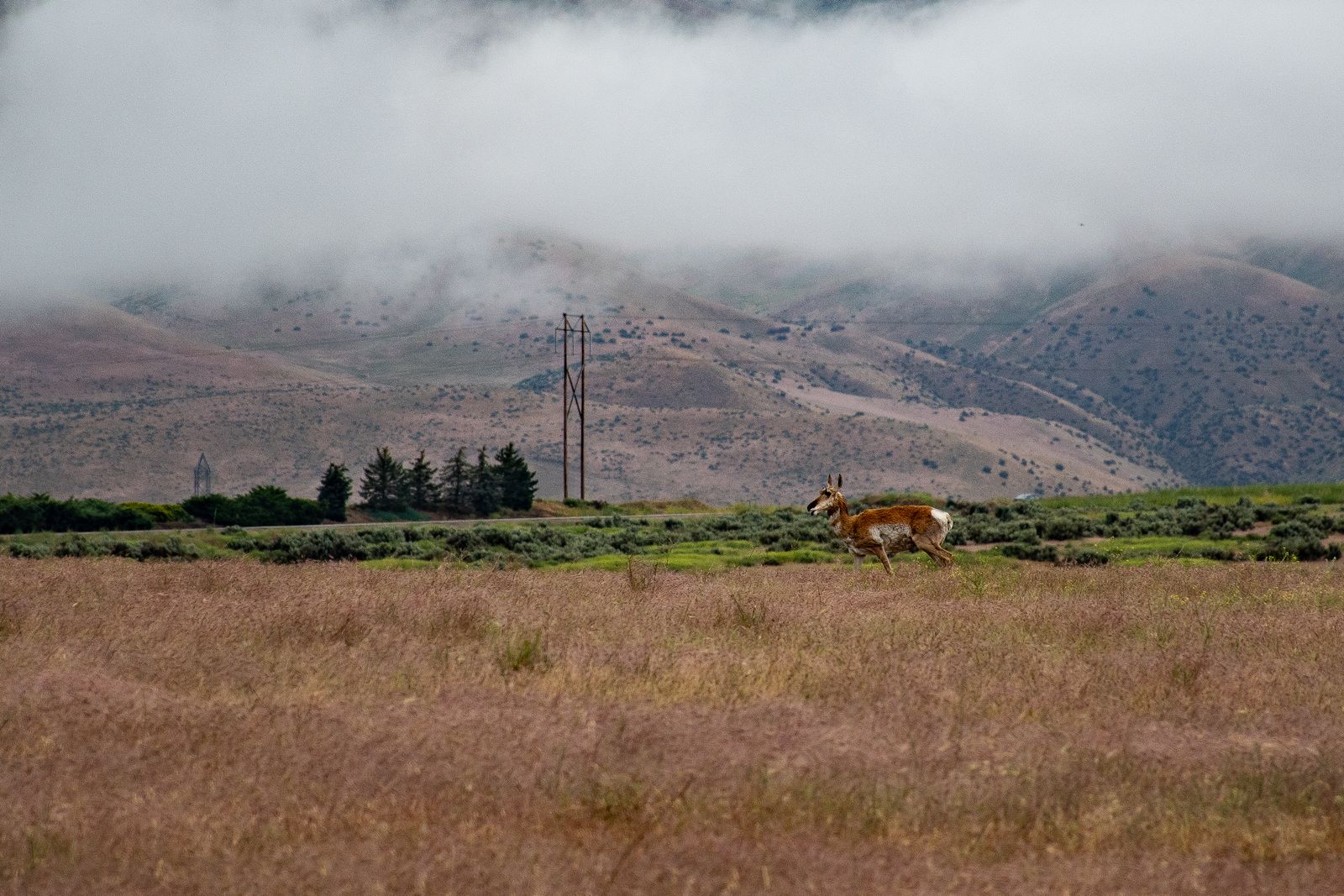
Pronghorn speed has long been explained as the product of an evolutionary contest with the extinct predator commonly called the American cheetah, Miracinonyx. Under that familiar account, modern pronghorn retained speed that no surviving North American predator could match. New fossil research makes that simple explanation much harder to defend.
A 2026 study published in the Journal of Mammalogy examined ankle bones from ancient relatives of the pronghorn. The findings, summarized in a University of Michigan research report, indicate that pronghorn relatives were developing running adaptations more than five million years before the American cheetah appeared in North America. Their speed may therefore reflect a much longer history of efficient movement through changing environments rather than an adaptation to one predator.
How other visual systems compare
Different animals solve different sensory problems. Raptors prioritize sharp central vision, while prey animals such as pronghorn benefit from broad peripheral coverage. No single ranking can capture those distinct advantages.
Bats provide another example of why simple comparisons can mislead. They use echolocation, but they do not abandon vision at night. Johns Hopkins research published in 2026 found that bats integrate vision and sonar during navigation.
Tarsiers prioritize low-light sensitivity through eyes that are exceptionally large relative to their bodies. Dartmouth researchers created a virtual-reality system called Tarsier Goggles to demonstrate differences in brightness, acuity and color perception. Bornean tarsiers also have protanopia, a form of red-green color blindness.
The fence problem
Pronghorn can jump, but they generally prefer to pass under fences rather than leap over them. That behavior turns livestock fencing into a serious migration obstacle, especially when deep or hardened snow reduces the space beneath the lowest wire. Animals can become delayed, diverted or trapped on the wrong side of critical seasonal habitat.
Wildlife-friendly designs create more room beneath the fence and replace the lowest barbed strand with smooth wire. During one Wyoming project, the Bureau of Land Management raised the bottom wire to 16 inches along approximately three miles of fencing east of Cody. The work involved the BLM, Wyoming Department of Transportation, Wyoming Game and Fish Department and local volunteers.
What the herd does with the information
Detecting movement does not automatically make a herd run. Pronghorn continually evaluate vehicles, birds, livestock and other activity around them. Their response can vary with distance, season, the presence of young and their familiarity with nearby roads or people.
When danger is recognized, a pronghorn can raise the white hairs on its rump. The conspicuous patch warns nearby animals and helps a herd coordinate its response across open ground. Broad vision therefore works alongside a visible social signal rather than operating as an isolated adaptation.
Energy development shares the landscape
Some of Wyoming’s most important pronghorn habitat also contains oil and gas development. The Sublette herd’s migration route passes through or near the Pinedale Anticline, the Jonah Field and other developed areas of western Wyoming. Roads, fences, housing and surface disturbance can reduce habitat connectivity even when animals can still see across the surrounding terrain.
In June 2026, Gov. Mark Gordon designated the Sublette Antelope Migration Corridor, creating a framework for consultation and development restrictions on state and public land. The final designation covered eight corridor segments and 12 bottlenecks, but excluded the Red Desert and East of Farson segments. It does not impose the same rules on private property.
Counting what remains
State agencies monitor pronghorn as both a wildlife-management concern and a hunted species. Oklahoma’s 2024-25 Big Game Harvest Report recorded 89 pronghorn harvested in the northwestern part of the state. The report describes Oklahoma’s Panhandle population as being at the eastern edge of the species’ native range.
Wyoming supports the country’s largest pronghorn concentrations, but individual herds can change sharply after severe winters and disease outbreaks. The Sublette herd, for example, fell from roughly 40,000 animals to about 20,000 after the winter of 2022-23. At the continental scale, the National Park Service says pronghorn numbered an estimated 35 million in the early 1800s before hunting, roads, settlement and harmful fencing drove a major decline.
A living eye in changing country
On a Wyoming sagebrush flat, a pronghorn may notice a moving person or vehicle long before the observer realizes the animal is watching. Its wide visual field, speed and alarm signals remain well suited to open ground. The modern challenge is that seeing danger does not guarantee a route around fences, highways, housing or industrial development.
The four-mile figure captures the reach of the animal’s vigilance, even if it is an approximate upper estimate. What determines the herd’s future is whether the landscape beyond that gaze remains connected enough to cross.