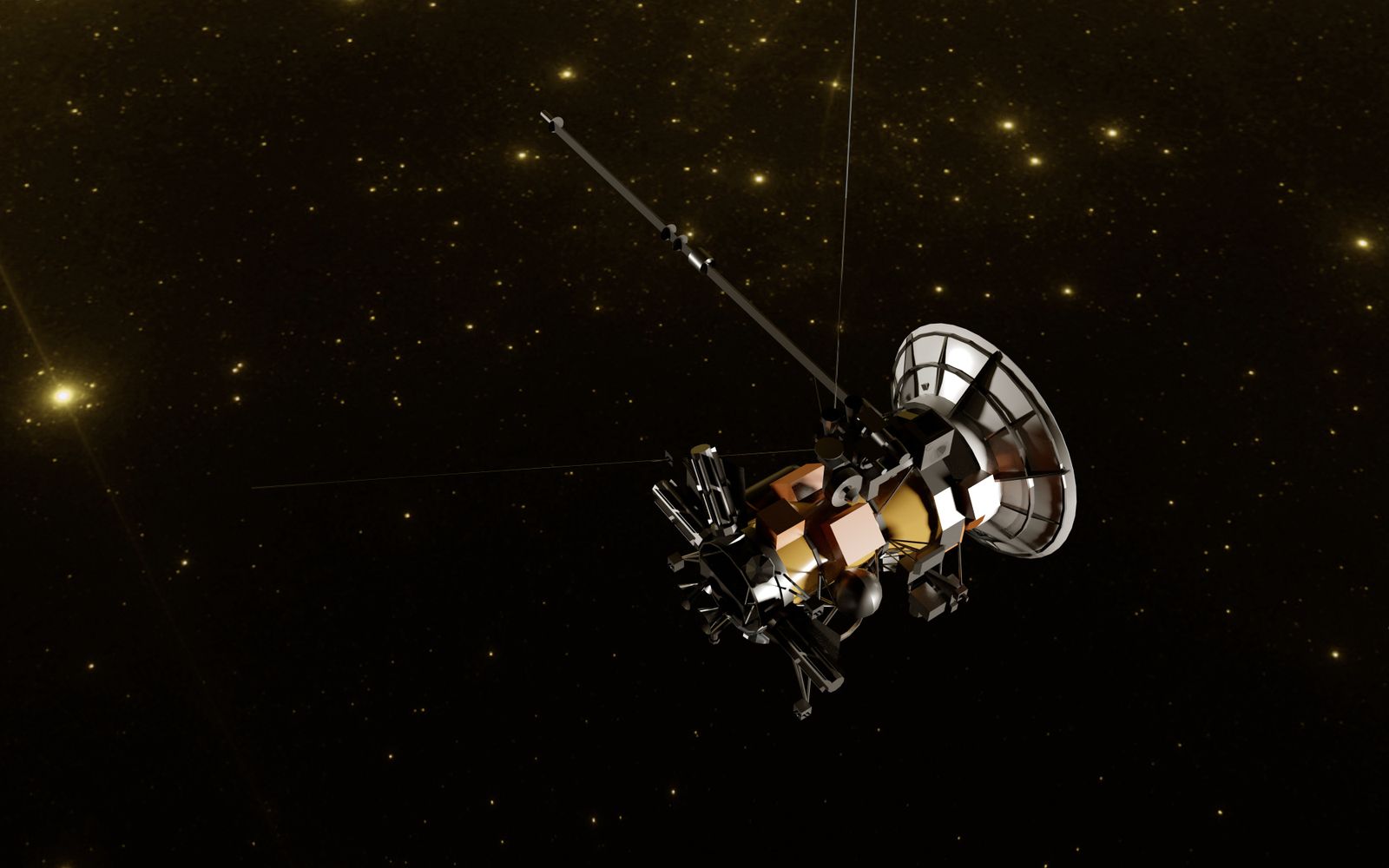
The famous 500-degree temperature span is real, but it was being attached to the wrong piece of hardware. NASA’s own spacesuit guidance says astronauts on spacewalks may encounter conditions ranging from minus 250 degrees Fahrenheit to plus 250 degrees in sunlight. That is an environmental range used for EVA design, not a measured 500-degree gradient across a spacecraft cruising to Mars.
The spacecraft itself still faces a severe thermal problem. One orientation exposes surfaces to direct solar radiation while other surfaces radiate heat toward cold space, and the balance changes with distance from the Sun, spacecraft attitude, internal power use and which instruments are running.
NASA spacesuit engineer Amy Ross has described a spacesuit as a human-shaped spacecraft because it has to solve many of the same environmental problems. In NASA’s discussion with Ross, she describes intense heating in sunlight and deep cold in shade, while the suit maintains a survivable environment inside.
Why vacuum makes thermal control different
On Earth, air moves heat by convection. Winds, clouds, oceans and the atmosphere continually redistribute energy, which is why the temperature of an object is influenced so strongly by the air surrounding it.
Interplanetary space does not provide that cushion. With essentially no surrounding gas to carry heat away by convection, the outside of a spacecraft gains and loses energy mainly through radiation. Heat can still move through the spacecraft itself by conduction, and engineers deliberately create or interrupt those pathways depending on what each component needs.
That creates a balancing act. Solar radiation heats exposed surfaces, while other surfaces radiate energy into space. Electronics add their own waste heat, batteries and propulsion hardware have allowable temperature ranges, and sensitive detectors may need to operate far colder than the equipment beside them.
The blankets do more than make spacecraft look gold
The gold and silver material wrapped around many deep-space vehicles is multi-layer insulation, or MLI. NASA’s spacecraft-systems guide describes MLI as a major form of passive thermal control, reflecting radiation to reduce solar heating while also helping retain heat generated inside the spacecraft.
The familiar gold appearance often comes from reflective aluminium behind amber-colored Kapton. The exact construction varies by mission, but the principle is consistent: instead of allowing exposed hardware to absorb and emit radiation freely, engineers control how efficiently each surface exchanges heat.
Some missions also use aerogel where an exceptionally light insulating material is useful. AZoQuantum’s review of aerospace aerogels describes NASA’s use of the material as thermal insulation on Mars rovers, including its role in protecting equipment from the cold Martian environment.
The important temperatures are often inside the spacecraft
A successful thermal design does not allow every component to follow the temperature of the surface facing space. Its purpose is almost the opposite: to create controlled thermal zones inside a vehicle that is travelling through an unforgiving environment.
Mars Express offers a useful real-world example. The European Space Agency says the spacecraft uses MLI blankets and heaters to keep most onboard equipment between 10 and 20 degrees Celsius, while infrared detectors that need to remain around minus 180 degrees Celsius are isolated and connected to coolers and radiators.
That is why there is no single cooling architecture shared by every Mars mission. Some spacecraft rely heavily on passive blankets, coatings and radiators. Others add electrical heaters, active coolers or dedicated thermal hardware where the mission demands it.
Radioisotope systems are another option, but their roles need to be distinguished carefully. NASA’s radioisotope-power overview says stand-alone radioisotope heater units provide heat on some spacecraft, while the MMRTGs used by Curiosity and Perseverance provide both power and heat to the rovers.
Some Mars spacecraft spin during cruise, but not all of them
Rotation can help a spacecraft maintain stability and can affect how sunlight falls across its surfaces, but it is not a universal Mars-flight trick.
NASA’s Perseverance mission is one example of a spinning cruise configuration. JPL’s Mars 2020 press kit says the combined spacecraft spun at about two revolutions per minute during its journey to remain stable.
InSight did something different. JPL’s InSight mission documentation explicitly says the spacecraft was not designed to use spin for cruise stability. Instead, it maintained three-axis stability using attitude sensors and intermittent thruster firings.
The contrast matters because it shows how dangerous universal statements can be in spacecraft engineering. Missions headed to the same planet can solve orientation, power and thermal-control problems in very different ways.
Arrival at Mars creates a different kind of heat
Cruise thermal control should not be confused with atmospheric-entry heating. Once an arriving lander or rover strikes the Martian atmosphere at high speed, its kinetic energy produces a short and much more intense heating event.
For Perseverance, JPL estimated that the spacecraft could encounter temperatures of about 2,370 degrees Fahrenheit, or 1,300 degrees Celsius, during descent. Its heat shield was covered in phenolic impregnated carbon ablator, or PICA, designed to carry most of that heat away from the rover.
That is a separate engineering regime from the months-long cruise. The cruise stage has to keep hardware within operating limits for a long period; the entry system has to survive an intense burst of aerodynamic heating before the parachute and descent systems take over.
Mars keeps the thermal problem alive after landing
The surface presents yet another environment. NASA’s Mars facts page gives a planetary temperature range reaching roughly 70 degrees Fahrenheit, or 20 degrees Celsius, at the warm end and about minus 225 degrees Fahrenheit, or minus 153 degrees Celsius, at the cold end.
The atmosphere is thin enough that heat is not retained the way it is on Earth. Landed spacecraft therefore combine insulation, heaters, careful energy management and, depending on the mission, radioisotope or solar power to keep electronics and batteries within allowable limits.
InSight demonstrates why the power budget matters. The mission did not end because the lander suffered a sudden thermal failure. NASA and JPL reported in December 2022 that the solar-powered lander had run out of energy after more than four years on Mars, as dust accumulation progressively reduced the energy available from its solar panels.
What the temperature story really describes
A Mars spacecraft does not spend its cruise with one plate fixed at plus 250 degrees Fahrenheit and another fixed at minus 250. The real engineering challenge is more complicated: solar heating changes with orientation and distance, internal electronics produce heat of their own, exposed surfaces radiate energy away, and individual components may require radically different operating temperatures.
Thermal engineers handle those competing demands with reflective blankets, surface coatings, radiators, conductive paths, heaters, insulation and mission-specific active systems. The goal is not to make the entire spacecraft one temperature. It is to make sure every critical component stays inside the range it can survive.
By the time a Mars spacecraft reaches the planet, that balance has been maintained automatically for months. Blankets have reflected unwanted radiation, heaters have switched on when required, radiators have shed excess energy, and the equipment inside has remained far more comfortable than the space surrounding it. That controlled interior, not a universal 500-degree hull gradient, is the quiet thermal achievement behind every successful cruise to Mars.