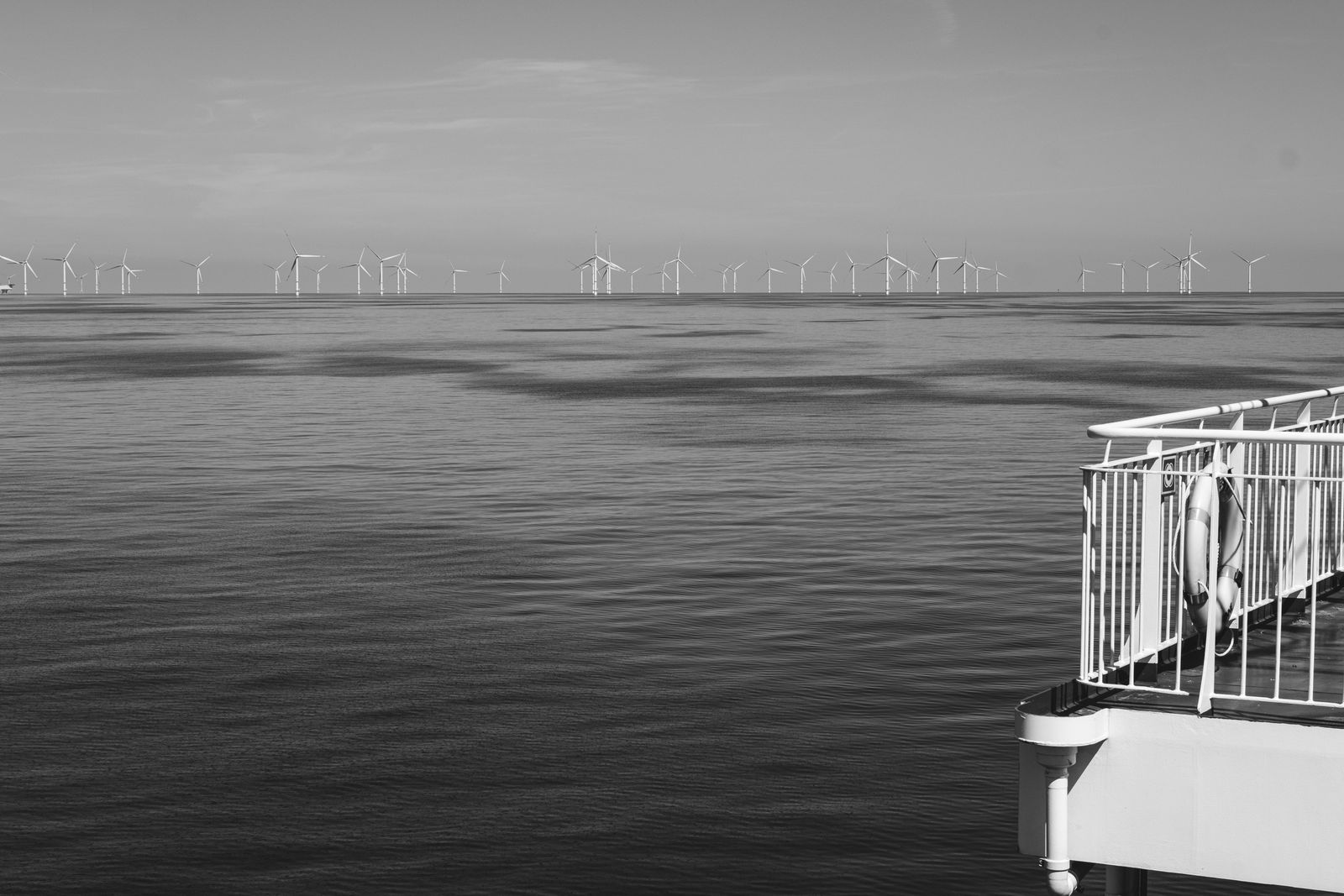
The rotor on a Siemens Gamesa SG 14-222 DD, the machine now going into the water off Virginia Beach, measures 222 metres from blade tip to blade tip. Spin it once and the swept circle covers roughly 38,700 square metres — larger than the London Eye’s 120-metre-diameter wheel by a comfortable margin, and enough moving air to generate, in Dominion Energy’s own phrasing, the power one American home uses in a full day from a single rotation.
That is one turn of one blade set. These rotors spin, on average, around ten times a minute in a decent breeze.
The blade is longer than a football pitch
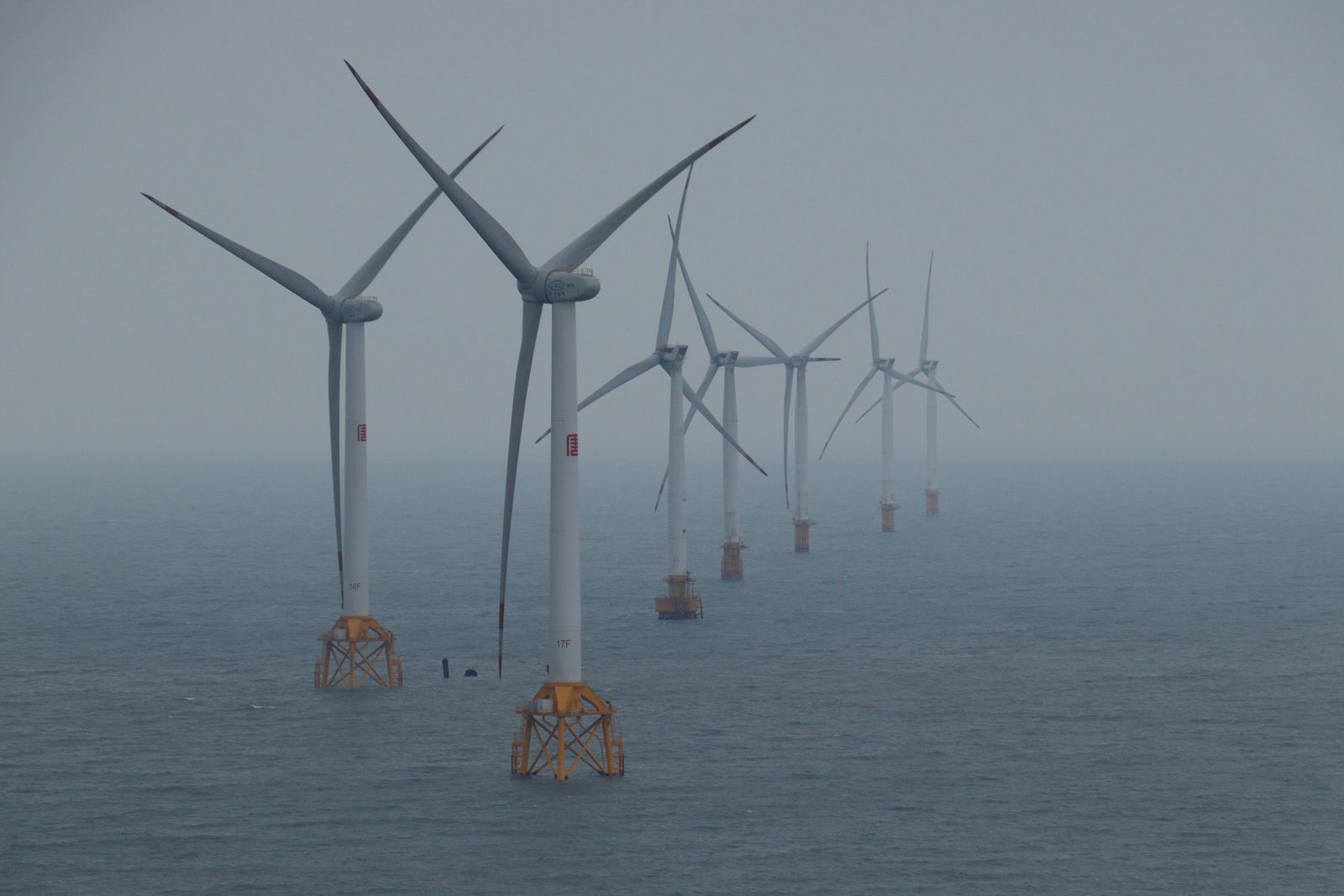
Each blade on the SG 14-222 DD stretches 108 metres from root to tip. Laid on a Premier League pitch, it would overshoot both goal lines. Bolt three of them to a hub and you get a circle of moving carbon-fibre and balsa composite that sweeps an area roughly two-thirds the size of the Colosseum floor every few seconds.
The 14.7-megawatt turbines being installed at the Coastal Virginia Offshore Wind project sit on monopile foundations weighing more than 1,000 tons each. Dominion’s contractor DEME drove 176 of those piles into the seabed with a vibro hammer, then stacked transition pieces, towers, nacelles and blades on top using the Charybdis, the first Jones Act-compliant turbine installation vessel ever built in the United States.
The vessel itself is 472 feet long and can only carry four full turbine sets at a time. That is the scale problem in one image: the boats that carry the parts are dwarfed by the parts.
Twenty thousand homes from a single machine
A 15-megawatt offshore turbine running at a capacity factor of roughly 50 percent — typical for a well-sited North Sea or mid-Atlantic location — produces around 65,000 megawatt-hours a year. A European household uses about 3,500 kilowatt-hours annually on average, which works out to somewhere in the range of 18,000 to 20,000 homes powered per turbine, depending on the country and the year’s wind.
In China, where average domestic electricity use is lower, the same maths goes further. Mingyang’s newest 20-megawatt platform is rated to power around 96,000 homes on Chinese consumption patterns. Multiple Chinese manufacturers are already developing 25-megawatt models, and Mingyang has unveiled a twin-rotor 50-megawatt configuration mounted on a single floating platform.
A decade ago, the standard offshore turbine was 6 megawatts. The jump from six to fifteen happened in about eight years.
Why the machines keep growing
Bigger rotors capture more wind, but the underlying economics are about everything except the blades. A wind farm needs foundations, subsea cables, offshore substations, installation vessels and grid connections regardless of whether the turbines on top produce 8 megawatts or 18. Doubling the power per tower roughly halves the number of every other expensive thing.
According to offshore wind analyst Sander Baksjøberget at Rystad Energy, larger turbines reduce the need for foundations, cables, and installation lifts while enabling bigger wind projects.
The United Kingdom generated close to 20 percent of its 2025 electricity from offshore wind alone, from around 3,000 turbines powering the equivalent of 15.5 million homes. Global installed offshore capacity reached roughly 92.5 gigawatts by the end of 2025, according to the Global Wind Energy Council, putting the industry within reach of the 100-gigawatt mark.
The vessel problem
There is a catch to endlessly bigger turbines. A blade 108 metres long cannot be moved by a truck without shutting down motorways, and it cannot be lifted onto a tower by a crane that fits into most existing ports. As turbines move from 11 megawatts toward 15 and 20, the fleet of jack-up vessels that installs them is running out of headroom on crane height, deck strength and leg length.
Industry analysis warns that the shift to 15-megawatt-plus turbines is already outpacing what the older generation of installation ships can handle. WindEurope and the International Marine Contractors Association have flagged looming gaps in foundation-laying vessels through 2030. More than 100,000 kilometres of subsea cable is expected to be laid between 2026 and 2040 — enough to wrap the equator two and a half times — and much of it will need specialised ships that don’t yet exist.
A wind energy professor at Denmark Technical University noted that the offshore wind sector is scaling faster than its manufacturing capacity, vessel availability, and port infrastructure can keep pace with.
What one turn actually does
The SG 14-222 DD is a direct-drive machine, meaning the rotor connects directly to a large-diameter generator with no gearbox in between. Fewer moving parts, fewer things to break in a nacelle sitting 140 metres above a saltwater environment where a helicopter is the only maintenance vehicle.
Dominion’s engineering summary puts the poetry into it: a single rotation of the blades produces enough electricity to run one American household for a full day. On a decent afternoon in the North Atlantic, that rotor turns roughly 10 times a minute. Six hundred homes an hour. Fourteen thousand homes a day.
Multiply by 176 turbines at Coastal Virginia and the array is designed to deliver up to 9.5 terawatt-hours a year — enough to cover the annual electricity needs of a mid-sized American city and, Dominion projects, save its customers around $5 billion in fuel costs over the plant’s first decade.
The rotor as a moving structure
A 108-metre blade weighs about 55 tonnes and is fabricated from layers of glass and carbon fibre bonded around structural spar caps and shear webs. Research published in Frontiers in Energy Research on composite blade health monitoring shows how these structures develop microscopic damage from repeated flexing, salt spray, lightning and — in some climates — impulsive ice shedding.
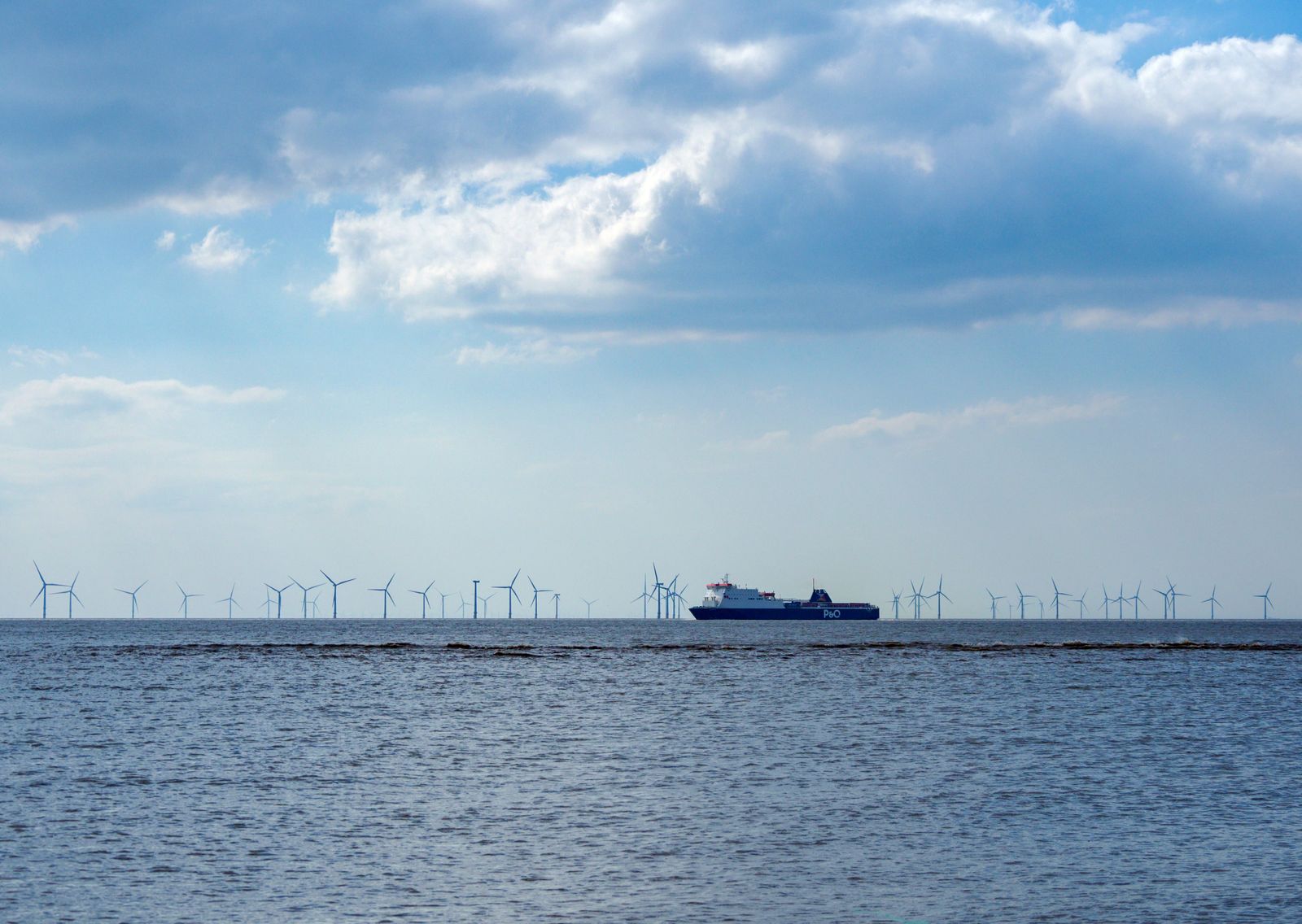
The tip of a 15-megawatt blade moves at more than 300 kilometres an hour at rated speed. That is a wing longer than the Statue of Liberty is tall, moving faster than a Formula 1 car, in the middle of the sea, for 25 years.
The engineering margins are extraordinary. The blades are pitched — twisted around their long axis — many times per revolution to unload gusts, and yaw motors turn the whole nacelle to keep the rotor facing the wind. Fault detection systems listen for guided acoustic waves travelling through the composite, hunting for delaminations before they become cracks.
A race that may need to slow down
Not everyone in the industry thinks bigger is always better. Louise Efthimiou of the World Forum Offshore Wind told Mongabay that turbine size needs to plateau at some point so that suppliers, port operators and vessel builders can standardise around a fixed set of dimensions.
Some industry experts argue that turbine size should be standardized at some point to allow the supply chain to optimize around a fixed set of technology specifications. This perspective suggests that continuing to increase turbine sizes may be counterproductive when rapid deployment is the priority.
The pressure is showing. In May 2025, Ørsted axed its 2.4-gigawatt Hornsea 4 project in the United Kingdom, citing supply chain costs and interest rates. TotalEnergies tried to walk away from 3 gigawatts of German offshore wind concessions in May 2026, citing similar pressures — though Germany’s government rejected the request the following month, leaving the dispute unresolved. Mitsubishi walked away from three Japanese sites — a story Energy Daily has tracked in detail. Government auctions awarded a record 56 gigawatts of new offshore wind capacity globally in 2024, but new site awards slowed sharply in 2025 as developers grew more cautious.
Where the next generation goes
Fixed-bottom monopile foundations only work in water shallower than about 60 metres. Beyond that, turbines have to float — tethered to the seabed by mooring lines and buoyed by ballasted platforms. Floating wind capacity today is under 300 megawatts globally, less than one percent of installed offshore wind. Norway’s Hywind Tampen, feeding power to North Sea oil and gas facilities, is the world’s largest floating farm at around 95 megawatts.
Getting floating platforms to work at commercial scale is one of the largest unsolved engineering problems in the sector. Research groups are testing everything from tension-leg platforms to semi-submersibles, and Energy Daily has looked at hybrid platforms that combine wind and wave generation on the same anchor points.
On the smaller end of the scale, vertical-axis turbines — the kind that spin around an upright shaft rather than a horizontal one — are being reworked for niche applications. Recent work at Flinders University on vertical-axis designs hints at where distributed generation could go, though nothing at that scale is competitive with a 15-megawatt monopile in open sea.
The next fifteen years
China now dominates offshore wind installations by a wide margin, adding 6.6 gigawatts in 2025 alone against Europe’s roughly 2 gigawatts. Its manufacturers are pushing turbines toward 25 megawatts a machine while Western firms consolidate around 14 to 18 megawatts, racing to match the size curve while managing warranty risk on machines that no one has yet operated for a full 25-year service life.
At Coastal Virginia, Dominion expects full commercial operation in mid-2027. The 176 turbines will feed power through nine buried export cables — a combined 350 miles — to a substation at the U.S. Naval Air Station Oceana, then inland to serve the data centre corridor that runs through northern Virginia. The array will send about 2.6 gigawatts into a grid that increasingly needs it to run AI training clusters that didn’t exist when the federal lease was first auctioned in 2013.
Somewhere out there, in a few months’ time, one of those 108-metre blades will make its first full revolution in the Atlantic wind. The tip will trace an arc bigger than the London Eye, moving faster than the fastest train on the East Coast. And by the time it comes back around to where it started, a house in Virginia Beach will have had its lights, its heating, its refrigerator and its router run for a day.
Then the blade turns again.