A steel catamaran roughly 130 metres long is now shuttling between Buenos Aires and Colonia del Sacramento across the Río de la Plata, moving passengers and their cars on stored electricity alone. No diesel stack. No exhaust plume trailing behind the wake. Just a quiet hum from the propulsion pods and a battery bank that recharges at the terminal while passengers file off.
The vessel, named China Zorrilla and built by Incat in Hobart, Tasmania for the Argentine-Uruguayan operator Buquebus, represents a significant step forward in battery-electric passenger ship design.
The scale of the jump
Until recently, the biggest fully battery-powered passenger vessels in the water carried a couple of hundred people on short hops. Flagship Cruises in San Diego, for example, is building two zero-emission ferries with California Air Resources Board grant support, each 90 feet long with room for 275 passengers. That is the class of vessel most operators consider ambitious.
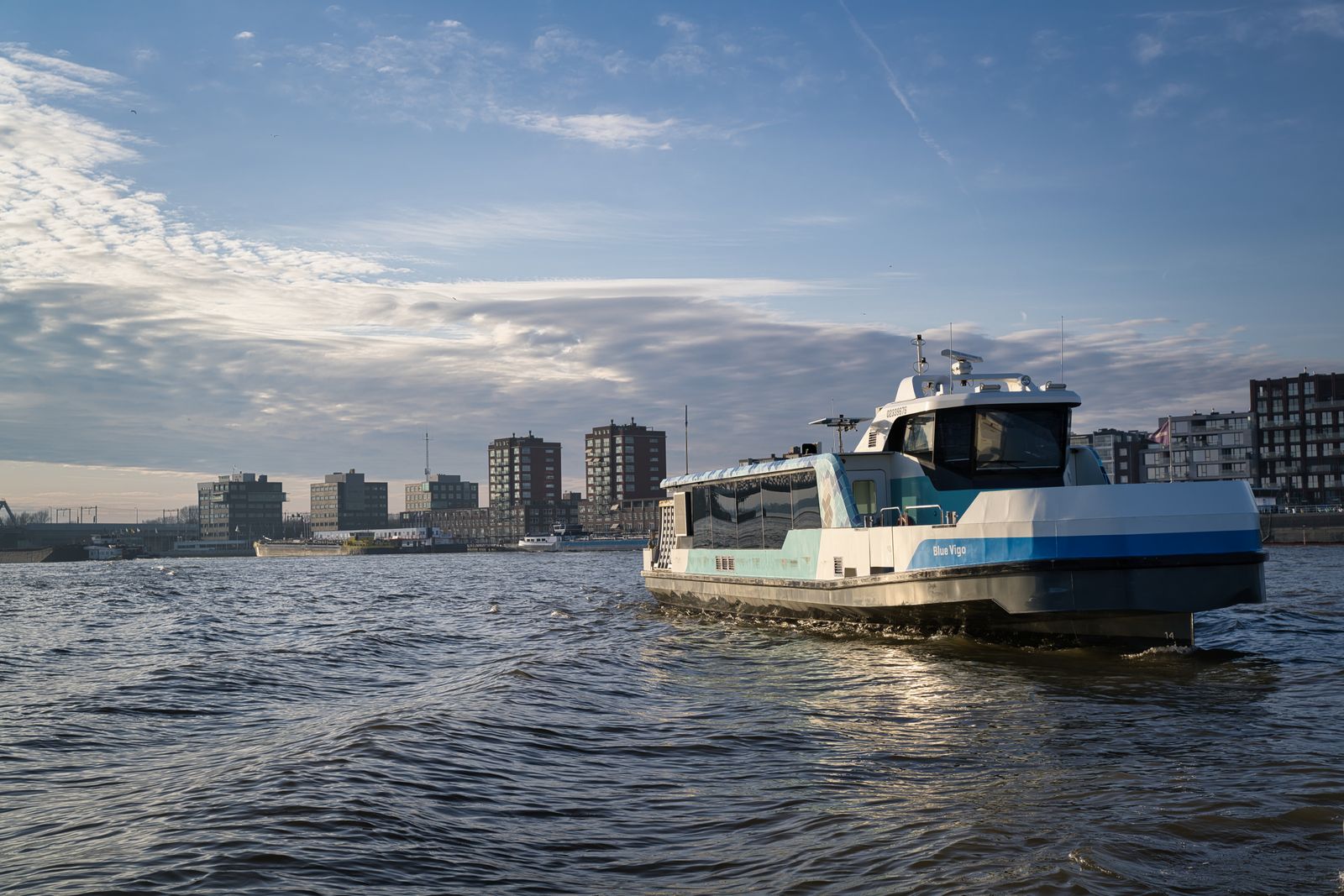
The Río de la Plata ferry is on a different order of magnitude. At around 130 metres bow to stern, it is longer than a football pitch and taller than a five-storey building at the wheelhouse.
The battery pack sits low in the twin hulls, doing double duty as ballast.
Why the Río de la Plata route works
Not every ferry route is a candidate for full electrification. The Río de la Plata crossing happens to be almost perfectly shaped for it.
The distance between the two terminals is relatively short across sheltered estuary water. The ferry does not need transoceanic range. It needs to make the crossing, dock, plug in, and go again. That duty cycle is where batteries beat combustion by a wide margin, because the vessel spends predictable hours at a berth where high-power shore charging can be installed.
Contrast that with the cruise industry, where MEYER-WERFT’s Project Vision battery-electric cruise ship concept is designed for routes like Barcelona to Civitavecchia — 500 to 550 nautical miles — and needs a hybrid generator option to handle transatlantic runs. Vision would carry about 1,856 passengers at 82,000 gross tonnes if it is ordered and delivered on schedule in 2031. The Incat ferry is smaller in tonnage and, crucially, is already sailing.
How Incat pulled it off
Incat has built aluminium high-speed catamarans for the ferry market for decades. The Hobart shipyard’s usual product is a lightweight, diesel-powered fast cat that can hit 40 knots. Swapping the diesels for electric motors was the easy part. The hard part was fitting the batteries without sinking the boat’s economics.
The company partnered with Corvus Energy, a Norwegian battery supplier with extensive experience in hybrid and fully electric seagoing vessels. Corvus makes maritime-grade lithium-ion modules with thermal runaway containment — a serious concern on a vessel carrying thousands of passengers. The battery banks on the ferry are distributed across the twin hulls, each compartment sealed and monitored, so a fault in one module can be isolated without threatening the rest.
Propulsion comes from four electric motors driving waterjets, the same configuration Incat uses on its diesel fast cats. Waterjets are efficient at cruise speeds and let the vessel operate in the shallow, silty water of the estuary without worrying about a grounded propeller.
What it replaces
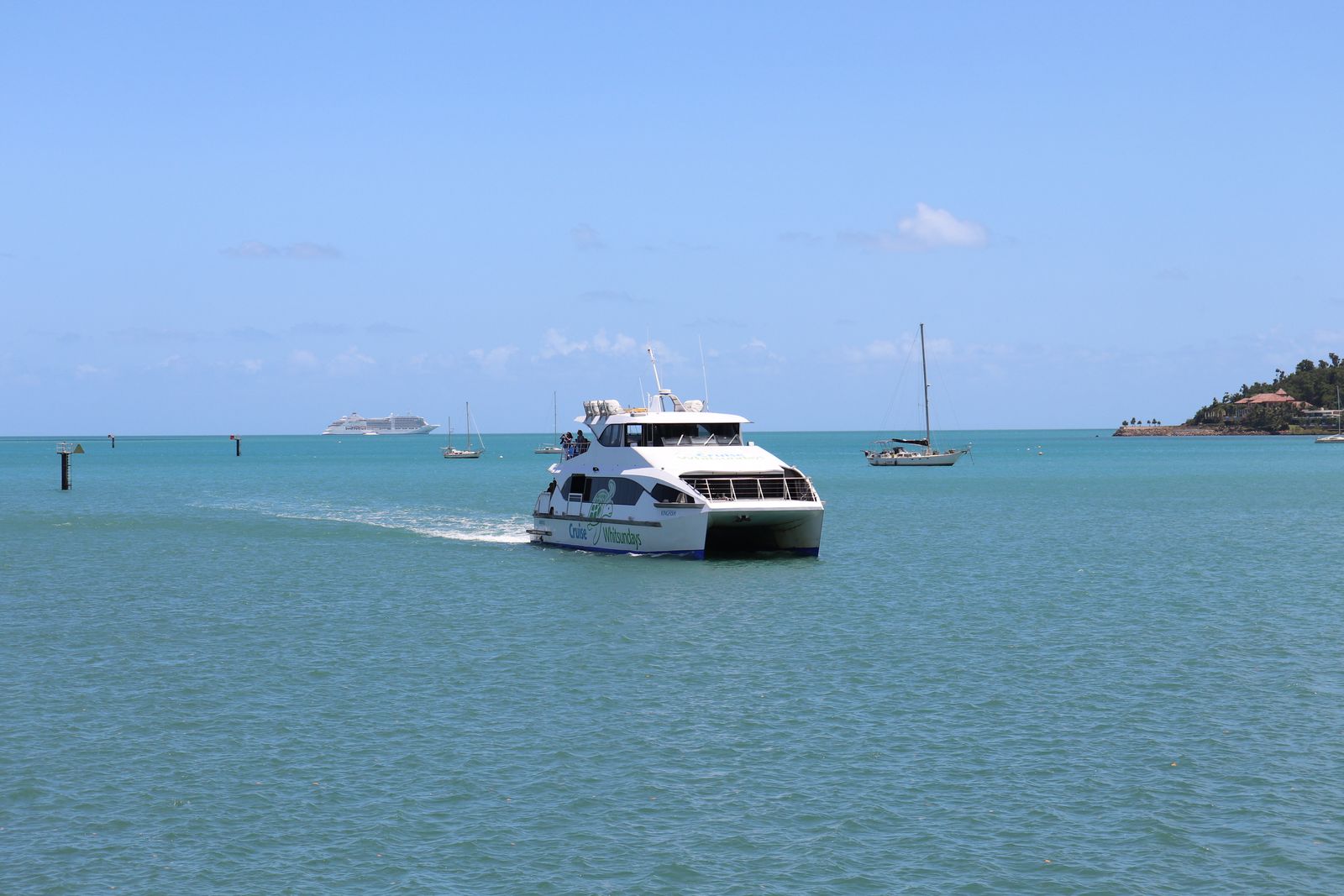
Buquebus has been running fast ferries across the Río de la Plata for decades, and the diesel versions burn a lot of fuel.
The battery-electric version emits none at the point of use. Its lifecycle emissions depend on how the electricity is generated, and Uruguay is a favourable case — the country generates the majority of its power from renewables, largely hydro and wind. Argentina’s grid is more fossil-heavy, but even accounting for grid mix, the emissions per passenger-kilometre drop substantially.
Global shipping accounts for a significant portion of planet-warming emissions, according to industry analysis of maritime decarbonisation options. Passenger ferries are a small slice of that total, but they are also the slice where batteries are ready today. Container ships crossing the Pacific are not going to run on batteries any time soon. Ferries can.
The charging problem
The ferry’s batteries are only half the engineering story. The other half is at the terminal.
Charging a large battery pack in the time it takes to unload and reload passengers requires a shore connection that can deliver tens of megawatts of power — comparable to the peak draw of a small town. Buquebus has built out high-voltage shore connections at both terminals, drawing from the local grid and, in Uruguay’s case, from a grid that is already largely decarbonised.
This is the bottleneck for scaling electric ferries elsewhere. MEYER-WERFT has said that roughly 100 European seaports will need maritime charging infrastructure by 2030 to support the fleet of electric passenger vessels now on drawing boards. Toronto is upgrading its Jack Layton Ferry Terminal in part to accommodate electric island ferries. San Francisco’s WETA has been publishing detailed technical requirements for shore-side charging as it plans its own battery-electric fleet.
None of this exists yet at the scale needed. The Río de la Plata terminals are, for now, an outlier.
What it looks like from the deck
Passengers who have taken the crossing report the same thing: it is quiet. A diesel fast cat vibrates. The deck plates hum with the low-frequency thrum of engines running at high load. Conversation happens at raised volume. On the electric version, the dominant sound is water hissing past the hulls.
The absence of a diesel funnel means more usable deck space, the same architectural advantage MEYER-WERFT highlighted for its Vision concept, where eliminating the exhaust stack frees up the sun deck entirely.
Where the concept goes next
The Río de la Plata ferry is a proof of concept scaled up to commercial reality. Whether the model spreads depends on three things: battery cost trajectories, port electrification, and route geometry.
Battery costs continue to fall. Lithium iron phosphate cells, which are less energy-dense than the nickel-manganese-cobalt chemistries used in most electric cars, are increasingly attractive for maritime use because they are cheaper, safer, and tolerate more charge cycles. A ferry that makes four round trips a day for 25 years needs a battery that can handle tens of thousands of cycles without significant degradation. LFP does that. Ni-based chemistries struggle.
Port electrification is the harder problem. It requires coordination between shipping operators, port authorities, and grid operators, and it requires capital investment that pays back only once the ferries are running. The Río de la Plata case worked because a single operator controls both terminals and both vessels, and because two national governments were willing to permit the shore-power connections.
Route geometry is the constraint that will not change. Battery-electric ferries make sense for short to medium crossings with predictable turnaround times. Beyond that, hybrid designs with small generators become the pragmatic answer, at least until battery energy density improves by another factor of two or three.
The wider signal
Energy Daily has covered the arrival of large-scale renewables at sea before — including the world’s largest offshore wind farm opening in Denmark and the first floating wind turbine off Norway. Each of those moments looked, at the time, like an outlier. Then they became the template.
The Buquebus ferry is likely to sit in the same category. Ten years from now, a 130-metre battery-electric passenger vessel may not be remarkable. Right now, it represents a significant milestone in maritime electrification.
Passengers boarding in Buenos Aires this month are stepping onto a boat that will still be crossing the estuary in the 2040s, most of its steel and aluminium unchanged, its battery packs replaced perhaps once or twice, its emissions per crossing a fraction of what the old diesels produced. The wake behind it looks the same as any other ferry’s. Everything above the waterline is quieter.