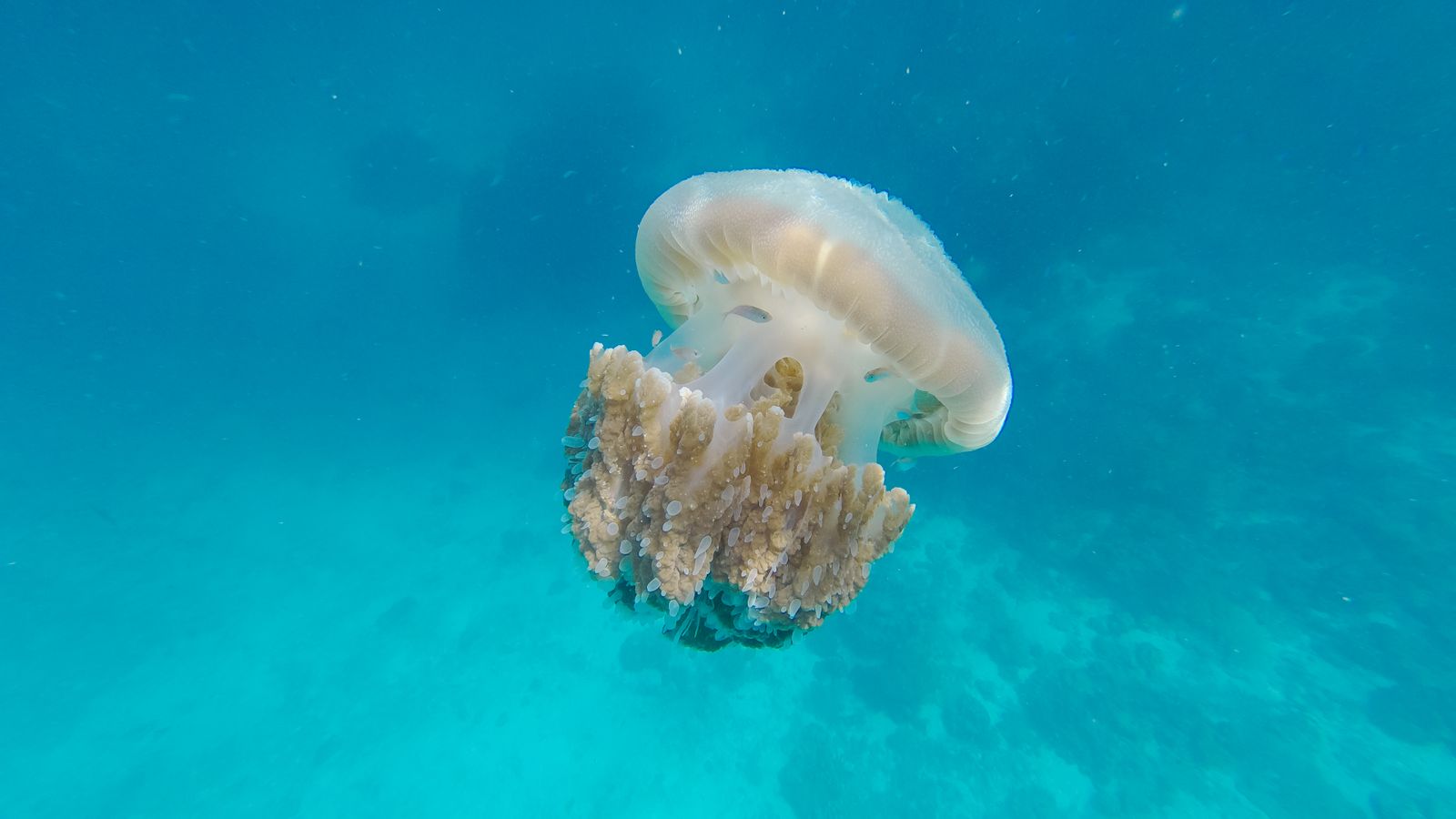
A jellyfish only a few millimetres across can respond to starvation, injury and other severe stresses by abandoning the adult body plan it has already developed. Its tentacles retract, its bell deteriorates and the animal settles onto a surface as a cyst-like mass of tissue. Over the following days, that mass reorganises into a polyp, an earlier stage of the jellyfish life cycle.
The species is Turritopsis dohrnii, commonly called the immortal jellyfish. Its adult medusa is about 4.5 millimetres across, with a translucent bell, a bright red stomach and numerous tentacles, features also described in a May 2026 Forbes explainer. The nickname is memorable, but it needs an important qualification: the animal can still be killed by predators, disease, pollution or injuries it cannot survive.
The cycle that can run backwards
Most hydrozoan jellyfish pass through a sequence of distinct life stages. A fertilised egg develops into a free-swimming planula larva, which settles on a hard surface and becomes a polyp. The polyp colony then produces medusae, the familiar bell-shaped animals that swim, feed and eventually reproduce sexually.
T. dohrnii has another route available. A stressed or damaged medusa can shrink, lose its ability to swim and settle onto a surface. It passes through a cyst-like stage before developing stolons and polyps, from which genetically matching medusae can eventually bud again.
That process is genuine rejuvenation, but T. dohrnii can no longer accurately be described as the only animal known to reverse development after reaching maturity. In 2024, researchers reported in the Proceedings of the National Academy of Sciences that the comb jelly Mnemiopsis leidyi could regress from its mature lobate form to an earlier cydippid stage following starvation or physical injury.
T. dohrnii remains exceptional because its reversal has been studied across repeated cycles and produces a polyp capable of generating another generation of medusae. It is better described as one of the clearest and most extensively studied examples of adult-to-juvenile life-cycle reversal, rather than the only animal capable of moving development backwards.
What happens to its cells
The process is commonly associated with transdifferentiation. As marine biologist Maria Pia Miglietta explains in BBC Science Focus, this is when a specialised adult cell becomes another kind of specialised adult cell. Medusa and polyp bodies contain different structures and cell types, so reversing from one form to the other requires extensive cellular and tissue-level reorganisation.
The biology is more complicated than every adult cell simply becoming an unspecialised stem cell. A 2019 transcriptomic study described transdifferentiation during the cyst stage but also noted that dedifferentiation could not be ruled out. Those processes may occur alongside programmed cell death, cell division and the reuse of surviving tissues.
The distinction matters. Transdifferentiation involves a switch from one cellular identity to another, while dedifferentiation involves a cell moving towards a less specialised state. Scientists are still working out which cells follow each route and how their behaviour is coordinated across the transforming animal.
An accidental discovery in a laboratory jar
The species itself was formally described in the nineteenth century, but its reversible life cycle was recognised much later. During the 1980s, researchers Giorgio Bavestrello and Christian Sommer collected and reared polyps from the Mediterranean. The polyps released medusae, which were expected to mature, reproduce and complete the conventional hydrozoan cycle.
Instead, polyps appeared in the container without the medusae releasing gametes and producing larvae. As recounted by The Scientist, continued observation showed that stressed medusae were forming cysts and developing directly into polyps.
Bavestrello and Sommer reported bidirectional conversion in 1992. Further experimental work led by Stefano Piraino and colleagues established that mature and immature medusae could be induced to reverse under conditions including starvation, temperature or salinity changes and physical damage.
Those experiments did more than produce an unusual life-cycle diagram. They showed that a sexually developed animal could reorganise into a much earlier body plan without passing through fertilisation and embryonic development again.
What the genome has revealed
Researchers have since begun investigating the genes and cellular programmes associated with the reversal. A 2022 comparative-genomics study assembled and compared the genomes of rejuvenating T. dohrnii and Turritopsis rubra, which was treated in the study as unable to rejuvenate at the mature stage.
The researchers reported differences affecting processes associated with DNA replication and repair, telomere maintenance, oxidative stress, stem-cell populations and communication between cells. During life-cycle reversal, they also observed changes involving genes associated with pluripotency and the control of developmental states.
Earlier transcriptomic research similarly found that the cyst stage was enriched for gene categories involving DNA repair, damage responses, telomere regulation and genome integrity. At the same time, pathways associated with specialised development, signalling and cell division were altered or suppressed.
These findings identify candidate mechanisms, not a single immortality switch. Having additional copies or different versions of a gene does not prove that the gene alone produces rejuvenation. Researchers still need to establish what those differences do in living cells and how the separate pathways interact during the transformation.
The comparison with Yamanaka factors needs caution
The jellyfish is sometimes compared with induced pluripotent stem-cell research because both involve dramatic changes in cellular identity. Shinya Yamanaka and John Gurdon shared the 2012 Nobel Prize in Physiology or Medicine for work showing that mature cells can be reprogrammed into a pluripotent state.
Homologues belonging to the Oct, Sox, Klf and Myc gene families have been identified in research on T. dohrnii. That does not yet establish that the animal relies on the same four-factor system used to create mammalian induced pluripotent stem cells, or that those genes alone drive the jellyfish’s reversal.
The safer conclusion is that both systems raise related questions about how cells retain, lose and recover developmental identities. Their molecular details, evolutionary histories and biological outcomes remain very different.
What researchers do not yet know
The most important gap is coordination. A medusa does not merely generate a patch of replacement tissue. It dismantles one body plan, passes through an intermediate form and constructs another body plan capable of feeding, growing and producing medusae.
The published genomic and transcriptomic studies identify processes that may contribute to that transformation, but they have not produced a complete cell-by-cell explanation. Researchers do not yet know which signals begin the reset, how different tissues coordinate their timing or what prevents the process from ending in a disorganised mass.
This uncertainty also makes strong claims about cancer premature. Cellular plasticity, telomere regulation and DNA repair are relevant to cancer biology, but no study has demonstrated that T. dohrnii possesses a particular tumour-suppression mechanism that humans could copy. The animal is a research model, not evidence of an available anti-cancer or anti-ageing treatment.
How many times can the reset happen?
The phrase “no known upper limit” describes an unanswered question, not a demonstrated infinity. According to the Natural History Museum in London, Shin Kubota maintained captive populations over long periods and reported colonies rejuvenating as many as ten times during a two-year period, sometimes at intervals of about a month.
Repeated reversal shows that the process is not necessarily a one-time emergency response. It does not prove that one individual can continue resetting forever. Long-term culture is demanding, and the animals must be fed, monitored and protected from the external causes of death that would normally end their lives.
No intrinsic biological ceiling has been established, but neither has limitless survival been observed. The current evidence supports the possibility of repeated rejuvenation under controlled conditions while leaving the ultimate number of possible cycles unresolved.
An accidental global traveller
T. dohrnii is associated with the Mediterranean but has been detected in widely separated waters, including areas near Japan, Panama and the Atlantic coast. Researchers have proposed that ship traffic helped disperse it, with polyps or medusae travelling in ballast water or on submerged surfaces.
Its stress response may make it a resilient passenger. An animal facing starvation or environmental disruption during a voyage could potentially enter the reversal process rather than continuing as a weakened medusa.
Populations can also differ in appearance. Tropical forms observed around Panama may possess fewer tentacles than individuals found in cooler Mediterranean or Japanese waters. Researchers have investigated whether apparently different populations belong to the same recently dispersed species, but the evolutionary and developmental reasons for their visible differences remain under study.
What the jellyfish means for human ageing
No therapy derived from Turritopsis dohrnii has been shown to reverse human ageing. Humans cannot safely dismantle their adult organs and reconstruct themselves as juveniles, and the jellyfish’s simple body plan is fundamentally different from that of a vertebrate.
The scientific value lies in the questions the animal makes experimentally accessible. Researchers can examine how genome integrity is maintained during cellular reprogramming, how developmental programmes are switched off and restarted, and how tissues establish a functioning body after extensive reorganisation.
A Business Today overview describes the process as a cellular reset that returns the animal to its polyp form. The primary literature adds an essential layer of caution: scientists are still determining which cells change identity, which molecular pathways are indispensable and whether the mechanisms can inform medicine beyond basic research.
A life cycle without a known final stage
The immortal jellyfish is not indestructible, and it is no longer the only known animal capable of reversing mature development. What makes it remarkable is the completeness and repeatability of its transformation. An adult medusa can become a cyst, develop into a polyp colony and produce medusae once again.
Laboratory observations have followed that loop repeatedly, but not indefinitely. For now, the most accurate description is also the most interesting one: Turritopsis dohrnii has a route backwards through its life cycle, and science has not yet discovered where that route finally ends.