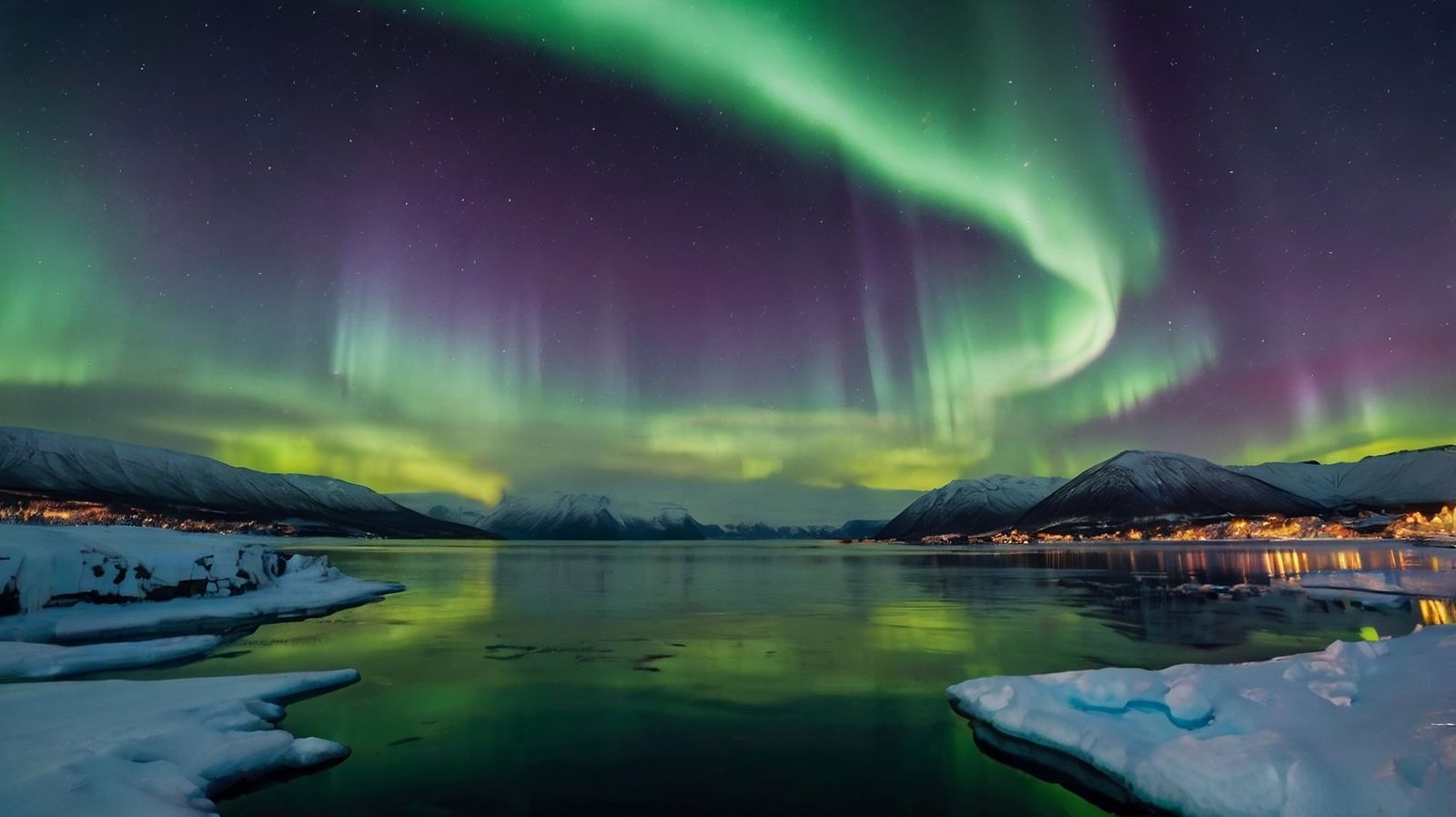
On the night of September 1, 1859, a telegraph operator in Boston pulled the batteries out of his machine and kept sending messages anyway. The wires were humming with electricity that had come from the sun. Ninety million miles away, a coronal mass ejection had ripped free of the solar corona, and now its magnetic field was reconnecting with Earth’s, dumping enough current into the copper telegraph lines running along New England railroad ties to keep the dots and dashes flowing without any local power at all. Sparks jumped from keys. Message paper caught fire. Operators reported jolts strong enough to knock them out of their chairs.
Outside, the sky was on fire too.
Auroras that normally hug the poles had slid down the planet to the Caribbean, to the Pacific, and far into the tropics. Miners in the Rocky Mountains got up and started cooking breakfast, thinking dawn had come early. In the southern hemisphere, the aurora australis reached unusually low latitudes. It was the strongest geomagnetic storm in recorded history, and it is now called the Carrington Event, after the English amateur astronomer who happened to be sketching sunspots when it started.
The five minutes that lit up the world
Richard Carrington was an heir to a brewing fortune, and obsessed enough with the sun that he had built his own observatory in Redhill, south of London. On the morning of September 1, he was projecting an image of the solar disk onto a screen and drawing sunspots when a burst of white light appeared inside one of the spot groups. Carrington later called it a “white light flare.” It was the first solar flare any human had ever knowingly observed.
The flare itself was the visible signature of something much larger — a coronal mass ejection, a billion-ton cloud of magnetized plasma hurled out of the sun’s upper atmosphere at speeds that can reach 3,000 kilometers per second. Most CMEs take two to four days to cross the gulf between the sun and Earth. This one arrived exceptionally quickly, fast enough to suggest an earlier eruption had cleared a path through the solar wind ahead of it, letting the main shock ride an empty highway toward the planet.
Carrington did something that had never been done before. He looked at his notebook, looked at the geomagnetic chaos unfolding the following night, and connected the two. Flares on the sun, he realized, could cause storms on Earth. The link is now the founding observation of space weather science.
Why the wires kept working after the batteries came out
The physics of what happened to the telegraph network on September 2 is the same physics that keeps power engineers up at night in 2026.
When a CME’s embedded magnetic field slams into Earth’s magnetosphere, it compresses the field on the day side and stretches it into a long tail on the night side. Field lines snap and reconnect. The reconnection dumps energy into the ionosphere, accelerates charged particles down field lines toward the poles, and paints the auroras.
At ground level, the rapidly changing magnetic field induces a voltage in any long conductor lying on the Earth’s surface. In 1859, the longest conductors around were telegraph lines. A wire strung from Boston to Portland became, in effect, the secondary winding of an enormous planet-scale transformer. The primary winding was the ionosphere itself. Operators didn’t need their zinc-and-copper battery cells because the storm was pushing current through the copper for them.
One American Telegraph Company exchange, recorded at the Boston office and later republished in newspapers, went like this: the Boston operator asked Portland to disconnect the battery. Portland did. Boston disconnected its own. Both offices kept sending. “We are working with the auroral current,” the Boston operator wrote. “How do you receive my writing?” Portland replied: “Better than with our batteries on.”
What people on the ground actually saw
The written accounts from that week read like descriptions of a religious event. In the tropics, where an aurora had never been seen in living memory, observers reported that the sky turned the color of blood. Newspaper editors in New Orleans wrote that they could read newsprint outside at midnight. In Washington, the light was bright enough that a policeman on his beat pulled out his watch to check the time and could read the dial without a lamp.
The Rocky Mountain gold miners are the detail that always sticks. They started making coffee. They fed their mules. Some of them had walked half a mile toward the pit before someone pointed out that the light in the sky was moving, that it had folds and curtains in it, that dawn does not glow green.
In the Southern Hemisphere, the aurora australis stretched to remarkably low latitudes. In Queensland, Australia, gold prospectors read letters by its light. According to reconstructions from historical records, the auroral oval — the ring of light that normally hovers over places like Tromsø and Yellowknife — had expanded to extraordinarily low latitudes, reaching regions where auroras had never been recorded before.
How often does a Carrington happen
The honest answer is that nobody knows for sure. The 1859 event is the largest in the roughly 165 years of instrumental record. Ice-core radionuclide data and historical proxies suggest that Carrington-class storms are rare events occurring perhaps once every few centuries. Storms of lesser but still significant intensity appear to occur more frequently.
Those numbers come with large error bars. Ice-core evidence from Greenland showed that a solar storm in 774 AD deposited radioactive beryllium-10 at levels comparable to or greater than 1859’s, and a still larger event appears to have occurred in antiquity. The sun’s capacity for extreme events may exceed what the modern instrumental record suggests.
The May 2024 storm — a G5-class event that pushed auroras into unusually low latitudes — was the strongest to hit Earth in about two decades. NASA scientists later suggested it may have been the strongest auroral display in 500 years, though it fell well short of Carrington in the ground currents it produced. Energy Daily covered the run-up in a piece on how the storm could bring auroras and telecoms disruptions, and the same active region later disturbed spacecraft at Mars, as reported in the write-up on how the storm supercharged the Martian atmosphere and knocked ESA orbiters offline.
What a Carrington-class event would do to a grid built on transformers
In 1859, the technology exposed to induced currents was a few tens of thousands of miles of iron and copper telegraph wire. The damage was measured in scorched paper and a few burned-down relay stations.
In 2026, the exposed technology is the entire high-voltage transmission network. Extra-high-voltage transformers — the refrigerator-sized-to-house-sized units that step voltages up and down at substations — are the choke points. They are custom-built, weigh hundreds of tons, and most are no longer manufactured in the United States. Replacement lead times are measured in years, and the potential economic damage of a modern Carrington-class hit could reach into the trillions of dollars in the United States alone.
The mechanism is the same one that let Boston talk to Portland without batteries. Geomagnetically induced currents flow into the grounded neutral of a high-voltage transformer. Because they are quasi-direct current, they push the transformer’s iron core into magnetic saturation. The core starts drawing enormous reactive power, heats up, and — in the worst case — melts.
A Lloyd’s of London study, working with the Atmospheric and Environmental Research agency, estimated that between 20 and 40 million Americans could lose power for periods ranging from 16 days to two years, depending on how many transformers were destroyed and how quickly replacements could be sourced.
Watching the sun watch us
The instruments that would give the modern world its warning are already in place. NOAA’s Space Weather Prediction Center in Boulder, Colorado, tracks sunspot regions daily. NASA’s Parker Solar Probe has flown inside the corona itself, closer to the sun than any spacecraft in history. The European Space Agency’s Solar Orbiter is imaging the sun’s poles. ESA’s Vigil mission, planned for launch to Lagrange Point 5, will watch active regions from a sideways vantage before they rotate to face Earth.
What none of them can do reliably is predict when the next Carrington will arrive. A CME can be spotted leaving the sun with reasonable confidence. Its speed and direction can be estimated within a few hours of arrival. What matters most for grid impact — the orientation of the magnetic field embedded in the plasma cloud — cannot be measured with confidence until the CME sweeps past the DSCOVR and ACE spacecraft at the L1 Lagrange point, roughly a million miles upstream of Earth. That gives grid operators between 15 and 60 minutes of warning.
Fifteen minutes is enough to shed load on parts of a grid, if operators have practiced the drill and the political authority is in place. It is not enough to physically disconnect and protect thousands of transformers spread across a continent.
The signature the sun leaves in ice
The 1859 event ended within about a week. The sky in the Caribbean went back to being black at night. Telegraph operators cleaned the scorch marks off their tables and got back to work. What the storm left behind, though, is still readable.
Cosmic-ray-driven radionuclides — beryllium-10, carbon-14, chlorine-36 — spike in tree rings and polar ice during large solar events. The Carrington signature is faintly visible in Greenland ice cores dated to 1859. The 774 AD event, the one that appears to have been at least Carrington-scale, left a much sharper mark; researchers pulled it out of Japanese cedar tree rings in 2012 and have been re-checking history against it ever since.
Somewhere on the sun right now, in the slow churn of Solar Cycle 25’s declining phase, there is a magnetic knot forming that will one day unwind. It may fire tomorrow, or in 2074, or in the century after that. Whenever it comes, it will make the 90-million-mile crossing in a matter of hours, and when it arrives, the auroras will slide south again — over Havana, over Honolulu, over the copper and aluminum lines that now hold up the electric century.