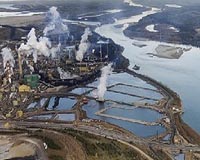
Canadian crude oil exports in the depressed energy market were down for conventional oil but up for heavier oil sands, national data show.
The National Energy Board reported exports of lighter conventional crude oil down 25 percent from January to 772,000 barrels per day in June. Compared with June 2014, total light crude oil exports are down 10 percent.
For the heavier oil sands, however, NEB data show a 6 percent increase from January to 2.2 million bpd in June and up 13.5 percent year-on-year.
In July, NEB released its report on full-year 2014 production. Though crude oil prices fell roughly 50 percent from June 2014 to year's end, the NEB said the energy sector was resilient and export revenue of $100 billion set a record.
Kevin Birn, a director of Canadian oil markets for the IHS Energy group, said in response to email questions the country's oil sector may be diverse enough to weather the weak market for crude oil.
"While convention supply will decline, oil sands is anticipated to continue to grow," he said. "IHS expects to see 800,000 bpd of new supply from the oil sands by 2020. This will likely over shadow any conventional decline rate."
Lower crude oil prices in 2015 have crimped spending in the energy sector. The Canadian Association of Oilwell Drilling Contractors said earlier this year it was revising downward its drilling forecast because of lower crude oil prices and changing market conditions in the resource-rich province of Alberta.
Nevertheless, Birn said not to expect any net reductions from Canada.
Canada relies heavily on export revenue from oil and natural gas. Most of the crude oil exported from Canada heads to the United States. In a weekly status report, the U.S. Energy Information Administration reported total U.S. crude oil imports averaged 7.2 million bpd for the week ending Aug. 21, down more than 10 percent from the previous week. From Canada, total crude oil imports were down 13.5 percent from the previous week.
Statistics Canada, the government's statistics office said real gross domestic product in Canada slipped 0.2 percent in May, the fifth straight month for declines and a sign the Canadian economy is moving into formal recession.
In terms of value, the statistics office said the value of energy products increased 3.7 percent in June to $6 billion, though overall volumes for the month decreased by 0.7 percent.
Regulator orders 95 Nexen pipelines suspended in Canada
Montreal (AFP) Aug 29, 2015 –
The oil and gas producer Nexen Energy, a Canadian subsidiary of China's CNOOC, was forced to suspend operations Saturday at 95 pipelines after a major leak last month.
The leak in Alberta, western Canada, spilled some 31,500 barrels (five million liters) of oil sands, prompting concern and criticism from environmental groups.
The Alberta Energy Regulator (AER) ordered the immediate suspension after it accused Nexen of "noncompliant activities" at the firm's Long Lake oil-sands operations in terms of maintenance and monitoring.
Nexen will have to provide documentation to assure the agency that it can operate the pipelines safely.
"Protection of public safety and the environment are the AER's top priority," said Jim Ellis, AER president and CEO.
"Given that this company has already had a pipeline failure at this site, the AER will not lift this suspension until Nexen can demonstrate that they can be operated safely and within all regulatory requirements.
"We will accept no less than concrete evidence."
Nexen had said previously that no injuries occurred as a result of the spill and that the problem pipeline had been "isolated."
Greenpeace says the spill is just the latest evidence of environmental risks posed by the controversial practice of extracting oil from tar sands.
Critics blame massive growth in the Alberta oil sands for a spike in Canadian CO2 emissions that have contributed to Canada's failure to meet its international obligations to curb global warming.