
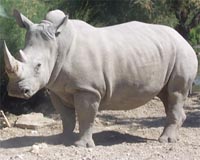
New research into the calls of young southern white rhinos suggest the rhinoceros calves boast a larger repertoire of vocalizations than previously thought.
As detailed in a new paper in the journal PLOS One, young southern white rhinos deploy four different vocalizations. Their choice of call depends on the behavioral context.
By comparing the calls of young rhinos to adults, scientists can gain a better understanding of how species learn to communicate. Researchers recorded the calls of eight rhino calves living in zoos in Germany, all between 1 and 4 years old. Seven of the eight were reared by their mother, while zookeepers hand-reared the eighth.
Their observations and recordings revealed four unique calls: a whine, snort, threat and pant.
Whines, used to express hunger for mom's milk, were deployed less frequently as the rhinos matured. Snorts, threats and pants were used in different social contexts.
The hand-reared rhino used vocalizations similar to the others in the same range of social scenarios, suggesting at least some of the animal's communication abilities are inborn.
Southern white rhinos, the most abundant subspecies of the white rhino, are more social than other rhinos. The additional time young rhinos spend with their moms might encourage more dynamic communication abilities.
"Our study provides first systematic data on vocal communication of infant and juvenile white rhinoceros and first evidence that there is a strong innate component to the development of vocal usage and production in white rhinoceros," Sabrina Linn, researcher at the University of Veterinary Medicine Hannover, said in a news release.
Pine martens are helping curb the gray squirrel invasion in Britain
Washington (UPI) Mar 7, 2018 –
Conservationists and ecologists have been searching for ways to control the growth of gray squirrel populations across the British Isles. New research suggests they're getting some help from a native predator, the pine marten.
Scientists wanted to find out what environmental factors were linked with the successes and failures of the invasive North American gray squirrel. Why has the squirrel's invasion been more successful in some places and less successful in others?
The gray squirrel is outcompeting native red squirrel populations for resources, leading to a decline in the species. Researchers want to identify ways to better protect the red squirrel.
In analyzing the parameters of the gray squirrel invasion in Scotland, scientists found pine martens are helping to suppress the gray squirrel numbers. The data also showed a correlation between the presence of pine martens and the recovery of local red squirrel populations.
The European pine marten belongs to the mustelid family; the species most closely resembles a mink or weasel.
"Our state-of-the-art analysis suggests that we can achieve conservation objectives twice over by allowing a native species, the pine marten, to spread naturally while conserving our precious red squirrel," Christopher Sutherland, a researcher at the University of Massachusetts Amherst, said in a news release.
Scientists set feeder traps to collect DNA samples from squirrels and pine martens, allowing researchers to estimate the densities of the different animals. They used the data to build a complex model analyzing the interactions between the three species.
The data — detailed in the journal Proceedings of the Royal Society B — revealed the positive ecological impact of the pine marten, a traditional enemy of the red squirrel.
"The findings of this research are extremely encouraging," said Kenny Kortland, a species ecologist for Forest Enterprise Scotland. "It seems we have a very welcome ally in our efforts to protect red squirrel populations on the national forest estate. The research demonstrates that the return of native predators can have beneficial impacts for other native species."
