
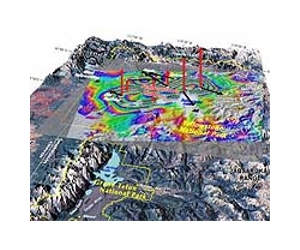
Scientists say a new measurement of the underground plume of partly molten rock feeding the Yellowstone supervolcano shows it's larger than previously thought.
University of Utah geophysicists say a large-scale image of the electrical conductivity of the underground plume suggests it's bigger than in earlier images made by measuring earthquake waves, The Salt Lake Tribune reported Monday.
"It's like comparing ultrasound and MRI in the human body; they are different imaging technologies," geophysics professor Michael Zhdanov said.
In December 2009, Utah geophysicist Robert B. Smith used seismic waves from earthquakes to make detailed images of the "hotspot" plumbing that feeds the Yellowstone volcano.
In the new study, images of the Yellowstone plume were recorded from the plume's electrical conductivity generated by molten silicate rocks and hot briny water mixed in the partly molten rock.
"It's a bigger size" in the geoelectric picture, Smith, co-author of the new study, said. "We can infer there are more fluids" than shown by seismic images.
Share This Article With Planet Earth
