
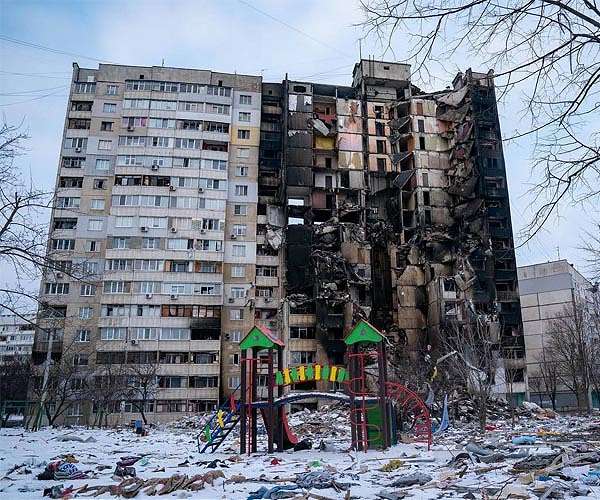
World leaders on Sunday backed Ukraine's independence and territorial integrity, and the need for eventual talks with Russia on ending the war — but left the key questions of how and when unresolved.
More than two years after Russia invaded, leaders and top officials from more than 90 states spent the weekend at a Swiss mountainside resort for a two-day summit dedicated to resolving the largest European conflict since World War II.
Ukrainian President Volodymyr Zelensky hailed the diplomatic "success" of the event, to which Russia was not invited. The path was open for a second peace summit, with a view to ending the war with a just and lasting settlement, he added.
"Russia and their leadership are not ready for a just peace," Zelensky told the closing news conference.
"Russia can start negotiations with us even tomorrow without waiting for anything — if they leave our legal territories."
Moscow, meanwhile, doubled down on its demand for Kyiv's effective surrender as a starting point for negotiations.
– 'Challenging' road ahead –
"Reaching peace requires the involvement of and dialogue between all parties," said the summit's final communique, backed by the vast majority of countries that attended the gathering at the Burgenstock complex overlooking Lake Lucerne.
The document also reaffirmed a commitment to the "sovereignty, independence and territorial integrity of all states, including Ukraine, within their internationally recognised borders".
Any threat or use of nuclear weapons in the war was "inadmissible", and food security "must not be weaponised", it added.
The declaration also urged a full exchange of prisoners of war and the return to Ukraine of "all deported and unlawfully displaced children", and other unlawfully detained Ukrainian civilians.
But not all attendees backed the joint communique. India, Saudi Arabia and the United Arab Emirates were among those who did not appear on a list of states endorsing it.
Pavan Kapoor, the head of India's delegation to the summit, said New Delhi continued to believe that peace "requires bringing together all stakeholders and a sincere and practical engagement between the two parties to the conflict".
While the declaration committed countries to taking "concrete steps… to further engagement of the representatives of all parties", it was still not clear how Russia was to be brought into the process.
"The road ahead is long and challenging," Swiss President Viola Amherd conceded.
– Kremlin reiterates Putin call –
Posting on social media platform X, Zelensky wrote: "It's important that all Summit participants supported Ukraine's territorial integrity because there will be no lasting peace without it."
But the summit came as Ukraine, outmanned and outgunned, is struggling on the battlefield.
Zelensky said the current level of Western military aid was not enough to ensure Kyiv wins the war.
"There is aid. There are serious packages. Is it enough to win? No. Is it late? Yes," he told reporters.
On Friday, Putin demanded Kyiv's effective surrender as a basis for peace talks.
His call for Ukraine to withdraw its troops from the south and east of the country, which Russia claims to have annexed, was widely dismissed at the summit.
The Kremlin nonetheless on Sunday insisted that Ukraine should "reflect" on Putin's demands, citing the military situation on the ground.
"The current dynamic of the situation at the front shows us clearly that it's continuing to worsen for the Ukrainians," Kremlin spokesman Dmitry Peskov said.
"It's probable that a politician who puts the interests of his country above his own and those of his masters would reflect on such a proposal."
Russia on Sunday claimed its troops had captured Zagrine village in southern Ukraine, continuing its progress on the front line.
– Children, nuclear fears –
The Burgenstock talks were framed around areas of common ground between Zelensky's 10-point peace plan presented in late 2022, and a 2023 UN resolution on the war that passed with the support of 141 countries.
Switzerland set a tight remit to try to garner the broadest support by sticking firmly to topics covered by international law and the United Nations Charter — and from there, sketch out a framework towards a lasting peace.
The summit focused on Sunday on food security and freedom of navigation on the Black Sea; nuclear safety and security to curb the risk of a disaster; and humanitarian issues including the return of deported children or the welfare of POWs.
Standing beside Zelensky, Chilean President Gabriel Boric told the closing press conference that the summit was not about NATO, left or right political convictions, or North versus South debates.
"This is about respect of international law and human rights as foundational principles of our living together. And this is applicable in Ukraine, in Gaza and in every other conflict in the world," he said.
Ghana's President Nana Akufo-Addo stressed the war's impact on food exports from Ukraine and how the conflict had sent inflation soaring, harming living standards in some of the world's poorest countries.
"The consequences of the invasion go far beyond the confines of Europe," he said. "Indeed in many ways, Africa has been the greatest victim."
Akufo-Addo said a method should be found whereby Russia and China join in the talks process "if we're ever going to arrive at a definitive settlement".
Zelensky called for Beijing, which refused to send a delegation to the summit due to Russia's absence, to engage seriously with the developing peace proposals.
Key points from Ukraine summit joint communique
Burgenstock, Switzerland (AFP) June 16, 2024 –
Dozens of countries agreed Sunday dialogue "between all parties" and respect for Ukraine's territorial integrity as a route to ending the war between Kyiv and Moscow.
The vast majority of the more than 90 countries taking part in a summit in Switzerland supported a final communique that also urged the return of deported Ukrainian children and a full exchange of captured soldiers.
But the document was not endorsed by some countries that maintain close ties with Russia, like India, Saudi Arabia and the United Arab Emirates.
Here are the key points from the document:
– Russia's war –
Russia is blamed for unleashing the war on Ukraine and the document noted the devastation the invasion had wrought as it called for a "comprehensive" peace settlement.
"The ongoing war of the Russian Federation against Ukraine continues to cause large-scale human suffering and destruction, and to create risks and crises with global repercussions," the document said.
– 'Territorial integrity' –
The countries said they "reaffirm our commitment to… the principles of sovereignty, independence, and territorial integrity of all states, including Ukraine, within their internationally recognised borders."
Russia currently controls just under a fifth of Ukraine, including the Crimean peninsula it annexed in 2014.
– Release of children, prisoners –
There was also a call for the full exchange of captured soldiers and for all Ukrainian children deported to Russia and Russian-controlled territory to be returned home.
Kyiv has accused Moscow of illegally abducting almost 20,000 children since the start of the conflict — the Kremlin says it moved them for their own protection.
"All prisoners of war must be released by complete exchange," the document stated.
"All deported and unlawfully displaced Ukrainian children, and all other Ukrainian civilians who were unlawfully detained, must be returned to Ukraine," it added.
– Nuclear safety –
The summit called for Ukraine to have "full sovereign control" of the Zaporizhzhia nuclear power plant, Europe's largest atomic energy site that is currently controlled by Russian forces.
The International Atomic Energy Agency (IAEA) has repeatedly warned of the risk of a major nuclear disaster at the facility, controlled by Russian forces since the start of the war.
"Ukrainian nuclear power plants and installations, including Zaporizhzhia Nuclear Power Plant, must operate safely and securely under full sovereign control of Ukraine," the final communique stated.
The countries also expressed concern over the possibility the conflict could turn nuclear, condemning the possibility of nuclear weapons being used.
"Any threat or use of nuclear weapons in the context of the ongoing war against Ukraine is inadmissible," the document stated.
– Food security –
On issues related to food and agricultural trade, the communique said: "Food security must not be weaponised in any way. Ukrainian agricultural products should be securely and freely provided to interested third countries."
Ukraine is one of the world's major agricultural producers and exporters, but Russia's invasion has complicated its exports through the Black Sea, which has become a battle zone.
"Free, full and safe commercial navigation, as well as access to sea ports in the Black and Azov Seas, are critical," the final document stated.
It added: "Attacks on merchant ships in ports and along the entire route, as well as against civilian ports and civilian port infrastructure, are unacceptable."
– 'All parties' –
The document also suggested future talks on a framework for peace would need to include Russia.
"We believe that reaching peace requires the involvement of and dialogue between all parties," the joint declaration stated.
It said the summit's attendees had "decided to undertake concrete steps in the future in the above-mentioned areas with further engagement of the representatives of all parties".
