
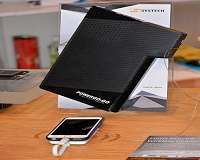
The wireless charging wars have just heated up, thanks to new innovations in one of the two dominant industry protocols. Hong-Kong-based Systech Electronics is helping to make the case for the so-called "A4WP" (Alliance for Wireless Power) standard with its next generation PowerGO-GO series of chargers, which it showcased recently in Hong Kong.
Systech's SW003 charging unit is a breakthrough; mounting under a thick wooden or glass surface, the guts of the machine remain hidden well out of view. With a 35mm effective range, laptops and smartphones needn't been directly on top, or too near to the machine to work, while multiple devices can be serviced on one Systech station.
Other new, semi-portable designs sport 30W power transmitters with 135 x 100mm recharge areas – wide enough for any standard laptop. All of the tech is based on the company's recent partnership with WiTricity, which authored A4WP. WiTricity made waves in 2015 with its first iPhone 5/5s wireless charging system.
At its core, A4WP uses an inductive power transfer technique with a relatively large area for its magnetic field. This enables the device positioning requirements to be less critical than with other systems; gadgets placed within the inductor ring don't have to line up perfectly with the coil. Mounted chargers can also be built deeper into other objects.
A4WP has a developing cadre of fans and large industry support, but the protocol is currently in a pitched battle with the Qi standard backed by the Wireless Power Consortium (WPC), which commands much popularity with mobile device users. While A4WP tries to build momentum by appealing to consumers, Qi utilizes a "push" strategy, enticing more manufacturers to adopt its standard.
Continuing innovations from Systech or other A4WP members may eventually swing the balance. Many are waiting for Apple to weigh in on its preference; while numerous phones feature wireless charging, the iPhone 7 still needs to be plugged in.
"Many wireless makers back both competing standards, so it's unlikely that a single unified wireless recharge system will emerge any time soon," says Systech CEO Patrick Lee. "New methods are also being developed all the time. But for now, the basic technology is officially in the mainstream. People are unlikely to go back to cables and power cords again."
