
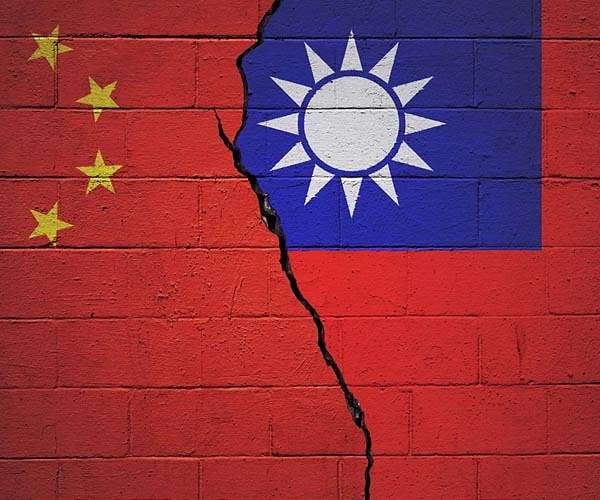
Tensions have soared in recent weeks over Taiwan, the self-governing democracy claimed by China — and allied with the United States.
How far the tensions will accelerate — and what the US response will be — is hotly debated among experts.
– What is each side's position? –
China's communist government considers Taiwan a province awaiting reunification, by force if necessary.
China's nationalist Kuomintang fled to the island in 1949 after losing the mainland's civil war. The island of 24 million people has since transformed into a vibrant democracy and major tech hub, leading many — including President Tsai Ing-wen — to assert Taiwan's separate identity.
The United States switched recognition from Taipei to Beijing in 1979, concluding that the Kuomintang was never going to retake the mainland, which has developed into one of the world's top powers and key rival of Washington.
The US Congress in 1979 required the United States to provide Taiwan weapons for its self-defense but Washington has remained deliberately ambiguous on whether it would defend Taiwan in an invasion.
– Why are tensions rising? –
President Xi Jinping has asserted Chinese nationalism and following protests in Hong Kong has clamped down sharply on freedoms in the financial hub, which had been promised a separate system before its handover from Britain.
"Beijing's dramatic demolition of that model in Hong Kong has had a significant impact on attitudes of many in Taiwan, even among those who might previously have been in favor of closer cultural or economic cross-strait ties," said Carl Minzner, a senior fellow at the Council on Foreign Relations.
Tsai easily won re-election last year in what formerly was a closely divided population.
China has dramatically ramped up military activities in recent years, with a record number of planes intruding near the island in early October.
– What is China's goal? –
Concerns have grown in the United States that Beijing is readying a full-scale invasion of Taiwan, although many experts reject the fears as overstated.
"In the last year, there has been a recognition that the Chinese military has either already achieved or is very close to achieving the capability of invading and controlling Taiwan," said Bonnie Glaser, Asia director at the German Marshall Fund of the United States.
"For a long time, this was considered to be a real factor," she said.
She pointed to worrisome signs including exercises that simulate bombing runs against Taiwanese ports or landings.
Glaser, however, is among those who doubt that China has a timetable to invade. Taiwan is the only issue that could bring the United States and China to war — which could escalate to the nuclear level.
"Having a military confrontation with the United States is something that China has tried to avoid for years," Glaser said.
Xi would "be putting at risk all of the other goals that he has for his country," she said.
"China's goal, in my view, is one of instilling psychological despair among the people of Taiwan so that they essentially give up and say, well, we will just have to concede to Beijing and become part of China. So they really want to win without bloodshed."
– What will US do? –
A growing number of pundits, notably Richard Haass, president of the Council on Foreign Relations, have called on the United States to move away from its "strategic ambiguity" on Taiwan and instead to warn China explicitly that the United States will intervene if there is an invasion.
Critics say that such a vow would backfire, with Chinese leaders already convinced that the United States is encouraging Taiwan's pro-independence forces, despite repeated US assurances that it only recognizes Beijing.
President Joe Biden on October 21 triggered Chinese warnings when he said that the United States would defend Taiwan, although the White House quickly clarified that he was not changing policy.
For now, the Biden administration appears to be seeking steps to support Taiwan without triggering a crisis, such as encouraging its inclusion in international institutions.
Tsai voiced confidence in a CNN interview this week. Asked if the United States would defend Taiwan, she said, "I do have faith."
Taiwan-China relations since 1949
Taipei (AFP) Oct 28, 2021 –
As tensions spike between mainland China and Taiwan, here are key dates in decades of fraught relations:
– 1949: separation –
Mao Zedong's communists take power in Beijing in October 1949 after defeating Chiang Kai-shek's Kuomintang (KMT) nationalists in a civil war.
The KMT flee to the island of Taiwan and form their own government in Taipei in December, cutting off contacts with mainland China.
In 1950, Taiwan becomes an ally of the United States, which is at war with Communist China in Korea. It deploys a fleet in the Taiwan Strait between the two to protect its ally from possible attack from the mainland.
– 1971: Beijing gets UN nod –
In October 1971, Beijing takes over China's seat at the United Nations, previously held by Taipei.
In 1979, the United States establishes diplomatic relations with China but also commits to assist the defence of Taiwan. It backs the policy of "one China", with Beijing as the legitimate government, but establishes trade and military ties with Taipei.
– 1987-2016: fragile reconciliation –
In late 1987, Taiwan residents are for the first time permitted to visit China, allowing families to reunite and leading to a boom in trade.
In 1991, Taiwan lifts emergency rule, unilaterally ending a state of war with China. The first direct talks between the two sides are held in Singapore two years later.
But in 1995, Beijing suspends talks in protest at a visit by Taiwanese president Lee Teng-hui to the United States.
In 1996, China tests missiles off Taiwan to deter voters in the island's first democratic presidential election.
In 2000 elections, the KMT loses power in Taiwan for the first time and over the next five years trade links between the two sides improve, first by sea and then via air.
In March 2005, Beijing adopts a law which makes secession by Taiwan illegal at the risk of military action. In April, there is the first meeting since 1949 of the leaders of the KMT and Communist Party of China.
In 2008, Taiwan and China resume high-level talks after the KMT's Ma Ying-jeou is elected president on a Beijing-friendly platform.
In 2010, they sign a sweeping Economic Cooperation Framework Agreement; in 2014 they hold the first government-to-government talks since separation.
In 2015, the leaders of both sides meet in Singapore, shaking hands and waving enthusiastically to a huge press throng but refraining from any joint statement.
– 2016: End of the honeymoon –
In January 2016, opposition candidate Tsai Ing-wen, from the traditionally pro-independence Democratic Progressive Party, wins presidential elections. The day of her inauguration in May, China cautions that peace would be "impossible" if she makes any moves to formally break away.
In June, China suspends all communications with Taiwan after the island's new government fails to acknowledge the concept that there is only "one China".
In December 2016, president-elect Donald Trump breaks with decades of US diplomatic policy by speaking directly, by telephone, with Taiwan President Tsai Ing-wen. In 2017, Trump's administration approves $1.3 billion worth of arms sales to Taiwan.
In March 2018, the United States adopts a law reinforcing ties with Taiwan, again infuriating China.
– 2021: New tensions –
On January 2, 2019, Xi Jinping warns that the unification of China and Taiwan is "inevitable", with the use of military force remaining an option.
On April 12, 2021, a record number of 25 Chinese military jets breach Taiwan's defence zone.
On October 5, Tsai warns of "catastrophic consequences" if the island were to fall to China. More than 600 Chinese military jets have made incursions into Taiwan's defence zone this year.
On October 7, the Pentagon says US special operations forces have been quietly training Taiwanese troops for months.
On the 9th, Xi Jinping says that "peaceful reunification" with Taiwan "will be and can be realised".
On the 22nd, US President Joe Biden says the United States will defend Taiwan if China attacks it.
On October 27, Beijing says Taiwan has "no right to join the United Nations".
On October 28, Tsai confirms, a first since 1979, that a small number of US troops are present in Taiwan to help with training.
On the same day, China says it opposes military ties between Washington and Taiwan.
