
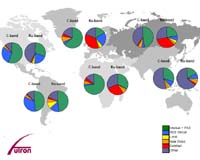
Following the news of Intelsat's acquisition of PanAmSat, there has been a lot of speculation about the size and impact of this new combined entity, in particular in relation to the rest of the satellite industry.
In order to put this into some perspective, Futron has compiled a review of the C-Band and Ku-Band capacity now on orbit around the globe operated by the following:
Intelsat/PanAmSat combined
SESGlobal (including Americom, Astra and other operators in which SES has a significant investment, i.e., AsiaSat, Nahuelsat, StarOne, Sirius)
Eutelsat
New Skies Satellites
Loral Skynet
Other (all other national/regional FSS and BSS operators)
This data has been taken from Futron's database of commercial GEO satellite supply and reflects a current snapshot, recognizing that some of the capacity is on moveable spot beams or on broader beams which can transfer service between regions as demand requires.
While it is clear that in some regions, and for some types of capacity the new Intelsat/PanAmSat will be a dominant player, in other areas the large number of "independent" operators maintains a competitive environment.
This latter issue also demonstrates that there is still room for further consolidation on either a regional or global basis, without the satellite industry being reduced to a monopoly or even a duopoly.
