
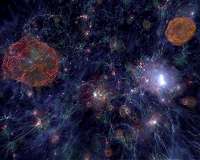
The idea that all of human existence might simply be a computer simulation — most recently popularized by Elon Musk — has captivated the minds of millions of computer chair philosophers and college stoners.
But new research by a pair of theoretical physicists suggests it is simply not possible to build a computer big enough to run such a massive simulation.
Zohar Ringel and Dmitry Kovrizhin of the University of Oxford and Hebrew University in Israel used Monte Carlo methods to simulate a quantum system. They found classical systems and their incumbent mathematics are insufficient to sustain a quantum many-body system — like a cosmos filled with trillions of possibilities.
Monte Carlo simulations encompass a range of computational algorithms that use randomness to generate probabilities. In physics, Monte Carlo methods are often used to simulate systems with multiple variables and dimensions.
Ringel and Kovrizhin used Monte Carlo methods to demonstrate the computing power required to model just a sliver of reality — the quantum phenomena occurring in metals. Their efforts showed such a simulation requires a massive amount of computing power. And as the simulation is expanded, the computer power required grows exponentially.
Simply put, their calculations showed there aren't enough particles in the universe to simulate the particles in the universe.
"Even just to store the information about a few hundred electrons on a computer one would require a memory built from more atoms than there are in the universe," researchers wrote in a paper on their efforts, published this week in the journal Science Advances.
"If the growth is exponential, or in other words if for every extra particle one has to double the number of processors, memory, etc., then this task becomes intractable," concluded Ringel and Kovrizhin.
The study doesn't weigh in on the possibility that quantum computers could someday run universe-approximating Monte Carlo simulations with greater efficiency.
And while plenty of philosophers and scientists are highly skeptical of the idea that our reality is simply a computer game, it may be an idea that's impossible to disprove entirely.
"You're not going to get proof that we're not in a simulation, because any evidence that we get could be simulated," David Chalmers, a professor of philosophy at New York University, told Scientific American.
Team led by graduate student at PPPL produces unique simulation of magnetic reconnection
Jonathan Ng, a Princeton University graduate student at the U.S. Department of Energy's (DOE) Princeton Plasma Physics Laboratory (PPPL), has for the first time applied a fluid simulation to the space plasma process behind solar flares northern lights and space storms. The model could lead to improved forecasts of space weather that can shut down cell phone service and damage power grids, as wel … read more
