
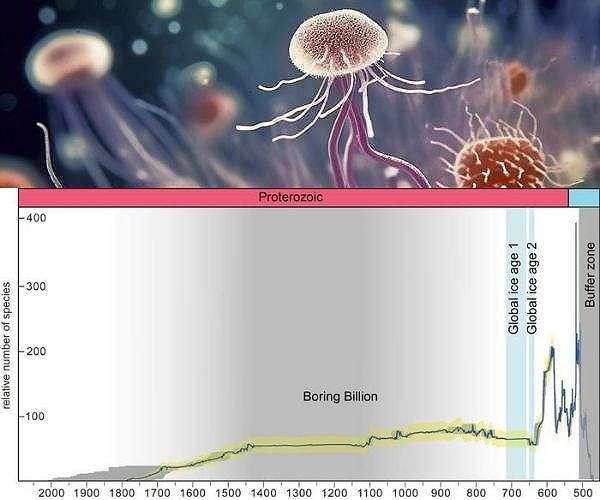
A groundbreaking Virginia Tech study has expanded our understanding of the evolution of life, extending the chart of species diversity to nearly 2 billion years ago, deep into the Proterozoic Eon. This analysis illuminates a period previously underexplored due to the limited fossil record left by early life forms.
Traditional fossilized skeletons and shells have long chronicled evolutionary and extinction events over the past 500 million years. However, this new chart pushes back the timeline, revealing the diversity and dynamics of ancient marine eukaryotes – organisms with nuclei in their cells, which later gave rise to multicellular life such as animals, plants, and fungi.
"This is the most comprehensive and up-to-date analysis of this period to date," said Shuhai Xiao, a Virginia Tech geobiologist and National Academy of Sciences inductee. "More importantly, we've used a graphic correlation program that allowed us to achieve greater temporal resolution."
The analysis, published in Science, showcases how eukaryotic species evolved during the Proterozoic, highlighting a stable "boring billion" years when species turnover was minimal, followed by dramatic evolutionary shifts triggered by global glaciation events.
Insights from the Study
The research revealed several patterns in the Proterozoic eukaryotic fossil record:
– Eukaryotic life emerged no later than 1.8 billion years ago and experienced a long period of stable diversity from 1,450 to 720 million years ago, dubbed the "boring billion."
– During this phase, eukaryotic evolution was relatively sluggish, with species persisting for extended periods.
– The Snowball Earth events, marked by global glaciation between 720 million and 635 million years ago, disrupted this stasis, spurring rapid evolutionary turnover as species adapted to new environmental conditions.
"The ice ages were a major factor that reset the evolutionary path in terms of diversity and dynamics," Xiao explained. "We see rapid turnover of eukaryotic species immediately after glaciation. That's a major finding."
Future Directions
The study raises questions about the factors influencing eukaryotic evolution. Why was it slow during the "boring billion," and what accelerated evolution after Snowball Earth? Possible drivers include climatic changes, increased atmospheric oxygen, or an evolutionary arms race among organisms.
Xiao emphasized that these patterns could provide a framework for future research. "Quantified patterns allow scientists to explore the complex interplay between life and Earth systems with greater precision," he noted.
Research Report:Quantifying the global biodiversity of Proterozoic eukaryotes
