
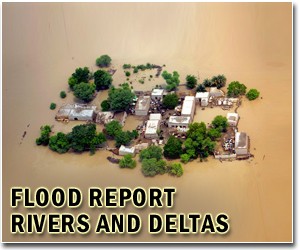
If Rockhampton is suffering its worst ever floods, Australian rescue chief John Fisher ought to know — flying overhead in his helicopter, the veteran pilot has seen them all.
"A lot of people around this place have seen floods, but not of this dimension before," said Fisher, one eye on the storm clouds gathering overhead.
"The extent of water out there in the Fitzroy (river), it's astounding how far it's gone. It's drained across the floodplains, particularly Rocky where it comes into the big delta. It's really stretched to its outermost limits."
A storm has forced Fisher to take a break from his hectic schedule of supply drops and evacuations, and he watches real-time weather maps stream on a nearby computer screen, discussing logistics with emergency officials.
Paper maps are pinned on an easel, and a whiteboard lists jobs for the four helicopters refuelling on the small green nearby.
Rockhampton's "Heritage Village" tourist park, a showcase of historic Australian life, seems an odd base for the vital helicopter operations, but the airport is swamped and the site's proximity to town makes it an ideal makeshift helipad.
"We're going to collect two English tourists who've found themselves stranded by the floods," Fisher chuckles, gesturing at the darkening sky.
"But we avoid those things (storms), they're not very pleasant."
Regional fire and rescue manager Fisher doesn't think himself a hero, but for the scores of families isolated by Australia's unprecedented floodwaters he's their lifeline to the outside world, bringing food and medicine and dropping fodder to water-bound cattle.
His sleek red chopper, Hannah, is laden with 200 kilograms (400 pounds) of groceries to fly to five families in a remote area surrounded by mucky water — enough for the four or five weeks before the deluge recedes.
Fisher, who has been in aerial rescue for more than 20 years, insists it's all routine — "flying helicopters and that sort of thing isn't that stressful" — but his team must delicately balance priorities and resources.
Medical emergencies worry him most, and there have been a few since flooding hit, including midnight call-outs for Black Hawk crews on loan from the military for "the very pointy end of those more difficult jobs".
"It might be a heart attack, suspected heart attack, it might be a broken leg — all of those things that might normally have gone through a triple-0 (emergency) call to the ambulance now might mean a helicopter ride," Fisher said.
Has he been hugged? "Not yet, no," but people are "always keen to see us" and there's definitely still time. Parts of the until-recently parched region could remain cut off by water or road damage for at least a month.
"Essentially the landscape has filled up… in pretty much all of central Queensland, and that's a huge amount of country," said Fisher, who said formerly drought-declared Rockhampton (left drought in May 2010) went from its worst ever wildfires to its worst floods in a little over 12 months.
"Two years ago we got a bit of rain but this is the real end of the drought," he added. "Fires, floods, we've got the lot."
Share This Article With Planet Earth
