
The European Space Agency's Venus Express ends a break of more than 10 years in the exploration of a planet that is notoriously hostile to human scrutiny.
Many missions have ended in failure, and those that have succeeded in sending probes or landers to the surface have received a data stream lasting only minutes before the instruments are crushed by the Venusian atmosphere.
Here is a chronology of missions to Venus, previous and planned:
1961: Venera 1 (Venus 1), Soviet-made probe designed for a fly-by of Venus. Fate unknown. Communications with ground station broke down about seven million kilometers (4.37 million miles) from Earth.
1962: Mariner 1 and Mariner 2 (US). Mariner 1 veered off-course and had to be destroyed shortly after launch. Mariner 2 became the first successful interplanetary probe. Found no significant magnetic fields or radiation belts around Venus. Heat sensors found the surface to be dry and scorching hot.
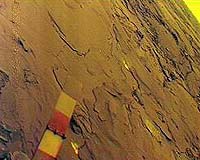
1965-83: Venera 2 – Venera 16. Ambitious programme of Soviet campaign of fly-bys and landings, characterised by several failures but some successes. Among them: Venera 7 (1970), which parachuted a capsule of scientific instruments to the surface, marking the first successful landing on Venus, and Venera 9 (1975), which sent back the first TV pictures of the Venusian surface.
1967: Mariner 5 (US). Flyby, measuring magnetic fields, charged particles, ultra-violet emissions.
1973: Mariner 10 (US). NASA flyby of a probe en route for Mercury. Returned first close up pictures of Venus, despite navigational problems.
1978: Pioneer Venus (US). Orbiter, operated until 1992.
– Pioneer Venus Multiprobe (US). Comprised one large and three small probes, equipped with sensors, that were sent down to the surface in 1978.
1984: Vega 1 and 2 (Soviet). Flybys of Venus while en route to Halley's Comet, dropped scientific packages to surface.
1989: Magellan (US). Orbiter designed to map Venus' surface. Highly successful. Operated until 1994.
– Galileo (US). Flyby of Venus in 1990 while en route to the outer planets.
2004: Messenger (US). Two scheduled fly-bys of Venus (Oct 2006, June 2007) en route to Mercury.
2005: Venus Express (Europe). European Space Agency (ESA) orbiter, designed to study Venus' cloud system.
2008: Planet-C (Japan). Orbiter designed to study dynamics and temperature of Venus' upper atmosphere.
2012: BepiColombo (Europe). ESA probe that will fly-by Venus while en route for Mercury.
