
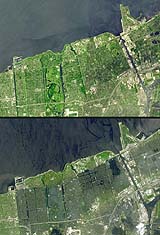
Hurricane Katrina has created huge environmental problems for the US Gulf coast, ranging from germ-laden floodwater, chemical spills and oily sediment to hazardous debris that includes medical waste, a US official said Wednesday.
Stephen Johnson, administrator of the Environmental Protection Agency (EPA), said Katrina was unprecedented in scope and admitted he could not give a date for when the cleanup would be over.
"This is the largest natural disaster that we at the EPA and, we believe, the nation have faced," he told a press conference here.
"(…) I wish I could speculate on (how long) it is going to take. What we are focussing on right now is what the impacts are."
Johnson said 646 EPA personnel were now deployed in Louisiana, Mississippi and Alabama after the August 29 storm, backed by a specially-equipped plane and trucks to monitor air pollution as well as two mobile labs.
More than two-thirds of the staff were in Louisiana, whose main city, New Orleans, was flooded by the hurricane, forcing the evacuation of half a million people.
Floodwater sampled there on September 3 showed unsafe levels of lead, Escherichia coli and coliform bacteria, and further tests showed "a range of chemicals," including chlorine, copper, sodium and iron, he said.
Another big problem is the debris littering the devastated coast, ranging from timber from shattered homes to trees, cars and building materials.
"We have recovered over 5,000 orphan [loose] containers," including gasoline cylinders, medical waste and hazardous materials, said Johnson. "The enormity of the amount of material is a challenge."
Included in that is oil-laden sediment that is drying out as the floodwaters recede.
The hydrocarbon content in this sediment is so high that it initially prevented labs from assessing samples for the presence of bacteria and other chemicals, Johnson said.
Further work was underway to assess the sediment to help figure out how to handle it and dispose of it.
Five oil leaks in the New Orleans area, where there is a cluster of petrochemical firms, had been identified and stopped, including a spill at the Murphy Oil refinery, southeast of the city.
"Thousands of gallons, rather than millions of gallons of oil" had entered the environment at that facility, said Johnson.
