
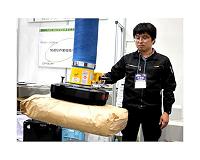
Good times or bad, Japanese companies have begun sucking it up at the workplace like never before. And thanks to advanced vacuum lifting technology, employees on the factory floor are breathing the biggest sighs of relief. At Green Plus Co., Ltd., designing vacuum lifting systems is central to its business of selling a safer and more efficient workplace.
The Osaka-based company showcased some of its new technology at a recent trade fair in Odaiba, Tokyo. Large, flexible hoses suspended from a ceiling grid and connected to a vacuum generator helped employees to lift and manipulate plain wrapped packages weighing 40kg or more with ease around a simulated workroom.
"The whole idea is to reduce the stress and strain on the human body," says company engineer Shunichi Yanagisawa. "It's no secret that many companies in Japan face manpower shortages. But totally automating factories is not always practical or economical, especially for smaller companies and in environments where specialized tasks are performed. Vacuum lifts fill a middle ground."
The lineup at Green Plus features three main products: its vacuum system, along with an aluminum crane system, and a manipulator/air balancer system, all of which are leveraged to design custom solutions for clients such as Mitsui and Co., Kawasaki Heavy Industries, and others.
Much of the core technology, however, comes from Germany, where firms such as Fezer and crane maker eepos have established industry leads. Fezer's vacuum technology, with its VacuBoy line of lifters, is key for Green Plus. Fezer's heaviest lifters are rated as capable of handling loads of finished steel weighing up to 10,000kg.
Noise level is a concern, and the drone of the vacuum generator at the expo made hearing a bit difficult, but Mr. Yanagisawa assured that a properly installed unit in a real factory would also feature sound-proofing.
The basic principle of creating an industrial-use air vacuum has evolved over the last 60 years, but not by quantum leaps. The basis technology remains fairly simple, and involves a piston-driven pump, along with monitoring, control, and suction pad units. Moving parts are relatively few and friction is low, meaning that systems tend to be durable, depending on usage. Heavy voltage is usually not required, and waste matter is nil, putting vacuum systems in the 'green' category.
Typical industry solutions include steel and pipe production, car and aircraft manufacture, construction, railway, stone, timber, and glass industries.
At Green Plus, sales began earlier this year, and are generating strong interest, according to Mr. Yanagisawa.
"Client needs vary widely, but the standard setup for a small- to medium-sized Japanese company involved in metal processing or package handling would probably require just three to four workstations and capacity for around 30kg or less of lifting power," he says. The price for such a complete system, with support, typically runs a few hundred million yen.
"Industrial vacuum lifters are not an ultra high-tech solution, but it is effective and efficient, and a pretty good fit for Japan, all things considered," he adds.
