
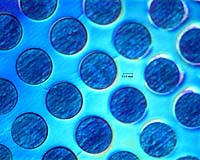
U.S. scientists report creating an artificial cell that can be used to study the organization and function of the most basic cell components.
The Penn State researchers said they focused on studying the cell membrane and the cytoplasm — the gelatinous fluid that surrounds the structures in living cells. They said their work could lead to the creation of drugs that take advantage of properties of cell organization to prevent the development of diseases.
"Many scientists are trying to understand cells by turning off genes, one at a time, and observing the effects on cell function but we're doing the opposite," said Associate Professor Christine Keating, who led the research. "We're starting from scratch, adding in components to find out what is needed to simulate the most basic cell functions. Our goal is to find out how much complexity can be observed in very simple collections of molecules."
The research that included Ann-Sofie Cans and M. Scott Longteam is to appear in the Journal of the American Chemical Society.
