
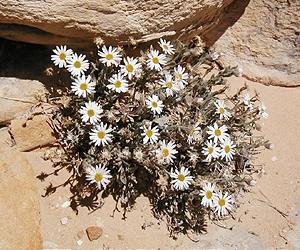
The tiny Maguire daisy, which grows in the desert southwest of the United States, has been plucked from the edge of extinction after a 25-year conservation effort, US officials have announced.
The minuscule member of the sunflower family had dropped to just seven known plants when it was listed as endangered in 1985, but with numbers of the daisy now back up to 163,000 plants in 10 populations in Utah, it will be removed form the endangered species list, the Interior Department said Tuesday.
"Working in partnership with other federal agencies, state and local governments, and other partners, we can ensure irreplaceable plants and animals such as the Maguire daisy and the habitat they depend upon are preserved for future generations," said Assistant Secretary of the Interior for Fish and Wildlife and Parks, Tom Strickland.
The Maguire daisy (Latin name: Erigeron maguirei) is a perennial plant with white or pink flowers roughly the size of an American dime or a one-cent Euro coin.
The daisy joins 20 other mostly animal species that have been removed from the endangered species list, including the brown pelican, the bald eagle, a symbol of the United States; the Arctic peregrine falcon and the American alligator.
The tiny daisy will be monitored for at least 10 years to ensure that it continues to flourish and to watch for "potential threat factors."
If, during the monitoring process, officials notice a decline in the population of the Maguire daisy, they could take steps to put it back on the endangered list.
earlier related report
Romanians adopt bears as part of WWF campaign
Bucharest (AFP) Jan 19, 2011 –
Some 140 bears living in the Romanian Carpathians have been adopted symbolically as part of a campaign launched by environmental group WWF, organizers said Wednesday.
"In one month we have received more requests than we had hoped," programme coordinator Daniela Caratas told AFP.
She said applicants have received an "adoption certificate" together with information on bears and on WWF's activities.
The funds raised, 20 euros (26 dollars) per adoptive parent on average, will be used to promote the group's campaigns aimed at preserving the bears' habitat.
The WWF says deforestation, scarce food, conflict with humans and poaching threaten the game in this Balkan country.
"Unfortunately Romania is no longer an inviting home to bears as roads, ski resorts and residential areas are being built in forests and other protected areas," the group stressed.
Romania officially counts some 6,500 bears, or 60 percent of Europe's total bear population.
In recent years, famished bears have been seen rummaging through garbage cans in Carpathian mountain resorts.
Share This Article With Planet Earth
