
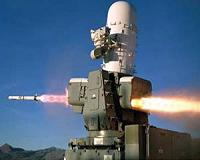
Raytheon reports that its SeaRAM anti-ship missile defense system has successfully completed test shots in U.S. Navy testing.
In the testing, the system took out several targets in a variety of scenarios, including one in which two supersonic missiles were inbound simultaneously, flying in complex, evasive maneuvers. The targets were intercepted with Rolling Airframe Block 2 missiles.
"SeaRAM achieved a new level of success, intercepting targets under high-stress conditions," said Rick Nelson, vice president of Raytheon's Naval and Area Mission Defense product line. "The system demonstrated once again that it can provide the sophisticated protection warfighters need."
The tests were conducted on the Navy's Self Defense Test Ship off the coast of Southern California.
SeaRAM is the development of key attributes of the Phalanx Close-In Weapon System and the Rolling Airframe Missile Guided Weapon System, replacing the 20mm Phalanx gun system with an 11-missile RAM launcher assembly.
It combines RAM's superior accuracy, extended range and high maneuverability with the Phalanx Block 1B's high-resolution search-and-track sensor systems and quick-response capability against close-in and extended range threats.
Navy to industry: it's all about plug-and-play
National Harbor, Md. (UPI) May 17, 2016 –
Navy leadership told its shipbuilding industry Monday that it's all about "plug-and-play," open-architecture capabilities going forward for the sea service.
Modern and future combat needs involve an essential degree of agility and flexibility, Marine Corp Lt. Gen. Jon Davis, the Corps' deputy aviation commandant, said Monday at the Navy League's Sea-Air-Space 2016 Exposition.
"You can't discover you're not interoperable on game day," Davis said during a roundtable panel on integration. "Make sure it plugs and plays."
"We're paying a lot of money for the platform," Lt. Gen. Robert Walsh, deputy commandant for combat development and integration, noted.
Vice Adm. Robert Thomas, Director, Navy Staff, said the service needs more open architecture in its amphibious and Military Sealift Command vessels.
Military Sealift Command head Rear Adm. Thomas Shannon said the command wants to be included in discussion on adding sensors and platforms to defend the mostly civilian crews.
He also touched on reinforcing hospital ship decks to accommodate the MV-22 Osprey.
"We need to put the M back in MSC," Shannon said.
