
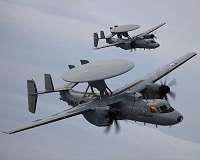
The U.S. Navy is strengthening airborne radar and detection capabilities in the Asia-Pacific with five E-2D Advanced Hawkeyes early warning and control aircraft.
Carrier Airborne Early Warning Squadron 125 arrived at Marine Corps Air Station Iwakuni on Thursday.
Japan's air self-defense force may also use the aircraft, Stripes Japan reported.
The E-2D "employs long-range radar and electronic communications capabilities to oversee the battle space and detect threats beyond the sensor range of other friendly units," a statement from the U.S. Navy read.
The aircraft was also described as the "digital quarterback" of the fleet, and includes an "all glass" tactical cockpit, an upgraded mission computer and data-link capabilities.
In response to reports of the deployment, China's Global Times stated Friday the E-2D are being placed in Japan in order to track Beijing's Chengdu J-20 stealth fighter.
Japanese newspaper Asahi Shimbun reported the E-2D unit is being deployed to the Pacific region for the first time. The report stated the aircraft is to be used to keep a check on Chinese movements.
According to Stripes Japan, the aircraft will be used to conduct surveillance missions of the Japan-claimed Senkaku Islands.
China is also a claimant of the uninhabited territory.
In South Korea, more U.S. strategic assets are expected to be deployed in preparation for joint military exercises to be held in March, local news service No Cut News reported.
On Friday, U.S. Defense Secretary James Mattis and his Seoul counterpart Han Min-koo agreed to hold the combined combat drills Key Resolve and Foal Eagle in March in order to curb North Korea provocations.
The B-1B strategic bomber is expected to be deployed for the first time during Key Resolve, according to the report.
The B-1B Lancer heavy strategic bomber landed on the Korean peninsula for the first time in 20 years last September and flew close to the North Korea border after Pyongyang conducted its fifth nuclear test on Sept. 9.
USS America completes combat systems ship qualifications trials
Washington (UPI) Feb 3, 2017 –
U.S. Navy personnel completed the final phase of weapons testing for the amphibious assault ship USS America ahead of the vessel's first operational deployment.
The combat systems ship qualifications trials, or CSSQT, were conducted by a team of Navy and U.S. Marine Corps participants. Testing focused on several of the vessel's main armaments, including the Mark 38 and Mod 2 30mm gun and close-in weapon system.
Navy officials say the trials were held to verify the ship's combat capabilities, and to ensure the vessel's components were installed properly.
"America is the first of its class, so we do tests like these to determine our overall capability to defend ourselves and to make sure our systems operate with peak efficiency at all times," Chief Fire Controlman Donald Reichert explained in a press release.
The Navy went on to add that all weapons aboard USS America were demonstrated successfully during live-fire exercises, and testers were able to establish missile firing procedures.
"We shot literally thousands of rounds through CIWS, thousands of rounds through the Mark 38, and not once did the guns quit due to a malfunction," Lt. Cmdr. Todd Blackman added. "I would put our weapons against any other ship in the fleet right now."
Amphibious assault ships resemble small aircraft carriers, and are designed to project power as part of amphibious ready groups or expeditionary strike groups. The America class is fitted to provide ship-to-shore movement with helicopters and landing craft.
USS America was commissioned by the Navy in October 2014, and is scheduled to make its first operational deployment later this year.
