
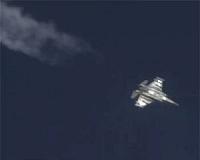
The U.S. Air Force announced the completion of a large air-and-missile defense exercise, involving F-35A fighter planes, in Europe.
"Astral Knight 2019" was the first involvement of the planes in a large-scale multinational exercise. It focused on simulated defense of several key areas of terrain from cruise-missile and aircraft strikes. U.S. military forces worked closely with NATO coalition forces of Croatia, Italy and Slovenia at various locations across Europe, conducting operational and cyber scenarios.
The fifth-generation F-35A Lightning IIs and personnel were brought from Hill AFB, Utah, to Aviano Air Base, Italy, in May for exercises and to train with other Europe-based aircraft. The squadron includes the 388th and Reserve 419th and 421st Fighter Wings of the U.S. Air Force.
In a four-day exercise ending on Thursday, the Air Force flew eight sorties per day. For the first time, U.S. Air Force F-35As integrated operationally with Italian air force F-35As. They communicated with each other over the Multifunction Advanced Data Link, a system unique to the plane's platform.
"It's truly rewarding to see that we can leverage all the capabilities of the F-35A, which we have all been working toward," said Lt. Col. Brad Klemesrud, 421st Fighter Wing Squadron deputy commander. "In an exercise this large and complex, you get the opportunity to see how theory meets reality and put into practice what's only been on paper."
The exercise, deemed a success, also tested the capabilities of maintenance teams.
"This is the first overseas location that the 421st AMU's [Aircraft Mantenance Unit] F-35As has gone to," said MSgt. John Ott, 421st AMU F-35A expediter. "Our duties include daily servicing and inspections, as well as logistics and coordination control to receive support on our aircraft and maintainers 24/7."
U.S. Air Force F-15s to get surveillance units in $14.9M contract
Washington (UPI) Jun 7, 2019 –
Raytheon Co. will retrofit F-15 fighter planes with identity and surveillance units in a $14.9 million contract modification, the U.S. Air Force announced.
The adjustment calls for equipping the entire fleet of 196 F-15s with Mode 5-capable "Friend or Foe" identity units, which provide National Security Agency-approved cryptography, and anti-jam interrogation and reply encryption capabilities. The equipment includes devices known as transponders and interrogators that enable pilots to identify friendly forces and make informed decisions in time-critical situations.
The plane, known in various forms as the "Eagle" and "Strike Eagle," has been in service since 1972 and is used by armed forces of the United States, Japan, Israel and Saudi Arabia.
Work will be performed at Raytheon facilities at Aberdeen Proving Grounds, Md., and Largo, Fla., with a completion deadline of March 2021. The modification, announced by the Air Force on Thursday, brings the value of the contract to $36.1 million. The Air Force Life Cycle Management Center at Wright-Patterson AFB, Ohio, is the contracting agent.
Sikorsky test flies Black Hawk helicopter without a pilot
Washington (UPI) Jun 7, 2019 –
Sikorsky for the first time operated a Black Hawk helicopter with full-authority, fly-by-wire flight controls in the Lockheed Martin company's quest to transform the aircraft into an optionally piloted vehicle.
The flight on May 29 at Sikorsky's test facility in West Palm Beach, Fla., marked the official start of the flight test program, the company announced Thursday. Future tests will include several different flight configurations throughout the summer, leading to fully autonomous flight — meaning no pilot — next year.
Sikorsky has developed a technology kit to turn the rotorcraft into drones by removing mechanical flight controls from it.
"This technology brings a whole new dimension of safety, reliability and capability to existing and future helicopters and to those who depend on them to complete their missions," Chris Van Buiten, vice president of Sikorsky Innovations, said in a statement. "We're excited to be transforming a once mechanically controlled aircraft into one with fly-by-wire controls. This flight demonstrates the next step in making optionally piloted — and optimally piloted — aircraft, a reality."
Sikorsky said it wants to give operators "the confidence to fly aircraft safely, reliably and affordably in optimally piloted modes enabling flight with two, one or zero crew."
The company has developed the technology through the Defense Advanced Research Projects Agency's Aircrew Labor In-Cockpit Automation System program.
Sikorsky earlier demonstrated the Matrix technology on a modified S-76B, called the Sikorsky Autonomy Research Aircraft. The aircraft has more than 300 hours of autonomous flight since 2013, the company said.
In March, Sikorsky announced that its S-92 helicopter fleet update will include the introduction of phase one Matrix technology. Missions include offshore oil transportation, search and rescue, and head of state uses, including the helicopter flown for the President of the United States, Marine 1.
The first UH-60A Black Hawk was accepted by the Army in 1978, and entered service in 1979 with aviation components of the 101st and 82nd Airborne Divisions. Future variations include the UH-60L and UH-60M, the latter of which Lockheed Martin calls the "best-in-class multi-mission performer."
In all more than 4,000 UH-60's have been produced for U.S. Dept. of Defense armed services branches, including 2,135 for the U.S. Army, as well as its allies with a S-70 designation, according to Lockheed Martin.
All three models can carry 11 troops. The UH-60A and UH-60L include a crew of three, with a cargo hook capacity of 8,000 pounds. The UH-60M has a crew of four with 9,000 pounds hauling. They can fly 4,000 feet in altitude.
