
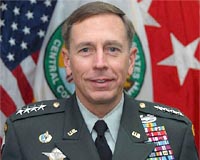
Iran could become involved in a regional strategy to the conflict in Afghanistan, as Tehran shares common interests with the United States there, suggested Thursday General David Petraeus, head of US Central Command.
A resolution to the ongoing conflict in Afghanistan requires "a regional approach … that includes Pakistan, India the Central Asian states and even China and Russia, along with perhaps, at some point Iran," Petraeus said at a conference organized by the Institute of Peace think tank.
"There is a common interest between Afghanistan, the coalition (of foreign forces in Afghanistan) and Iran, but there are also major conflicting interests, needless to say," said Petraeus, who is in charge of US operations in Afghanistan and Iraq.
"I am happy to leave that element of the regional approach to the diplomats and policymakers," he added.
Remnants of the hardline Taliban regime, which was ousted from power in the US-led invasion in late 2001, are now waging an insurgency against the US-backed government of President Hamid Karzai.
There are about 70,000 international troops in the country fighting alongside Afghan security forces to quell the Taliban.
Petraeus emphasized that Iran is "conflicted" over the situation in Afghanistan.
"Clearly they don't want to see Afghanistan in the grip of ultra-fundamentalist extremist Sunni forces, as is the case with the Taliban, but nor do they want to see the narcotics problem get worse," he said.
Afghanistan produces more than 90 percent of the world's opium, much of it in the Helmand province, the region host to a large part of the conflict. The drugs are exported throughout the wider region, including Iran.
The United States, which severed diplomatic relations with Iran thirty years ago, accuses Tehran of developing a nuclear program for military purposes — a charge the Iranians denies.
US president-elect Barack Obama, however, has stated he wishes to establish "tough but direct diplomacy" with Iran.
Petraeus noted that the country "would also like to see the development of trade, commerce" with its neighbor.
There are parts of Iran's government, Petraeus admitted, that he was sure "is determining how they can make life miserable for the coalition and Afghan forces as well, citing examples of Iranian weapons being intercepted in the conflict.
And Petraeus stressed the need for a cohesive strategy involving Afghanistan and Pakistan.
For the United States, he said, the two countries "have, in many ways, merged into a single problem … the way forward in Afghanistan is incomplete without a strategy that includes and assists Pakistan."
The way forward, Petraeus said, will be difficult.
"There has been nothing easy about Afghanistan, indeed nearly every aspect has been hard and that will continue to be the case in 2009 and the years beyond," he said.
The head of Al-Qaeda in Pakistan and his lieutenant were killed in the past days, a US counterterrorism official told AFP on Thursday.
A US missile strike killing the men reportedly took place in the autonomous tribal area of northwest Pakistan, on the Afghan border, which has been wracked by violence since hundreds, perhaps thousands, of Taliban and Al-Qaeda rebels have set up base there over the last few years.
The US military announced last month that additional reinforcements of 20,000 to 30,000 troops are set to be sent to Afghanistan.
Share This Article With Planet Earth
