
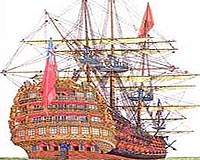
The US firm which claims to have discovered one of the greatest British warships ever lost at sea said Monday it was seeking "immediate" permission to begin recovering artefacts from the wreck.
Florida-based Odyssey Marine Exploration said it discovered the final resting place of the HMS Victory last year in the English Channel and notified the British Ministry of Defence as soon as the team concluded it was the man-of-war which sank in a storm in 1744 with a crew of 1,150.
The exploration company said it was negotiating a collaboration agreement with the British government, which claims sovereignty over the ship thought to have been the most impressive war vessel of its time.
"The money is not as important as the cultural and historical significance of the discovery. It is a monumental event, not only for Odyssey but for the world," Greg Stemm, Odyssey's chief executive officer, told a news conference in London.
"It is probably the most significant shipwreck find to date. HMS Victory was the mightiest vessel of the 18th century and the eclectic mix of guns we found on the site will prove essential in further refining our understanding of naval weaponry used during the era," he added.
Odyssey said it feared the wreck was suffering substantial damage from natural erosion and extensive trawler-fishing and its contents could be lost unless they were brought to the surface as soon as possible.
The Victory's archeological treasures are prized by salvagers because they are believed to include 100 brass cannons, thought to be engraved with dolphins and the monogram of King George II, and a substantial amount of gold and silver.
"Rather than staying frozen in time beneath the waves, this unique shipwreck is fading fast," marine archaeologist Sean Kingsley, director of Wreck Watch International, said in a statement from Odyssey.
"The Victory lies in an area of intensive trawling, and her hull and contents are being ploughed away by these bulldozers of the deep day in, day out."
Odyssey said it found the wreck 100 metres (330 feet) under the English Channel, nearly 100 kilometres (62 miles) from the Channel Islands site where the ship was historically believed to have been wrecked in a violent storm.
Jason Williams, executive producer of JMW Productions, which filmed the discovery, said: "Reports from the time say that the ship was carrying four tonnes of gold, around 400,000 sterling, which it picked up from Lisbon on its way to Gibraltar.
"Today this has a bullion value of 125 million pounds, but that is just its raw weight. That means it is worth about a billion dollars."
Share This Article With Planet Earth
