
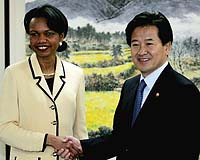
The United States denied Thursday suggestions of a policy rift with South Korea despite a Seoul official's endorsement of North Korea's right to maintain a civilian nuclear program that Washington opposes.
Adam Ereli, deputy State Department spokesman, did not try to explain the apparent contradiction in the positions taken by the two allies but wrote it off as part of the multi-nation negotiating process.
"There's no rift between the United States and South Korea," he said. "We are close partners in a broad bilateral relationship and particularly in our common approach to denuclearizing the Korean Peninsula."
The United States, South Korea, China, Japan and Russia are in negotiations with North Korea in an effort to persuade Pyongyang to renounce its program to develop nuclear weapons.
Thirteen days of intensive discussions in Beijing recessed Sunday for three weeks with no agreement. A main stumbling block was North Korea's insistence on retaining civilian nuclear capacity.
South Korean Unification Minister Chung Dong-Young threw a new wrinkle into the negotiations Thursday, telling an Internet news provider that Pyongyang had a "natural right" to the peaceful use of nuclear energy.
The Americans flatly reject the idea, saying they were burned when North Korea converted a civilian reactor into a processing facility for weapons-grade nuclear fuel.
"It's our view that they do need to dismantle all their programs," chief US negotiator Christopher Hill told reporters Wednesday in Washington.
Ereli sought to downplay any differences between the Americans and South Koreans: "There's a negotiation going on. And in any negotiation, you've got at least as many views as there are parties, sometimes more."
"I think what you're seeing emerging from the 13 days of talks is an emerging set of common goals and common approaches. They're working through those," he said.
Ereli said the negotiations would be held in Beijing and not through the press. He would not say whether the United States had any flexibility on North Korea's use of civilian nuclear energy.
But a senior State Department official, who asked not to be named, stressed that the nuclear talks were multilateral and "you're going to hear a lot of different opinions expressed.
"Where they finally end up is, a) going to take a long time, but b), it's going to be the result of a consensus because that's the only way it's going to work."
