
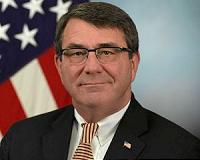
US Defence Secretary Ashton Carter held talks in Baghdad Wednesday to review progress in the war against the Islamic State group.
Carter, who on Tuesday visited a Turkish base that has become a key hub for air raids against the jihadists, met Prime Minister Haider al-Abadi and Defence Minister Khaled al-Obeidi.
They discussed means of "improving cooperation between the two countries in the fields of arming and training," a statement from Abadi's office said.
Carter and his delegation also met US partners in the international anti-IS coalition, and were due to leave later Wednesday.
US aircraft carry out daily air strikes against IS targets, most of them in the Iraqi part of the jihadists' self-proclaimed "caliphate", which also covers regions in Syria.
Out of the 11 strikes conducted by the coalition on Tuesday in Iraq, five were on targets in the area of Ramadi, which Iraqi forces are trying to wrest back from IS, according to a US military statement.
President Barack Obama said on Monday the US and its allies were hitting IS "harder than ever" and warned the extremists' leaders: "You are next."
Iraq approves $88.2 bn budget for 2016
Baghdad (AFP) Dec 16, 2015 –
Iraq's parliament adopted Wednesday a 2016 budget of $88.2 billion, based on projected oil prices of $45 per barrel, according to a copy received by AFP.
The budget includes oil production the federal government does not now control and envisions a rise in oil prices, meaning revenue may fall short of projections.
Parliament speaker Salim al-Juburi announced that the budget had been approved, but did not provide further details.
The 105.8 trillion dinars ($88.2 billion at the 1,200 dinars/dollar rate in use within Iraq) was little changed from the 106 trillion dinars the cabinet proposed last month.
It projects a deficit of $20.1 billion (24.1 trillion dinars), but there are two significant factors that could undercut a projected $68.1 billion in revenue.
Firstly, it envisions oil exports of 3.6 million barrels per day, including a total of 550,000 bpd from Iraqi Kurdistan and Kirkuk province, a large part of which is under the autonomous region's control.
Kurdistan has been exporting oil independently and is likely to continue doing so barring a deal with Baghdad, meaning $9 billion in revenue may not materialise.
The budget is also based on an oil price of $45 a barrel, a significant increase from Iraq's November average of $36.
And with the US Congress set to lift a four-decade ban on oil exports and the OPEC cartel deciding against cutting output, prices could remain low.
Iraq has been especially hard hit by low oil prices, which come as it wages a costly war against the Islamic State group that overran large parts of the country last year.
