
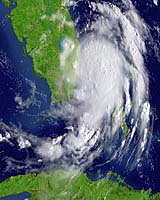
Americans breathed a sigh of relief Thursday at the official end of an uncommonly quiet Atlantic hurricane season, a year after record-setting 2005 saw the US Gulf Coast ravaged by the Hurricane Katrina mega-storm. Out of nine tropical storms during the June-November season this year, only five hurricanes formed and none of them made landfall on US coasts.
That compared to the deadly 2005 season, which produced a record 27 named storms and 15 hurricanes, seven of them intense.
Hurricane Katrina, which swept westward across Florida before barrelling straight into New Orleans on August 29, 2005, and Hurricane Rita which followed shortly behind it, killed over 1,500 people and left hundreds of thousands homeless.
Two other violent hurricanes, Emily and Wilma, blasted through the tip of Mexico's Yucatan peninsula in 2005, wrecking hotels in international tourism destinations like Cozumel and Cancun.
By contrast, the 2006 season mostly took place in the mid-Atlantic.
Only three storms had significant impact. In mid-June tropical storm Alberto swept western Cuba with heavy rains before passing much diminished into the United States mainland from the Gulf of Mexico coast.
In early August tropical storm Chris washed between Cuba and Florida before dying out in the gulf.
The heaviest was Hurricane Ernesto, which killed at least three people in Haiti and forced the evacuation of 700,000 in Cuba as a tropical storm. It then developed into a hurricane momentarily before again diminishing and then crossing Florida.
US scientists had predicted a more active season of 17 named storms and nine official hurricanes.
But they said that the unexpected rapid formation of the El Nino climate and current phenomenon in the eastern Pacific Ocean helped to quell the generation of storms this year.
"The development of El Nino conditions by September helps explain why this Atlantic hurricane season was less active than predicted," said Gerry Bell, the lead Atlantic hurricane forecaster at the US National Oceanic and Atmospheric Administration.
"El Nino developed quickly and the atmosphere responded rapidly, reducing hurricane activity during an otherwise active era that began in 1995."
It was only the 11th time since 1945 that the US coastline had been spared a hurricane landfall, according to leading hurricane expert William Gray of Colorado State University.
November 30 was also the official end of the slightly longer eastern Pacific hurricane season, which proved more active and damaging this year with 18 named storms and ten full-blown hurricanes, several of which battered popular tourist resorts along Mexico's west coast and on the Baja California peninsula.
Source: Agence France-Presse
