
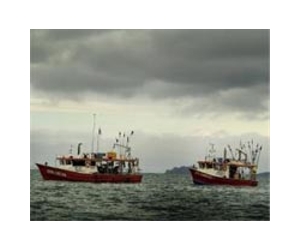
A large swathe of the Gulf of Mexico remained closed to fishing Wednesday as fears that a giant oil slick could hit Florida's beaches and corals reefs overshadowed progress in stemming the spill.
The closure, which affected some 45,728 square miles (118,430 square kilometers) — around 19 percent of the Gulf's federal waters, was announced Tuesday as politicians in Washington raged over the apparently lax enforcement of safety standards and grilled government officials over what went wrong.
While lawmakers probed the disaster, the chief of the US agency monitoring the spill warned that the "unprecedented and dynamic" slick was on course to sweep along Florida's coastline, if it had not already reached the region.
National Oceanic and Atmospheric Administration chief Jane Lubchenco told reporters the oil was "increasingly likely" to reach the powerful Gulf current that would carry it to the Florida Keys and perhaps even beyond.
But she said that by the time the oil reaches the Florida Strait — within eight to 12 days of entering the loop current — "it would likely be significantly weathered and degraded as well as diluted," showing up in the form of emulsified streamers and tar balls rather than fresh crude.
Senator Bill Nelson described the prospect of oil hitting his state of Florida and heading up the US eastern seaboard as his "worst nightmare".
The bleak warnings obscured BP's positive reports on progress in its month-long effort to contain the leak: a tube inserted into a gushing oil pipe is now sucking up about 40 percent of the crude, twice as much as on Monday.
The company said its "riser insertion tube tool" is carrying about 2,000 barrels of oil a day up to the Discoverer Enterprise drill ship on the surface via a mile-long pipe.
BP estimates that some 5,000 barrels, or 210,000 gallons, of crude is spewing each day from the wreckage of the Deepwater Horizon rig, although independent experts warn the flow rate could be at least 10 times as much.
President Barack Obama voiced frustration with Republican lawmakers over hold-ups to a measure that would force oil companies to pay for the clean-up of spills in which they have played a role.
Questions of ultimate liability have raged in the wake of the April 20 explosion on the Deepwater Horizon rig that sank to the sea floor. US law requires that oil firms pay up to 75 million dollars for economic damages, but the president and Democratic lawmakers have tried to raise the cap.
The economic and environmental impact of the spill could be magnified if it reaches the hugely popular tourist beaches and fragile coral reefs around the southern tip of Florida.
There are also concerns that huge underwater plumes of crude could be starving the Gulf of oxygen and thus harming the marine environment far more than previously thought.
Experts warned that the plumes found in deepwater spills may be linked to dispersants that stop the oil from rising.
"Normally, in a shallow spill, everything pretty much shoots up to the surface and the impacts are primarily to surface organisms like turtles, dolphins, whales and birds," explained Paul Montagna of the Harte Research Institute for Gulf of Mexico Studies.
However, "under this really cold, high-pressure environment, the oil is getting dispersed through the water column," the marines scientist said.
Government wildlife officials said Tuesday that they had recovered 156 dead sea turtles, 12 dead bottlenose dolphins, and 35 oiled birds — 23 of them dead — though they said it was not possible to say whether all the animals died as a result of the oil spill.
But Rowan Gould, acting director of the US Fish and Wildlife Service, told reporters that "visibly oiled birds are a small, small part of our concern."
"What concerns us most is what we can't see," he said.
Share This Article With Planet Earth
