
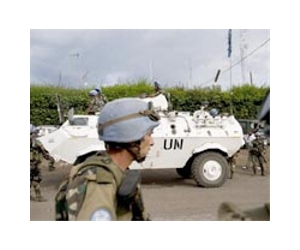
UN troops can begin leaving the west of Democratic Republic of Congo (DRC) in late June but further drawdowns elsewhere would depend on whether civilians can be protected and stability maintained, a UN report said Monday.
Kinshasa has asked for a complete pullout of the UN mission in DRC (MONUC) by August 30, 2011, with the first departure of a contingent before next June 30, when the huge, mineral-rich central African country will celebrate the 50th anniversary of its independence from Belgium.
The report by UN chief Ban Ki-moon also recommended that the UN Security Council extend the deployment of the 20,000-strong MONUC, the UN's largest peacekeeping mission, for a further 12 months from May 31.
Ban said the Security Council should authorize the "immediate implementation of the first phase" of a drawdown involving up to 2,000 troops from the western provinces of Bas-Congo, Kinshasa, Equateur and Bandundu.
But he urged the 15-member council to endorse an understanding reached between the UN and Kinshasa for a dialogue "on the specific modalities and timelines for successive drawdown phases" that have to be set in the framework of periodic joint reviews.
Subsequent drawdowns would depend on the UN and MONUC agreeing on "specific benchmarks" toward measuring progress toward achieving urgent strategic goals in conflict-ridden zones.
These include protecting civilians, including from sexual violence, increasing the number of trained DRC police units and reducing the threats posed by armed groups such as Rwandan Hutu rebels of the Democratic Forces for the Liberation of Rwanda (FDLR) and Uganda's rebel Lord's Resistance Army (LRA).
Currently, 95 percent of MONUC troops are based in DRC's troubled eastern provinces: North and South Kivus as well as Orientale and MONUC is providing the Congolese army (FADC) with logistical support for an offensive against the Rwandan rebels.
Ban's report said a UN technical assessment team that visited DRC from February 22 to March 5 concluded that the withdrawal of MONUC could be "completed over a period of three years if the security situation continued to improve."
The team recommended that a first phase of the drawdown start immediately, from the provinces of Bas-Congo, Kinshasa, Equateur and Bandundu.
The UN force would however maintain a small military presence of up to a battalion in the DRC capital Kinshasa to protect UN personnel and facilities.
A reserve force based in the east would retain the capability to respond, in an emergency, to protect UN personnel and assets and, if asked by Kinshasa, to back government forces and the national police in provinces beyond the Kivus and Orientale.
The assessment team said stage two of the drawdown could start in the second half of this year and involve the withdrawal of MONUC forces from Kasai Oriental, Kasai Occidental and Katanga provinces.
Stage three would involve a steady troop reduction in Maniema, Orientale in the northeast, North and South Kivu provinces in the east "as ongoing military operations are successfully concluded, effective state authority established freed from armed groups and the buildup of an army core progressed."
UN planners concluded that "the full withdrawal of MONUC military forces could be completed once the government and the United Nations agreed that the conditions for complete withdrawal without risking renewed instability were in place."
A UN Security Council delegation is due to visit Kinshasa in late April to hold final talks with the authorities before renewing MONUC's mandate.
The UN force has been deployed in DRC since 1999 and backs government troops in the country's east where they are battling several armed groups. It is tasked with protecting civilians in a country where more than 1.25 million people have been uprooted or displaced by violence in the east.
The Security Council's trip to DRC will be part of a three-nation tour of central Africa that will also take the delegation to Rwanda and Uganda.
The team was to meet MONUC and other UN officials in Kinshasa on April 18 and President Joseph Kabila the following day.
On April 20, the Council delegation was to head for the eastern DRC town of Goma before traveling to Kigali. The final stop will be Kampala on April 22.
earlier related report
DR.Congo army retake control of airport after UN deaths
Kinshasa (AFP) April 5, 2010 –
The Congolese army has retaken control of the airport in a major city in northwest Democratic Republic of Congo, a day after two UN personnel died in clashes, officials said Monday.
The DR Congo military retook control of the airport in Mbandaka, the main town in Equateur province, where fighting took place Sunday afternoon, an advisor to the provincial governor Guy Inenge said.
On Sunday government forces had exchanged fire with several dozen tribal insurgents in Mbandaka and a UN soldier from Ghana was killed in the clash.
Communications Minister Lambert Mende, who is also government spokesman, said that a local civilian member of the UN mission in the DR Congo, MONUC, "died of a heart attack" during the violence.
The gun battle erupted after security personnel found the rebels in a boat from the capital Kinshasa, and insurgents attacked the airport.
The fighting pitted the DR Congolese army (FARDC) against about 100 members of the Enyele tribe, according to Inenge.
"I think there were more casualties on their side, apart from the MONUC soldier who died at the airport and the Congolese employee of MONUC who died of a heart attack," Mende said.
"The situation is under control (of the FARDC)," he added. "The governor is reassuring people that they can return home safely."
A member of a local rights group, who asked not to be named, said that "the situation calmed down during the night. The FARDC have regained the airport and soldiers are circulating everywhere in the town."
No source contacted by AFP was able to give a casualty toll from the past 24 hours.
Tens of thousands of people left Equateur province after tribal fighting broke out in October and the UN and Congolese army sent reinforcements to the densely forested area, eventually restoring state control in December.
The tribal violence mainly pitted the Enyele, led by a witch doctor, against the Munzaya people, and erupted as a dispute over fishing rights in ponds at a village called Dondo.
According to officials, the fighting spread to several other villages and claimed at least 270 lives, mostly those of villagers. The clashes induced about 187,000 people to flee, including 109,000 in the neighbouring Republic of Congo and 18,000 in the Central African Republic.
In an article published Monday by the daily Le Potentiel, a senator, Modeste Mutinga, noted that "a small disagreement over the ponds at Dondo … has gone beyond a trivial news story."
Mutinga added that "from political experience, the facts that have often darkened the Democratic Republic of Congo always begin with an anodyne event, a trivial news item, before taking on alarming proportions, even setting the country ablaze."
The weekly L'Observateur said that the attack on Mbandaka was the third by the Enyele in the same region since the start of the year.
"On Saturday February 27, 2010, the Enyele occupied the Makanza region, located about 200 kilometres (125 miles) from Mbandaka." Then they "occupied, without a fight, the town of Bomongo, about 102 kilometres from Mbandaka."
Sunday's attack on Mbandaka airport "was a diversion, but they failed in their aim," government spokesman Mende said. "It was a bit suicidal in view of their numbers."
Share This Article With Planet Earth
