
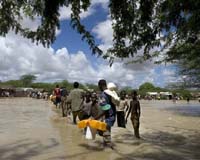
The United Nations on Thursday launched a massive appeal for funds to ease suffering in crisis-stricken Somalia, where nearly two million people, already hit by drought and floods, may now face war. With all-out conflict between the country's powerful Islamists and weak Ethiopian-backed government now appearing imminent, the world body urged donors to contribute more than 237 million dollars (178 million euros) this year.
"The humanitarian needs inside the country remain critical but have recently worsened due to drought, floods and conflict," said Eric Laroche, the UN Humanitarian Coordinator for Somalia.
The impoverished lawless nation has been without a functioning central government since 1991 and beset by a series of natural disasters including a searing drought last year, exacerbated by devastating floods since October.
An estimated 1.8 million Somalis — already holders of some of the lowest human development indicators, including child and maternal mortality and a 48-year average life span — are now at severe risk, the UN said.
"To make things worse, Somalia now faces the possibility of war," Laroche said in a statement released in the Kenyan capital.
"The international community must do what it can to avert such a scenario and to preserve a 'humanitarian space' respecting the human dignity of Somalis by ensuring access to the most needed basic services," he said.
Of the 1.8 million at risk, 1.4 million suffer from chronic food shortages and 400,000 have been forced from their homes by drought, floods or fighting, the UN said.
The total amount sought — 237,112,824 dollars — will be used for an array of humanitarian activities in Somalia, including improving food and water security, assisting the displaced, generating jobs and restoring farmland destroyed by conflict or natural disasters, the UN said.
"A generous response from the international donor community will ensure an integrated approach by humanitarian organizations in meeting needs as well as strengthening the capacity of Somalia's most vulnerable communities," it said.
Source: Agence France-Presse
