
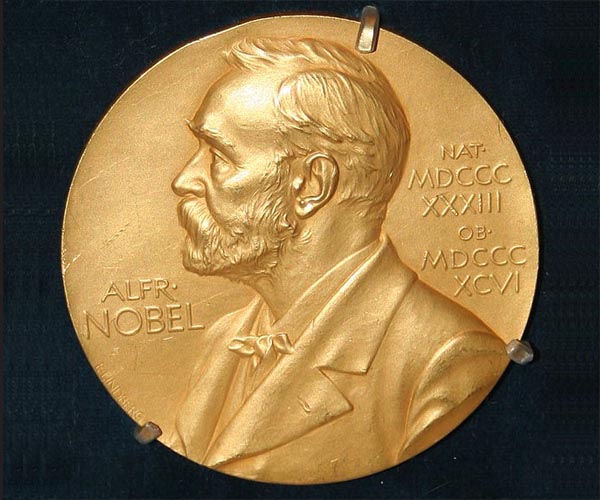
The Nobel Peace Prize will be unveiled Friday, with experts speculating it could go to critics of Vladimir Putin, climate activists or even no prize at all amid the war in Ukraine.
The climax of the Nobel season, the Peace Prize laureate will be announced at 11:00 am (0900 GMT) in Oslo, against the backdrop of Moscow's invasion of Ukraine which has plunged Europe into one of its worst crises since World War II.
The Norwegian Nobel Committee keeps the list of nominations a closely guarded secret, but it is known to have 343 names on it, including 251 individuals and 92 organisations.
With Ukraine dominating headlines since the start of the year, some prize experts say it is doubtful the committee can ignore it.
"It is likely we will see a prize that in one way or another will point in the direction of Ukraine," the director of the Peace Research Institute Oslo, Henrik Urdal, told Norwegian broadcaster NRK just hours before the announcement.
In such case, he said possible laureates could be Belarusian opposition leader Svetlana Tikhanovskaya and Russian dissident Alexei Navalny, thorns in the side of the Kremlin and one of its few allies in the war, Belarus strongman Alexander Lukashenko.
Or it could go to the International Court of Justice based in The Hague, which in March ordered the immediate end of the Russian offensive, or the UN High Commission for Refugees, as millions of people have been displaced by the conflict.
Urdal also mentioned those documenting suspected war crimes, such as the International Criminal Court (ICC), also based in The Hague, or investigative site Bellingcat.
Ukraine President Volodymyr Zelensky's chances are seen as minimal as long as the war is raging, even though he is the bookies' favourite.
Other Nobel observers — including Oda Andersen Nyborg, head of the Norwegian Peace Council — have meanwhile suggested the prize could this year go to climate campaigners, as the planet's alarm bells ring.
Swedish teen activist Greta Thunberg has been seen as a potential Nobel laureate for several years despite her young age, and could take home the prize with her movement "Fridays for Future", British naturalist David Attenborough or other environmentalists.
– 'Tense world' –
The five members of the Nobel committee may also go in an entirely different direction, or even decide to not award the prize at all, as they have already done 19 times in the past, most recently 50 years ago.
The head of the committee hinted mildly however that the panel had chosen one or several laureates — up to three can be honoured.
The decision was "maybe even harder" this year, Berit Reiss-Andersen, chair of the Norwegian Nobel Committee, told NRK, noting that "we're living in a difficult security situation and a tense world".
Last year, the Peace Prize crowned two champions of freedom of the press, Philippine journalist Maria Ressa and her Russian colleague Dmitry Muratov.
The Peace Prize is the only Nobel awarded in Oslo, with the other disciplines announced in Stockholm.
On Monday, the Medicine Prize kicked off the 2022 season, going to Swedish paleogeneticist Svante Paabo, who discovered Neanderthal DNA and the previously unknown Denisova hominin.
The Physics Prize on Tuesday honoured Alain Aspect of France, Austria's Anton Zeilinger and John Clauser of the United States for their discoveries in the field of quantum entanglement.
On Wednesday, the Chemistry Prize went to another trio, Carolyn Bertozzi and Barry Sharpless of the United States together with Morten Meldal of Denmark, for laying the foundation for a more functional form of chemistry where molecules are linked together, called click chemistry.
French author Annie Ernaux on Thursday won the Nobel Literature Prize, the 17th woman to get the nod out of 119 literature laureates since 1901.
The Nobel season winds up Monday with the Nobel Economics Prize.
Full list of Nobel Peace Prize winners
Oslo (AFP) Oct 7, 2022 –
Here is the full list of Nobel Peace Prize laureates from 1901, when the prize was first awarded.
2021: Maria Ressa (Philippines/United States) and Dmitry Muratov (Russia)
2020: The UN World Food Programme (WFP)
2019: Abiy Ahmed Ali (Ethiopia)
2018: Denis Mukwege (DR Congo) and Nadia Murad (Iraq)
2017: International Campaign to Abolish Nuclear Weapons (ICAN)
2016: Juan Manuel Santos (Colombia)
2015: The National Dialogue Quartet (Tunisia)
2014: Kailash Satyarthi (India) and Malala Yousafzai (Pakistan)
2013: The Organisation for the Prohibition of Chemical Weapons (OPCW)
2012: The European Union (EU)
2011: Ellen Johnson Sirleaf and Leymah Gbowee (Liberia), Tawakkul Karman (Yemen)
2010: Liu Xiaobo (China)
2009: Barack Obama (United States)
2008: Martti Ahtisaari (Finland)
2007: Al Gore (United States) and the UN Intergovernmental Panel on Climate Change
2006: Muhammad Yunus (Bangladesh) and the Grameen Bank
2005: The International Atomic Energy Agency (IAEA) and Mohamed ElBaradei (Egypt)
2004: Wangari Maathai (Kenya)
2003: Shirin Ebadi (Iran)
2002: Jimmy Carter (United States)
2001: Kofi Annan (Ghana) and the United Nations
2000: Kim Dae-jung (South Korea)
1999: Medecins Sans Frontieres (Doctors Without Borders)
1998: John Hume and David Trimble (Northern Ireland)
1997: Jody Williams (United States) and the International Campaign to Ban Landmines
1996: Carlos Filipe Ximenes Belo and Jose Ramos-Horta (East Timor)
1995: Joseph Rotblat (Britain) and the Pugwash movement
1994: Yitzhak Rabin, Shimon Peres (Israel) and Yasser Arafat (Palestine Liberation Organization)
1993: Nelson Mandela and Frederik de Klerk (South Africa)
1992: Rigoberta Menchu Tum (Guatemala)
1991: Aung San Suu Kyi (Burma)
1990: Mikhail Gorbachev (Soviet Union)
1989: Dalai Lama (Tibet)
1988: United Nations Peacekeeping Forces
1987: Oscar Arias Sanchez (Costa Rica)
1986: Elie Wiesel (United States)
1985: International Physicians for the Prevention of Nuclear War
1984: Desmond Tutu (South Africa)
1983: Lech Walesa (Poland)
1982: Alva Myrdal (Sweden) and Alfonso Garcia Robles (Mexico)
1981: Office of the United Nations High Commissioner for Refugees
1980: Adolfo Perez Esquivel (Argentina)
1979: Mother Teresa (Albania)
1978: Anwar Sadat (Egypt) and Menachem Begin (Israel)
1977: Amnesty International
1976: Betty Williams and Mairead Corrigan (Northern Ireland)
1975: Andrei Sakharov (Soviet Union)
1974: Sean MacBride (Ireland) and Eisaku Sato (Japan)
1973: Henry Kissinger (United States) and Le Duc Tho (Vietnam, declined)
1972: prize not handed out
1971: Willy Brandt (West Germany)
1970: Norman Borlaug (United States)
1969: International Labour Organization (ILO)
1968: Rene Cassin (France)
1967: prize not handed out
1966: prize not handed out
1965: United Nations Children's Fund (UNICEF)
1964: Martin Luther King Jr (United States)
1963: International Committee of the Red Cross and the League of Red Cross Societies
1962: Linus Carl Pauling (United States)
1961: Dag Hammarskjold (Sweden)
1960: Albert Luthuli (South Africa)
1959: Philip Noel-Baker (Britain)
1958: Georges Pire (Belgium)
1957: Lester Pearson (Canada)
1956: prize not handed out
1955: prize not handed out
1954: Office of the United Nations High Commissioner for Refugees (UNHCR)
1953: George Marshall (United States)
1952: Albert Schweitzer (France)
1951: Leon Jouhaux (France)
1950: Ralph Bunche (United States)
1949: Lord (John) Boyd Orr of Brechin (Britain)
1948: prize not handed out
1947: Friends Service Council (The Quakers), American Friends Service Committee (The Quakers)
1946: Emily Greene Balch (United States), John Raleigh Mott (United States)
1945: Cordell Hull (United States)
1944: International Committee of the Red Cross
1943: prize not handed out
1942: prize not handed out
1941: prize not handed out
1940: prize not handed out
1939: prize not handed out
1938: Nansen International Office for Refugees
1937: Viscount Cecil of Chelwood (Britain)
1936: Carlos Saavedra Lamas (Argentina)
1935: Carl von Ossietzky (Germany)
1934: Arthur Henderson (Britain)
1933: Sir Norman Angell (Ralph Lane) (Britain)
1932: prize not handed out
1931: Jane Addams (United States) and Nicholas Murray Butler (United States)
1930: Nathan Soderblom (Sweden)
1929: Frank Billings Kellogg (United States)
1928: prize not handed out
1927: Ferdinand Buisson (France) and Ludwig Quidde (Germany)
1926: Aristide Briand (France) and Gustav Stresemann (Germany)
1925: Sir Austen Chamberlain (Britain) and Charles Gates Dawes (United States)
1924: prize not handed out
1923: prize not handed out
1922: Fridtjof Nansen (Norway)
1921: Karl Hjalmar Branting (Sweden) and Christian Lous Lange (Norway)
1920: Leon Victor Auguste Bourgeois (France)
1919: Thomas Woodrow Wilson (United States)
1918: prize not handed out
1917: International Committee of the Red Cross
1916: prize not handed out
1915: prize not handed out
1914: prize not handed out
1913: Henri La Fontaine (Belgium)
1912: Elihu Root (United States)
1911: Tobias Michael Carel Asser (The Netherlands) and Alfred Hermann Fried (Austria-Hungary)
1910: Permanent International Peace Bureau
1909: Auguste Marie Francois Beernaert (Belgium) and Paul Henri Benjamin Balluet, Baron d'Estournelles de Constant de Rebecque (France)
1908: Klas Pontus Arnoldson (Sweden) and Fredrik Bajer (Denmark)
1907: Ernesto Teodoro Moneta (Italy) and Louis Renault (France)
1906: Theodore Roosevelt (United States)
1905: Baroness Bertha Sophie Felicita von Suttner (Austria-Hungary)
1904: Institute of International Law
1903: William Randal Cremer (Britain)
1902: Elie Ducommun (Switzerland) and Charles Albert Gobat (Switzerland)
1901: Jean-Henri Dunant (Switzerland) and Frederic Passy (France)
